The Vatican’s Archaeology: A Tool for Ecumenical Apostasy
The Vatican’s Archaeology: A Tool for Ecumenical Apostasy
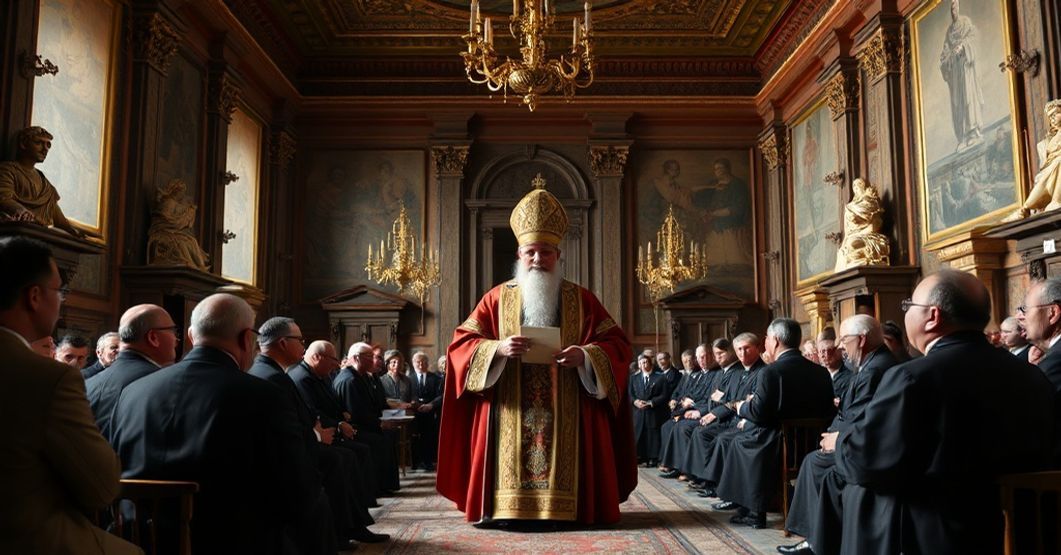
[VaticanNews] portal reports that antipope Leo XIV addressed the Pontifical Institute for Christian Archaeology on December 11, 2025, urging its members to employ archaeological studies as instruments of “cultural diplomacy” and ecumenism. The article frames this discipline as a bridge-builder between nations and Christian denominations, citing Leo XIV’s recent participation in an interfaith gathering at the Nicaea archaeological site. Europe’s “Christian roots” are invoked while avoiding any call for the continent’s return to Catholic unity under Christ the King. This anniversary celebration epitomizes the conciliar sect’s substitution of convertendi errores (converting errors) with dialogue and syncretism.
Naturalism Masquerading as Cultural Diplomacy
Leo XIV’s exhortation to “build bridges” through archaeology constitutes a betrayal of the Church’s divine mandate: “Going therefore, teach ye all nations; baptizing them in the name of the Father, and of the Son, and of the Holy Ghost” (Matthew 28:19). The Institute’s 1925 founding by Pius XI served to defend Catholic truth against modernist distortions of history, not to facilitate interfaith compromise. By repurposing it as a tool of “cultural diplomacy,” the antipope reduces the Faith to a mere anthropological artifact. His claim that “through culture, the human spirit transcends […] prejudice” echoes the naturalist heresy condemned by Pius IX in the Syllabus of Errors: “Human reason, without any reference whatsoever to God, is the sole arbiter of truth” (Proposition 3). True peace arises not from diplomacy but from Regnum Christi—Christ’s Social Kingship—as Pius XI declared: “Nations will be reminded by the annual celebration of this feast that not only private individuals but also rulers and princes are bound to give public honor and obedience to Christ” (Quas Primas, §32).
Ecumenism: A Subterfuge Against Divine Unity
The article’s praise for archaeology as a “valuable tool for ecumenism” unveils the conciliar sect’s apostasy. Leo XIV’s prayer at Nicaea with heterodox leaders blasphemes the Council that defined Christ’s divinity against Arian heretics. Pius XI’s encyclical Mortalium Animos (1928) anathematized such syncretism: “The union of Christians can only be promoted by promoting the return to the one true Church of Christ of those who are separated from it.” The antipope’s assertion that “different denominations can recognize their common origins” denies the extra Ecclesiam nulla salus dogma, as reiterated by Pius XII: “By divine mandate the interpreter and guardian of the Scriptures, and the depository of Sacred Tradition living within her… the Church alone is the entrance to salvation” (Humani Generis, §21). Archaeology, when divorced from Catholic exclusivity, becomes a weapon to relativize dogma—precisely the modernist tactic denounced in St. Pius X’s Lamentabili Sane (Proposition 65): “Contemporary Catholicism cannot be reconciled with true science unless it is transformed into a non-dogmatic Christianity.”
Europe’s Christian Roots Without Christ the King
Leo XIV’s reference to Europe’s Christian heritage omits the only solution to its apostasy: submission to the Social Reign of Christ. Quoting John Paul II—a heretic elevated to pseudo-sainthood by the same sect—the antipope reduces Christianity to a historical footnote. Contrast this with Pius XI’s warning: “The empire of Christ over all nations was rejected. The right which the Church has from Christ Himself, to teach mankind, to make laws, to govern peoples in all that pertains to their eternal salvation, that right was denied” (Quas Primas, §24). Archaeology, as promoted here, serves not to restore Christendom but to entomb it as a relic—a betrayal of the Institute’s original mission under Pius XI, who established it to combat modernist falsifications of Church history.
Silences That Condemn
The article’s omissions are theological crimes. No mention is made of:
• The necessity of the Catholic Church for salvation (Unam Sanctam, Boniface VIII)
• The duty of states to profess and promote the one true Faith (Immortale Dei, Leo XIII)
• The anathema against religious indifferentism (Singulari Quidem, Pius IX)
Instead, the conciliar sect’s lexicon of “dialogue,” “common good,” and “harmony” replaces supernatural faith with naturalist ideology. The white and red banner of the Institute, bearing the Good Shepherd, is exploited to mask wolves in vestments—a sacrilege foretold by Our Lady of La Salette (condemned by Pius XI as inauthentic yet prophetically accurate): “Rome will lose the Faith and become the seat of the Antichrist.”
Conclusion: A Discipline Weaponized Against Itself
Christian archaeology, stripped of its confessional vigor, now serves the very modernism it was founded to combat. This audience epitomizes the conciliar sect’s modus operandi: hollowing out Catholic institutions to advance apostasy. Let true Catholics heed Pius X’s injunction: “The true friends of the people are neither revolutionaries, nor innovators: they are traditionalists” (Notre Charge Apostolique, 1910). Only by rejecting the Vatican II sect and its antipopes can Christ’s Kingship be restored.
Source:
Pope: Cultural diplomacy can build bridges and overcome prejudices (vaticannews.va)
Date: 11.12.2025