Venezuelan Regime’s Persecution Exposes Conciliar Sect’s Impotence
Venezuelan Regime’s Persecution Exposes Conciliar Sect’s Impotence
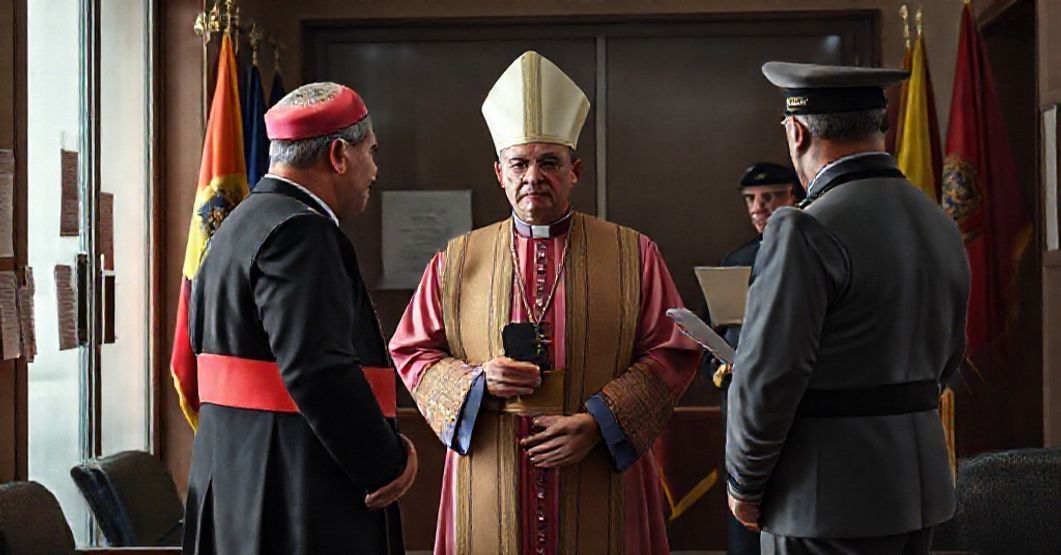
Catholic News Agency reports that Venezuelan immigration police confiscated the passport of Baltazar Enrique Porras Cardozo, archbishop emeritus of Caracas, on Dec. 10, 2025, preventing his travel to Colombia and Spain. The Military and Hospitaller Order of St. Lazarus condemned the act as a “flagrant violation” of the Vienna Convention, citing humiliating searches and refusal to recognize Porras’ Vatican passport. Porras responded with vague references to “the weakness of the manger,” avoiding direct confrontation with Nicolás Maduro’s socialist regime.
Diplomatic Pretenses Mask Ecclesiastical Bankruptcy
The incident reveals the conciliar sect’s reliance on human diplomatic protocols rather than supernatural authority. While the Order of St. Lazarus appeals to the Vienna Convention, true Catholic doctrine asserts higher principles: Ecclesia non sit subdita principibus saecularibus (The Church is not subject to secular princes). Pius IX’s Syllabus of Errors condemned the notion that “the Church ought to be separated from the State, and the State from the Church” (Error 55), yet the conciliar hierarchy behaves as a NGO pleading for secular legitimacy.
“The cardinal was subjected to humiliating treatment, including a search of his personal belongings and clothing, with the use of drug-sniffing dogs”
This indignity underscores the collapse of the regnum sociale Christi (social kingship of Christ). Pius XI’s encyclical Quas Primas (1925) declared that rulers must “publicly honor and obey” Christ, warning that societies rejecting His reign “had to be shaken, because it lacked a stable and strong foundation.” Maduro’s regime operates precisely as Pius XI foretold – a godless power persecuting those who refuse total submission.
Conciliar Passivity as Complicity in Persecution
Porras’ response – “Strength lies in the weakness of the manger” – exemplifies the conciliar sect’s spiritual paralysis. Contrast this with St. Thomas More’s defiance before Henry VIII or St. John Fisher’s martyrdom. Authentic shepherds confront tyrannical regimes with the sword of truth, not sentimental Nativity imagery. The article notes Porras recently denounced Venezuela’s “precarious situation,” yet his watered-down appeals avoid naming Marxism’s intrinsic evils condemned by Pius XI in Divini Redemptoris (1937).
Modernist clergy consistently omit doctrinal substance when confronting anti-Catholic regimes. Porras speaks of “political persecution” but never identifies Venezuela’s socialist tyranny as a fruit of atheistic communism, which the Syllabus condemned as “the pest of indifferentism” (Error 78). This mirrors “Pope” Leo XIV’s November 2025 call for “dialogue” with Venezuela – a betrayal of Pius X’s condemnation in Lamentabili of those who “equate the Christian religion with false religions” (Proposition 18).
Canonical and Theological Nullity of Conciliar “Princes”
The article repeatedly calls Porras a “prince of the Catholic Church,” but this title presupposes legitimate ecclesiastical authority. Since the invalid election of Angelo Roncalli (John XXIII), all conciliar “cardinals” lack jurisdiction, as the Holy See remains vacant. St. Robert Bellarmine’s De Romano Pontifice proves that manifest heretics cannot hold office, and Canon 188.4 of the 1917 Code voids offices held by those who “publicly defect from the Catholic faith.” The conciliar sect’s embrace of religious liberty (contra Quanta Cura) and ecumenism (condemned in Mortalium Animos) constitutes such defection.
Porras’ planned participation in the Order of St. Lazarus ceremony in Toledo further demonstrates the conciliar sect’s masonic tendencies. Pius IX’s Syllabus condemned secret societies that “conspire against the Church” (Error 4), while Leo XIII’s Humanum Genus (1884) exposed masonic attempts to infiltrate Catholic organizations. The Military and Hospitaller Order’s ecumenical membership policies contradict Pius XI’s Mortalium Animos, which forbade Catholic participation in interfaith associations.
Omission of Supernatural Realities
Nowhere does the article mention prayer, penance, or Christ’s kingship as remedies for tyranny. Porras reduces Christmas to a metaphor of “fragility,” ignoring the Incarnation’s triumphal implications: “The government shall be upon His shoulder” (Isaiah 9:6). True Catholics recall Pius IX’s proclamation: “The Son of God, the Creator and Redeemer of mankind, Jesus Christ, must reign in the minds, wills, and hearts of all individuals, families, and nations.”
The conciliar sect’s diplomatic protests contrast starkly with the sanguis martyrum (blood of martyrs) that traditionally fortified the Church. While Venezuelan authorities listed Porras as “deceased” in their system, authentic shepherds rejoice when “accounted worthy to suffer dishonor for the Name” (Acts 5:41). The article’s focus on travel inconveniences ignores Venezuela’s thousands of political prisoners and persecuted faithful – a silence proving the conciliar hierarchy’s abandonment of caritas in veritate (charity in truth).
Conclusion: Only Christ the King Brings Liberation
This incident epitomizes the conciliar sect’s double failure: unable to secure earthly diplomatic privileges or offer supernatural hope. As Pius XI taught, nations rejecting Christ’s reign inevitably descend into despotism. Venezuela’s crisis stems not merely from socialist policies but from rejecting the Social Reign of the Sacred Heart. Until Catholics restore public devotion to Christ the King – not through NGO-style lobbying but through the Mass of Ages, Eucharistic reparation, and doctrinal clarity – such persecutions will intensify. Let Venezuelan faithful remember: “If the Son makes you free, you shall be free indeed” (John 8:36) – a freedom no socialist tyrant can confiscate.
Source:
Venezuelan authorities prevent Cardinal Porras from traveling, cancel passport (catholicnewsagency.com)
Date: 10.12.2025