Apostolic Letter’s Naturalism Masquerading as Piety
Apostolic Letter’s Naturalism Masquerading as Piety
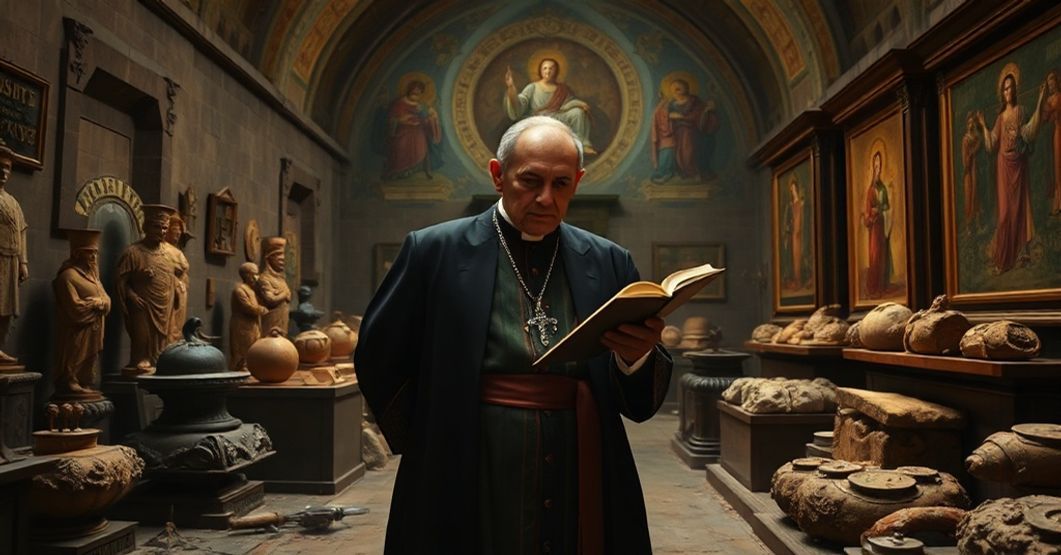
CatholicNewsAgency.com reports on an apostolic letter issued by antipope Leo XIV (Robert Prevost) commemorating the centenary of the Pontifical Institute of Christian Archaeology. The document claims archaeology “bring[s] to light the anonymous holiness of many faithful” and serves as “a valuable instrument of evangelization.” The article emphasizes archaeology’s alleged role in proving Christianity’s historical roots and fostering “dialogue,” while omitting the supernatural foundations of the Faith. This represents yet another attempt by the conciliar sect to replace divine revelation with humanistic historicism.
Reduction of Holiness to Anthropological Artifact
The letter’s central claim – that archaeology reveals “anonymous holiness” – constitutes a direct attack on the Church’s sacramental economy. True holiness derives solely from sanctifying grace, received through valid sacraments administered by the Church Christ founded. Pius XI’s 1925 encyclical Quas Primas unequivocally teaches:
“The empire of our Redeemer embraces all men. His power not only as God but as Man is proper and supreme… The right to command and require obedience extends even to those who have no faith in Christ.”
By suggesting holiness can be excavated from dirt rather than conferred through sacraments, the conciliar sect reduces sainthood to a sociological phenomenon. This aligns with Modernist claims that religion emerges from human consciousness – condemned by St. Pius X in Lamentabili Sane (1907) as the heresy that divine revelation is merely “man’s self-awareness of his relationship to God” (Proposition 20).
Subversion of Evangelization Through Historical Relativism
The letter’s assertion that archaeology makes Christianity “accessible to anyone” regardless of belief exposes its indifferentist core. The Church has always taught that faith comes “by hearing, and hearing by the word of Christ” (Romans 10:17), not through pottery shards. Pius IX’s Syllabus of Errors (1864) explicitly condemned the notion that:
“Protestantism is nothing more than another form of the same true Christian religion, in which form it is given to please God equally as in the Catholic Church.” (Proposition 18)
Yet the letter promotes archaeology as speaking “to believers and nonbelievers” alike – implying pagan tomb inscriptions hold equal weight to Apostolic Tradition. This relativization fulfills St. Pius X’s warning that Modernists seek to make theology “embrace… profane sciences” (Pascendi Dominici Gregis, 33).
Theological Vacuum in “Reconciled Memory”
Most damning is the letter’s demand for a “reconciled memory” acknowledging the Church’s “limitation… fragility… rupture.” This directly contradicts the Church’s divine constitution. As Pope Leo XIII declared in Satis Cognitum (1896):
“The Church, founded on these principles and mindful of her office, has done nothing with greater zeal and endeavor than she has displayed in guarding the integrity of the faith.”
The conciliar sect’s insistence on paradigmatic “rupture” confirms its revolutionary character. True Catholic archaeology would highlight the perennial continuity of doctrine and worship – from catacomb Masses to the Tridentine rite – not fabricate discontinuity to justify liturgical vandalism.
Omission of Supernatural Finality
Throughout the article, the conciliar sect’s fixation on temporal artifacts betrays its abandonment of eternity. Nowhere does it mention that catacombs testify to the Resurrection of the Body or that early churches were oriented ad orientem awaiting Christ’s return. This naturalism reflects Paul VI’s blasphemous claim that “the Church has no proper mission in the political, economic or social order” (Octogesima Adveniens, 1971).
True Catholic archaeology serves sursum corda – lifting hearts to heavenly realities. The conciliar sect’s archaeology digs downward, seeking validation from human remains rather than divine revelation. As Christ warned: “Let the dead bury their own dead” (Luke 9:60).
Source:
Pope Leo praises Christian archaeology, capable of ‘bringing to light anonymous holiness’ (catholicnewsagency.com)
Date: 12.12.2025