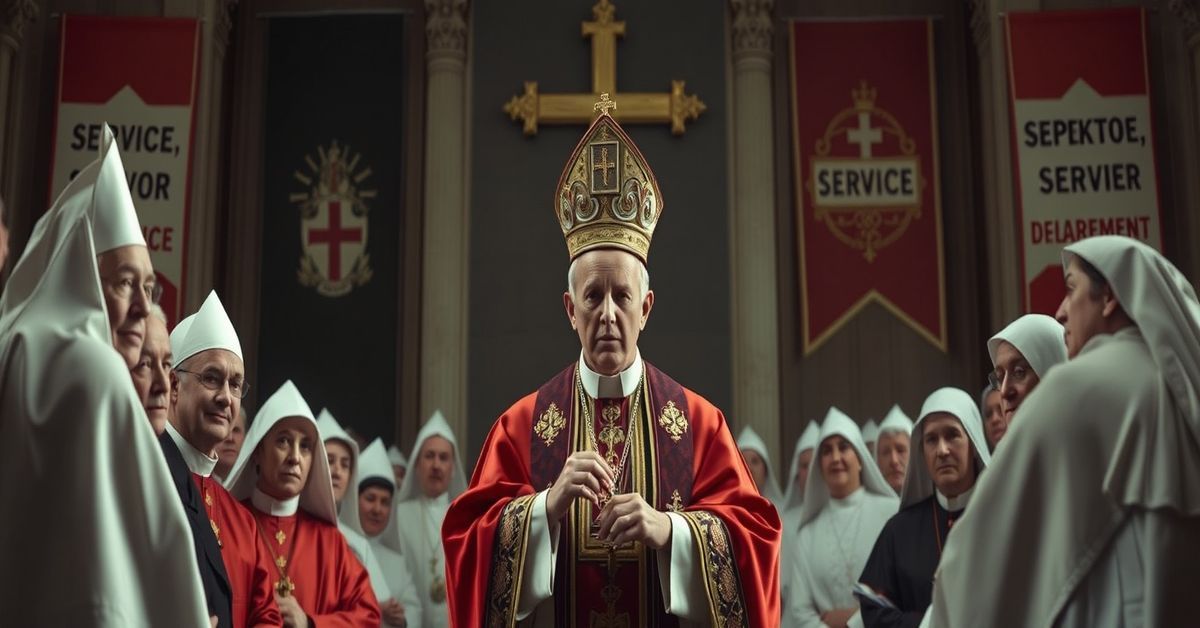
Pope Leo XIV’s Modernist Re-engineering of Religious Authority
The Subversion of Religious Authority into Naturalistic Communitarianism
The cited article reports that “Pope” Leo XIV (Robert Prevost), the current apostate antipope who occupies the Vatican, addressed the General Chapter of the Legionaries of Christ on February 19, 2026. His speech centered on redefining religious authority as “service, not domination,” promoting “communal discernment,” “mutual listening,” “co-responsibility,” and “transparency” as the ideal governance model for religious institutes. He exhorted the Legionaries to avoid “control that does not respect people’s dignity and freedom” and to embrace “the art of accompaniment.” This presentation, emanating from the conciliar sect’s supreme authority, constitutes a deliberate and heretical subversion of the immutable Catholic doctrine on hierarchical authority, the nature of religious life, and the governance of the Church. It is a quintessential expression of the modernist synthesis of all errors condemned by St. Pius X in Pascendi Dominici gregis and Lamentabili sane exitu.
1. The Erasure of Hierarchical Authority in Favor of Naturalistic Democracy
The antipope’s core thesis—that authority in religious life must be understood as “spiritual and fraternal service” and must avoid every form of “control”—directly contradicts the Thomistic and papal doctrine on the nature of legitimate authority. Authority is not primarily a “service” in the modern, egalitarian sense; it is a potestas (power) to govern, correct, and, when necessary, command, derived from God and exercised for the salvation of souls. St. Pius X, in his encyclical Pascendi, condemned the modernist error that “authority is nothing else but numbers and the sum total of material forces” (Syllabus of Errors, #60), which is precisely the naturalistic, democratic principle underlying the speech.
Leo XIV’s emphasis on “mutual listening, co-responsibility, transparency, fraternal closeness, and communal discernment” replaces the hierarchical, vertical structure of religious obedience with a horizontal, quasi-democratic model. This is a clear echo of the modernist error condemned by Pius IX in the Syllabus (#77): “In the present day it is no longer expedient that the Catholic religion should be held as the only religion of the State, to the exclusion of all other forms of worship.” Here, the “religion” is replaced by a “governance model,” but the principle is identical: the rejection of a supreme, divinely instituted authority in favor of a relativistic consensus. The pre-conciliar Church taught that superiors, by virtue of their office, have the right and duty to command, and inferiors the obligation to obey, even in matters not strictly sinful, for the sake of order and the common good (Regiminis Apostolici of Pius VI, Immensa Pastorum of Benedict XIV). The “art of accompaniment” is a modern euphemism for the dissolution of authority into vague spiritual friendship, which St. Pius X identified as a characteristic of the “dangerous enemies of the Church” who “introduce a new system of life” (Pascendi).
2. The Charism as a Tool for Doctrinal Relativism and Autonomy
The antipope states: “A charism is a gift of the Holy Spirit… You are not owners of the charism, but its custodians and servants.” While superficially orthodox, this phrase, in the context of his entire speech, is a Trojan horse for the modernist principle of the “evolution of charisms.” He adds that each charism “contains various forms and styles of life, which should be welcomed and discerned,” implying that the concrete expression of a religious rule is a matter of ongoing, community-based adaptation rather than fidelity to a founder’s specific, God-given rule. This is the precise error condemned by Pius X in Lamentabili #54: “Dogmas, sacraments, and hierarchy… are merely modes of explanation and stages in the evolution of Christian consciousness.”
The Legionaries of Christ, founded by the scandal-ridden Marcial Maciel Degollado, are a prime example of a “charism” that has been repeatedly “discerned” and “adapted” to accommodate modern sensibilities. The historical “scandals and pain” mentioned are not mere disciplinary failings but the inevitable fruit of a founder whose life and teachings were incompatible with Catholic asceticism. The pre-1958 Church would have suppressed such an institute entirely. Instead, under the conciliar regime, it was “renewed” through a process of “communal discernment” that effectively rewritten its rule, demonstrating that the “charism” is now a malleable concept subject to the fashions of the times. The antipope’s instruction to “welcome and discern” various forms is an open invitation to doctrinal and disciplinary relativism, where the original, strict rule of the founder is gradually abandoned under the guise of “fidelity to the Gospel” and “listening to the Holy Spirit.” This is the heresy of “living tradition” as a dynamic, evolving reality, condemned by St. Pius X as the “synthesis of all errors.”
3. The Omission of the Supernatural End and the Reign of Christ the King
The most damning silence in the antipope’s address is the complete absence of the finis operantis and finis operis of religious life. There is no mention of the primary purpose of religious life: the perfection of charity, the salvation of souls, the mortification of the flesh, the practice of the evangelical counsels for the love of God, and the public witness to the superiority of the spiritual over the temporal. Instead, the focus is entirely on intra-community dynamics: “common life,” “shared discernment,” “harmonizing diversity.” This is a radical shift from the traditional Catholic vision, so powerfully expounded by Pope Pius XI in Quas Primas.
In Quas Primas, Pius XI establishes that Christ’s kingship demands that “all relations in the state be ordered on the basis of God’s commandments and Christian principles” and that individuals, families, and states must be governed by Christ. Religious institutes, as perfect societies within the Church, exist to advance this reign. Their authority is a participation in Christ’s own kingly authority, which is “not by force but by essence and nature” (quoting St. Cyril of Alexandria). The antipope’s speech is a studied avoidance of this supernatural monarchy. His “authority as service” is a secularized concept borrowed from corporate management theories, utterly alien to the Catholic doctrine of sacra potestas. The “missionary unity” he speaks of is not the unity of all things in Christ (Eph. 1:10) but a vague “harmonization of diversity” for the sake of community cohesion. The silence on Christ’s explicit claim: “All power in heaven and on earth has been given to Me” (Matt. 28:18), and His command to teach and observe all His commandments, is deafening. It reveals a fundamental naturalism: the religious life is presented as a human project of “deepening identity” and “responding to the present,” not as a supernatural vocation to be configured to the crucified Christ and to labor for the conversion of souls and the establishment of His social reign.
4. The Promotion of the “Art of Accompaniment” as a Rejection of Pastoral Authority
The phrase “art of accompaniment” is a key modernist slogan, popularized in the post-conciliar period to replace the traditional concepts of direction, correction, and fraternal correction. In the pre-1958 Church, superiors and spiritual directors had the duty to guide, admonish, and, if necessary, punish for the spiritual good of the soul. The “accompaniment” model, however, implies a peer-to-peer relationship where the “guide” is merely a fellow traveler without real authority to command or condemn. This is a direct attack on the scriptural and traditional model: “Obey your prelates, and be subject to them. For they watch as being to render an account of your souls” (Heb. 13:17).
The antipope’s requirement of “humility to listen, interior freedom to speak sincerely, and openness to accept shared discernment” inverts the proper order. In a religious community, the superior’s judgment, made after proper discernment, is what binds. The “shared discernment” he advocates is the modernist error of making the sensus fidelium (sense of the faithful) a source of revelation parallel to, or even superior to, the hierarchical Magisterium. Pius IX condemned this in the Syllabus (#6): “The faith of Christ is in opposition to human reason and divine revelation not only is not useful, but is even hurtful to the perfection of man.” Here, “human reason” is manifested in the “interior freedom” of each member to “speak sincerely,” making the community’s “discernment” a product of human consensus rather than obedience to the established authority that holds the charism in trust. St. Pius X, in Lamentabili #7, condemned the notion that “the Church listening cooperates in such a way with the Church teaching in defining truths of faith, that the Church teaching should only approve the common opinions of the Church listening.” The same error is applied here to governance: the “community” (listening) must have its “common opinions” approved by the “leader” (teaching), thereby neutering the leader’s authority and making it a mere ratification of popular sentiment.
5. The Symptomatic Context: The Legionaries of Christ and the Conciliar Sect’s Rehabilitation of Scandal
The choice of the Legionaries of Christ as the audience is profoundly symptomatic. This congregation was founded by Marcial Maciel, a man whose life of scandal, fraud, and alleged sexual abuse was notorious yet systematically covered up by the conc
Source:
Pope to Legionaries of Christ: Religious authority is service, not domination (vaticannews.va)
Date: 19.02.2026