Charity Without Christ: The Modernist Reduction of the Church to Social Agency
The “Stronghold of Charity” That Is Not a Stronghold of Christ
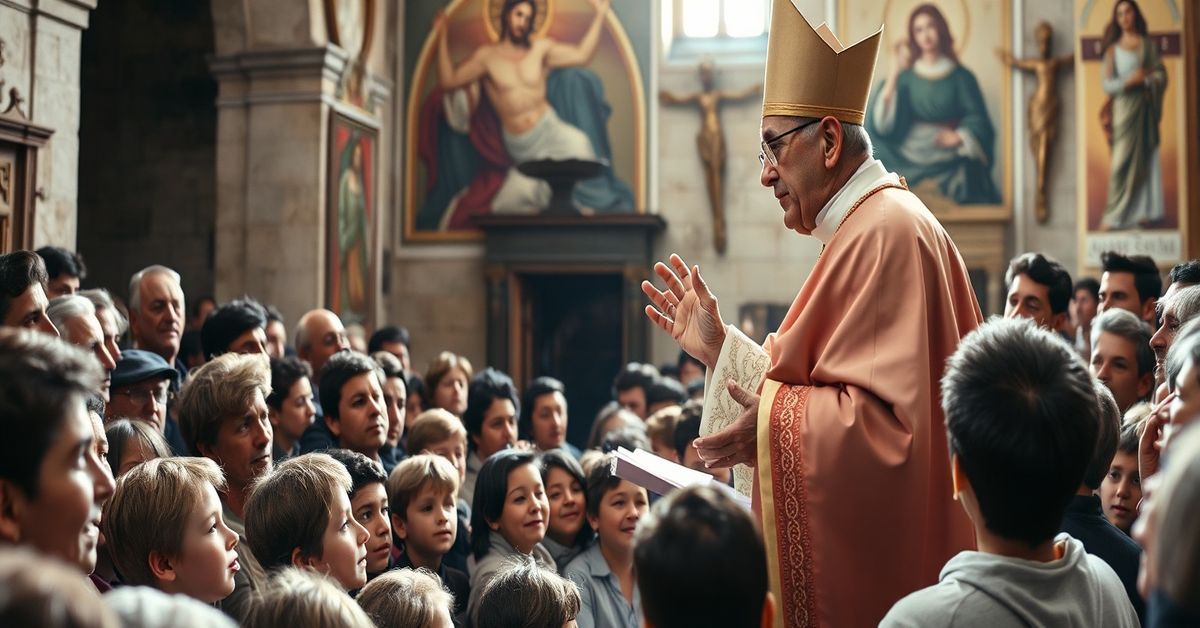
VaticanNews reports that antipope Leo XIV, during a visit to the parish of the Sacred Heart of Jesus in Rome’s Castro Pretorio neighborhood on February 22, 2026, urged the community to be “the yeast of the Gospel in the dough” of an area marked by difficulties, calling the Church a “stronghold of charity” against “widespread violence.” The homily centered on “closeness” and “charity” in the face of urban poverty, immigration, and social fragmentation. The antipope praised the parish’s charitable initiatives—the Listening Center, the Talent Bank food distribution, aid for refugees—and saw in them the tangible expression of the Church’s mission. He reflected on the “contradictions of our time,” noting how within meters one encounters both comfort and homelessness, potential for good and illicit trades. The visit included greetings to children, catechumens, and the Salesian community, with gifts and prayers at the historic rooms of St. John Bosco.
This narrative, steeped in the sentimental language of post-conciliar pastoral activism, represents the ultimate theological and spiritual bankruptcy of the modernist “Church of the New Advent.” It reduces the Corpus Mysticum to a mere humanitarian NGO, replaces the supernatural end of the Church—the sanctification and salvation of souls—with a naturalistic social program, and silently apostatizes from the integral Catholic faith by omitting the non-negotiable foundations of the Reign of Christ the King. The analysis below exposes this error on factual, linguistic, theological, and symptomatic levels, using the unchanging Magisterium as the sole criterion.
1. Factual Deconstruction: The Omission of Supernatural Ends
The article presents the Church’s activity as primarily social service: a “meal, or warm water, a plug to connect to.” The antipope’s language speaks of “closeness,” “charity,” “welcome,” and “building community.” Nowhere is there mention of sin, judgment, conversion, the state of grace, the Sacrifice of the Mass as a propitiatory offering, or the ultimate destiny of the soul. This is not an oversight; it is the systematic exclusion of the supernatural order that defines the Catholic Church. As Pope Pius XI taught in Quas Primas, the Kingdom of Christ is “primarily spiritual and relates mainly to spiritual matters” (§ 15). The Church’s mission is to lead souls to eternal happiness, not to provide temporary material relief. The article’s focus on “contradictions of our time” accepts the secular framework of material inequality as the primary problem, ignoring the far graver contradiction: the separation of human societies from God, which Pius XI identified as the root cause of all social ills (§ 31).
“When God and Jesus Christ… were removed from laws and states and when authority was derived not from God but from men, the foundations of that authority were destroyed, because the main reason why some have the right to command and others have the duty to obey was removed.” (Pius XI, Quas Primas, § 31)
The charitable works described—while potentially good in themselves when ordered to the supernatural end—are presented as an end in themselves, a “stronghold” against violence. This inverts the Catholic order: caritas is a virtue that springs from the love of God and is ordered to the eternal good of the neighbor’s soul, not merely his temporal comfort. The article’s “Church” is a provider of social services, not the “dispenser of salvation” (§ 2) spoken of by Pius XI.
2. Linguistic Analysis: The Rhetoric of Naturalistic Humanism
The language employed is that of modern psychology and sociology: “closeness,” “warmth of welcome,” “social wounds,” “high-speed train loaded with peace, hope, and Christian commitment to build community.” This is the jargon of the “cult of man” condemned by St. Pius X in Pascendi Dominici gregis and Lamentabili sane exitu. The phrase “yeast of the Gospel in the dough of the territory” is particularly insidious. It suggests an immanent, evolutionary transformation of society through vague “Gospel values,” divorced from doctrinal truth and sacramental grace. This is pure Modernism, which Lamentabili condemned:
“Dogmas, sacraments, and hierarchy… are merely modes of explanation and stages in the evolution of Christian consciousness…” (Proposition 54)
The “dough” metaphor implies the Church is an ingredient to leaven an already-existing secular society, rather than a supernatural society that must convert nations to Christ the King. The tone is one of gentle, optimistic pastoral care, utterly devoid of the prophetic denunciation found in the Syllabus of Errors or the stern calls to repentance of the pre-conciliar Magisterium. This is the “sweetness” that St. Pius X identified as the mask of Modernism, which “under the guise of more serious criticism… aims at such a development of dogmas as appears to be their corruption” (Lamentabili, Preamble).
3. Theological Confrontation: The Reign of Christ vs. the Reign of Man
The article’s entire framework is naturalistic. It accepts the modern state’s monopoly on public life and reduces the Church to a private charitable actor within a secular framework. This is precisely the error condemned by Pius IX in the Syllabus of Errors:
- Error 19: “The Church is not a true and perfect society… but it appertains to the civil power to define what are the rights of the Church.” The article’s Church operates within the limits set by the secular state (e.g., receiving permits for distributions, working within municipal shelters).
- Error 55: “The Church ought to be separated from the State, and the State from the Church.” The antipope’s visit, with its civic imagery and acceptance of the neighborhood’s “contradictions” as a given, implicitly endorses this separation. The Church is a “stronghold” within the city, not the ruler of the city.
- Error 77: “In the present day it is no longer expedient that the Catholic religion should be held as the only religion of the State.” By focusing on “immigrants seeking employment” and “young refugees” without a word of converting them to the one true Faith, the antipope practices the indifferentism Pius IX condemned.
Contrast this with the Catholic doctrine of the Social Kingship of Christ, so clearly defined by Pius XI in Quas Primas:
“It is necessary that Christ reign in the mind of man… in the will… in the heart… in the body… All power in heaven and on earth is given to Christ the Lord… there is no power in us that is exempt from this reign.” (§§ 34-35)
The article’s Church has no authority over laws, education, or public morality. It does not remind rulers of their duty to “publicly honor Christ and obey Him” (§ 36). Instead, it serves as a pressure valve for social discontent, thereby legitimizing the secular order that has expelled Christ from public life. This is the “abomination of desolation” standing in the holy place (Matt. 24:15): a church that occupies the buildings but has abandoned the doctrine.
4. Symptomatic Analysis: The Fruit of the Conciliar Apostasy
This visit is not an anomaly; it is the logical culmination of the revolution begun at Vatican II. The “hermeneutics of continuity” is a lie: there is a rupture. The pre-1958 Church taught:
- The primary duty of bishops is to teach sound doctrine and guard the faithful from error (Lamentabili condemns the idea that the Church should “tolerate the errors of philosophy” – Prop. 11).
- The Church has the right and duty to influence laws and constitutions (Quas Primas, § 36).
- Charity is ordered to the salvation of souls: “You were redeemed not with corruptible gold or silver… but with the precious blood of Christ” (1 Peter 1:18-19, cited in Quas Primas, § 20).
The post-conciliar “Church” teaches:
- The primary duty is “dialogue,” “accompaniment,” and “building community” (as seen in this article).
- The Church must “read the signs of the times” and adapt its message to modern man (Gaudium et Spes, a document condemned in spirit by Lamentabili and the Syllabus).
- Charity is often reduced to social work, with the supernatural goal minimized or denied.
The antipope’s invocation of “freedom” (“in the utmost respect for our freedom”) echoes the modernist error of exalting human autonomy over divine law. The “drama of man’s independence” is presented as a question (“can I live my life to the fullest by saying ‘yes’ to God?”) rather than a sin. This is the “cult of man” in its purest form: the human subject, with his “freedom” and “contradictions,” becomes the measure of all things. Pius IX’s Syllabus condemned the notion that “human reason… is the sole arbiter of truth and falsehood” (Error 3). Here, human experience—the “contradictions” of the neighborhood—becomes the starting point for theology.
5. The Sedevacante Reality: The See Is Vacant
All of the above errors are not merely the faults of a misguided individual. They are the public, notorious, and persistent teaching of the “conciliar sect” that occupies the Vatican. The doctrine of sedevacantism, based on the unanimous teaching of the Fathers and theologians like St. Robert Bellarmine, holds that a manifest heretic cannot be pope. The antipopes from John XXIII onward have promulgated doctrines contrary to the Catholic faith—religious liberty (Dignitatis Humanae), collegiality, ecumenism, the evolution of dogma. They have committed, as Bellarmine states, “public defection from the Catholic faith” (cf. Canon 188.4 of the 1917 Code). Therefore, the See of Peter is vacant. The true Church subsists in those who hold the integral faith, led by bishops who have not defected (however few they may be). The “parish” visited by Leo XIV is a conciliar structure, occupied by false clerics (the “Salesian Order” is a post-conciliar institute), administering a false “Mass” (the Novus Ordo), and propagating a false gospel of naturalistic charity. Attendance at such a “Mass” and cooperation with such “charities” is, at best, material cooperation with evil and, at worst, sacrilege and idolatry.
Conclusion: A Church That Has Exchanged Its Soul for a Bowl of Pottage
The article depicts a “Church” that has utterly abandoned its supernatural mission. It has exchanged the preaching of the Regnum Christi for the distribution of food, the call to repentance for the call to “community,” the fear of Hell for the fear of “social wounds.” This is not the Church of Pius XI, who instituted the feast of Christ the King to combat secularism, but the synagogue of Satan (Apoc. 2:9, 3:9) masquerading as the Church of Christ. The “stronghold of charity” is in fact a fortress of apostasy, where the poor are fed but their souls are starved of the Bread of Life, where refugees are welcomed but not taught that “there is no other name under heaven given to men by which we must be saved” (Acts 4:12, cited in Quas Primas, § 29). The “yeast” is not the Gospel but the leaven of the Pharisees, which is hypocrisy (Luke 12:1). The “contradictions” are not between rich and poor, but between the City of God and the City of Man—and this “Church” has sided with the latter.
The only authentic charity is that which seeks the eternal good of the soul, which requires the preaching of the hard truths of the Catholic faith, the administration of the true Sacraments, and the call to submit every aspect of life—personal, familial, social, political—to the sweet yoke of Christ the King. Until the conciliarists are denounced, their “sacraments” rejected, and their false “popes” acknowledged as antipopes, the Catholic faithful must flee such parishes and such “charity” as they would flee a plague. For what does it profit a man if he is fed for a day and loses his soul?
Tags: charity, modernism, Pius XI, Quas Primas, Syllabus Errorum, Lamentabili, social gospel, naturalism, sedevacantism, antipope Leo XIV
Source:
Pope: Church must be a stronghold of charity in the contradictions of our time (vaticannews.va)
Date: 22.02.2026