Charlotte Bishop’s “Evangelization” Omits Christ’s Social Reign
Naturalistic “Evangelization” in the Service of the Conciliar Apostasy
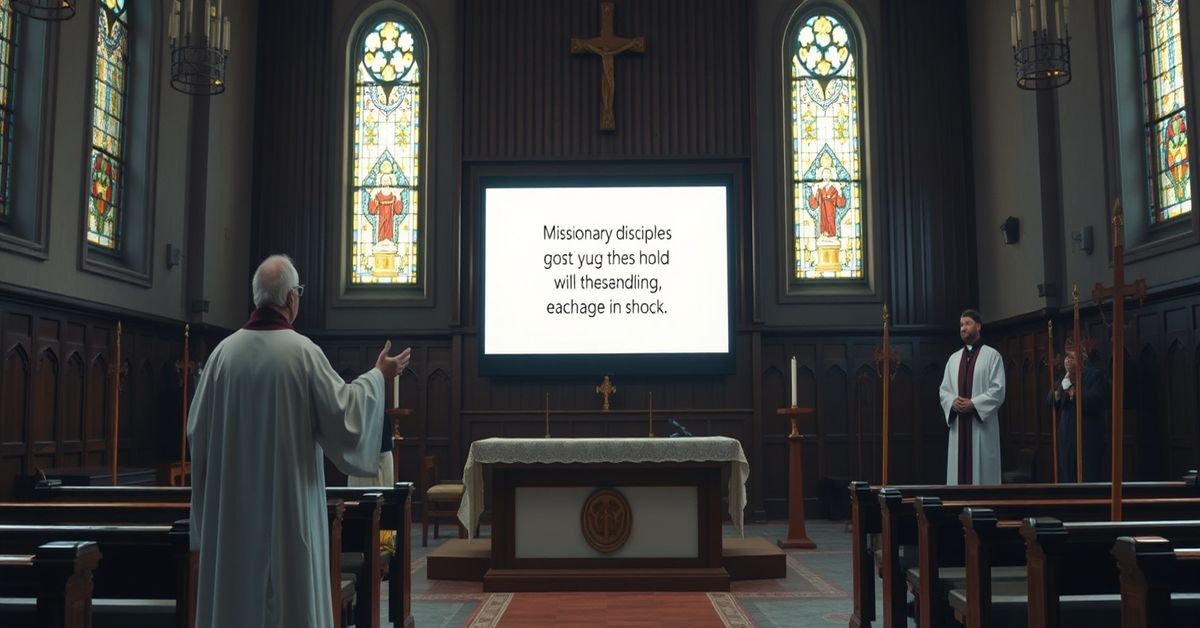
The cited article from Infovaticana (February 15, 2026) reports that “Bishop” Michael T. Martin of Charlotte has mandated that all pastors in his diocese project a video explaining his “pastoral vision” at every Sunday Mass. The video, titled “Everyone so Loves Jesus, We Share Him with Others,” focuses on forming “missionary disciples” and making the faith “visible” among the approximately 600,000 Catholics in the diocese. This initiative follows previous controversial decisions by Martin, including the suppression of traditional Latin Mass celebrations and the removal of kneelers and railings for Communion in the post-Vatican II rite. A quarter of his priests have submitted dubia to the Holy See regarding his authority to impose such restrictions.
The article itself presents these events as routine administrative and pastoral matters within the contemporary ecclesial structure. However, from the perspective of integral Catholic faith—the immutable doctrine of the pre-1958 Church—this episode is a stark revelation of the theological and spiritual bankruptcy of the post-conciliar system. The “bishop’s” program is not Catholic evangelization but a naturalistic, human-centered project that systematically omits the absolute, non-negotiable requirement of the social reign of Christ the King over individuals, families, and nations. It is a perfect symptom of the “abomination of desolation” standing in the holy place.
1. Factual Deconstruction: A Program of “Evangelization” Without the King
The core of Martin’s message, as described, is the formation of “missionary disciples” who “share” Jesus with others. The language is deliberately vague and experiential, focusing on “living the faith visibly” and “passing from an internal to an explicit proclamation.” This is classic post-conciliar jargon, stripped of the supernatural objectives and the dogmatic content that define true Catholic mission.
What is conspicuously absent from this “vision” is any reference to the primary duty of every Catholic, every family, and every state: to publicly recognize and submit to the reign of Our Lord Jesus Christ. Pope Pius XI, in the encyclical Quas Primas (December 11, 1925)—which established the Feast of Christ the King—declared unequivocally:
“It is necessary that all men, individually and collectively, submit to the reign of Christ… For the kingdom of Christ is not a mere metaphor, but a true and proper kingdom, based on the title of right which Christ has as God and Man… His reign extends not only to Catholic nations… but His reign encompasses also all non-Christians, so that most truly the entire human race is subject to the authority of Jesus Christ.”
The “bishop” of Charlotte speaks of “evangelization” without ever mentioning that the object of that evangelization is the conversion of souls and societies to the law and sovereignty of Christ the King. This is not an oversight; it is the logical outcome of the conciliar revolution’s rejection of the Social Kingship of Christ, condemned in the errors of the Syllabus of Errors (Pius IX, 1864). Error #77 states: “In the present day it is no longer expedient that the Catholic religion should be held as the only religion of the State, to the exclusion of all other forms of worship.” This error, which Martin’s program implicitly accepts, is the foundation of the modern “separation of Church and State” that Pius XI in Quas Primas called the “plague” of secularism (laicism) that poisons society.
2. Linguistic and Rhetorical Analysis: The Language of Naturalism
The title of the video, “Everyone so Loves Jesus, We Share Him with Others,” is revealing. It reduces the Catholic faith to an affective, sentimental relationship (“so loves Jesus”) and a voluntary, promotional activity (“share Him”). This is the language of religious sentimentality and marketing, not of dogmatic truth and sovereign command.
Key terms are loaded with post-conciliar naturalism:
- “Evangelization”: In pre-conciliar terminology, the primary goal was the salvation of souls through incorporation into the Catholic Church, the “Ark of Salvation.” The secondary, but still crucial, effect was the leavening of society with Christian principles. The modern term, as used by Martin, implies a primary focus on “witness,” “dialogue,” and “presence” without the explicit, obligatory goal of Catholic conversion. This aligns with the condemned proposition in Lamentabili sane exitu (St. Pius X, 1907), #26: “Faith, as assent of the mind, is ultimately based on a sum of probabilities.” The new “evangelization” is based on personal testimony and probabilistic appeal, not on the absolute authority of Christ the Lawgiver.
- “Missionary disciples”: This phrase, popularized in post-conciliar documents, democratizes and interiorizes the concept of mission. It bypasses the hierarchical, sacramental, and juridical mission of the Church (to teach, sanctify, and govern) in favor of a vague, individualistic “witness.” It ignores that the Church’s mission is by divine institution, not a voluntary project of the laity. The Syllabus, Error #21, condemns the notion that “The Church has not the power of defining dogmatically that the religion of the Catholic Church is the only true religion.” Martin’s program, by not defining this truth as the essential goal of mission, operates on this condemned principle.
- “Visible faith”: This is a contradiction in terms. Faith, as St. Paul defines it, is “the substance of things to be hoped for, the evidence of things that appear not” (Hebrews 11:1). To reduce faith to its “visibility” is to reduce it to mere external activism and social presence, the very naturalism condemned in Lamentabili, #58: “All the rectitude and excellence of morality ought to be placed in the accumulation and increase of riches by every possible means, and the gratification of pleasure.” The “visibility” sought is not the visibility of sanctifying grace and the Sacraments, but of social impact and numerical growth.
3. Theological Confrontation: Omission as Heresy
The gravest error in Martin’s “vision” is not what it says, but what it omits. The entire supernatural framework of the Catholic faith is absent.
a) Omission of the Sacrifice of Calvary and the Propitiatory Mass. The article mentions “Masses” and “Communion” in a purely functional, communal sense. There is no mention that the Holy Mass is the unbloody sacrifice of Calvary, the primary act of worship owed to God and the sole means of applying the merits of Christ’s Passion. This omission aligns with the modernist errors condemned by St. Pius X. Lamentabili #45 states: “Not everything that St. Paul relates about the institution of the Eucharist (1 Cor 11:23-25) is a historical fact.” The post-conciliar “Mass” is often presented as a “meal” or “assembly,” which is the very error Pius X condemned. Martin’s focus on “sharing” and “proclamation” reduces the Mass to a prelude to activism, not the central, transcendent reality.
b) Omission of the Necessity of the Catholic Church for Salvation. The “evangelization” described has no defined object: “share Him with others” implies that all are already in a state of grace or that the goal is a generic “relationship with Jesus.” This is the indifferentism condemned by Pius IX. Syllabus Error #16: “Man may, in the observance of any religion whatever, find the way of eternal salvation, and arrive at eternal salvation.” True Catholic evangelization must proclaim: “Outside the Church there is no salvation” (Extra Ecclesiam Nulla Salus), a dogma defined by the Council of Florence and reiterated by Pope Pius IX in Quanto conficiamur (1863). Martin’s program is silent on this, thus teaching by omission the condemned indifferentism.
c) Omission of the Reign of Christ the King over Society. This is the cornerstone of the error. As shown above, Quas Primas is the definitive magisterial document on this point. Pius XI wrote:
“The State has not been created for the purpose of degenerating into a god… but that it might serve God… Therefore, if men were ever to recognize Christ’s royal authority over themselves, both privately and publicly, then unheard-of blessings would flow upon the whole society… For what we wrote at the beginning of Our Pontificate about the diminishing authority of law and respect for power, the same can be applied to the present times: ‘When God and Jesus Christ were removed from laws and states… the foundations of that authority were destroyed.'”
Martin’s “evangelization” is entirely privatized and internalized (“from an internal to an explicit proclamation”). It does not call for the conversion of the social order to the laws of Christ. It does not demand that civil legislation conform to the Ten Commandments and the rights of the Church. It does not condemn the secular, laicist state. This is the precise error of the modernists, who reduce religion to the private sphere. Pius XI explicitly linked the feast of Christ the King to the condemnation of secularism: “This plague is the secularism of our times, so-called laicism, its errors and wicked endeavors… the Christian religion began to be equated with other false religions… then it was subordinated to secular power.” Martin’s program, by its total silence on the public duty of states and rulers, is an implicit endorsement of this secularism.
4. Symptomatic Analysis: The Conciliar Revolution in Microcosm
The actions of “Bishop” Martin are not an anomaly but a direct fruit of the Second Vatican Council (1962-1965), which initiated the systematic dismantling of Catholic doctrine and practice. The council’s document Gaudium et Spes famously embraced the “joys and hopes” of the modern world without first demanding the world’s conversion to Christ. This is the hermeneutic of discontinuity that John XXIII and Paul VI introduced.
Martin’s suppression of the traditional Latin Mass (the “Extraordinary Form”) and his removal of kneelers are acts of liturgical violence against the immemorial tradition of the Church. They implement the Protestantizing and humanizing reforms of the Novus Ordo Missae of Paul VI (1969), which was designed to appeal to “modern man” and to downplay the sacrificial nature of the Mass. The Instruction on Sacred Liturgy of the Sacred Congregation of Rites (1964) already stated that the altar should be moved to the center to facilitate the “assembly” of the people—a direct attack on the traditional orientation toward God. Martin’s actions are a local enforcement of this global revolution.
Furthermore, his centralized, authoritarian imposition of a video “vision”—with password protection and forced broadcast—reveals the authoritarian clericalism of the post-conciliar hierarchy. This is not the paternal, doctrinal authority of a true bishop feeding his flock with sound doctrine; it is the managerial, psychological-operations style of a corporate CEO imposing a “brand message.” It mirrors the “dictatorship of relativism” diagnosed by Joseph Ratzinger (later “Pope” Benedict XVI) in his 2005 homily, a relativism that this article’s subject embodies perfectly: a “vision” that is all about method (“how to evangelize”) and empty of content (what to evangelize).
The reaction of the priests—sending dubia to “Rome”—is tragically inadequate. They still recognize the authority of the “bishop” and the “Holy See” of the antipopes. They do not see that the entire conciliar structure is occupied by a parallel, counterfeit church. The Defense of Sedevacantism file demonstrates that a manifest heretic (and one who promotes the errors of Vatican II is manifestly heretical) ipso facto loses all ecclesiastical jurisdiction. Therefore, Martin possesses no legitimate authority, and his decrees are null. The priests’ error is to appeal to a “Holy See” that has been vacant since the death of Pope Pius XII in 1958, a see occupied by a line of apostate antipopes beginning with Angelo Roncalli (“John XXIII”).
5. The Only Catholic Response: Return to Immutable Tradition
The “vision” of Charlotte is a blueprint for the continuation of the apostasy. Its goal is to create a “visible” Church that is, in reality, invisible in its supernatural substance because it has abandoned the dogmas, the liturgy, the morality, and the social doctrine of the Catholic Church.
The true Catholic response is not to reform the conciliar structures from within, but to separate from them entirely. As St. Pius X taught in Pascendi Dominici gregis (1907), modernists must be “driven out” and “avoided.” The true Church continues in those who hold the integral faith, served by bishops and priests who have never embraced the errors of Vatican II. The mission is not to “share Jesus” in a vague, sentimental way, but to:
- Profess the entire dogmatic deposit of the faith, especially the Social Kingship of Christ as defined in Quas Primas and condemned by the Syllabus.
- Offer the Most Holy Sacrifice of the Mass according to the unaltered Roman Rite, which propitiates God’s justice and applies the merits of Calvary.
- Live a life of penance, prayer, and reparation for the sins of the world and the apostasy of the conciliar church.
- Form Catholic families and societies based on the principles of the Rerum Novarum of Leo XIII and the Quas Primas of Pius XI, which demand the subordination of all human law to the eternal law of God.
The “bishop” of Charlotte and his “pastoral vision” represent the final stage of the modernist infection: an activism that has completely evacuated the Catholic faith of its supernatural content. It is a “church” without a King, without a Sacrifice, without a Dogma, and without Salvation. It is the “conciliar sect” in its most banal, managerial form. The faithful are called not to participate in this charade, but to flee from it and to find refuge in the true, traditional Catholic faith, which alone can lead them to eternal life.
Source:
El obispo de Charlotte ordena difundir su «visión pastoral» en todas las parroquias de su diócesis (infovaticana.com)
Date: 15.02.2026