Conciliar ‘Angelology’ as Naturalistic Substitution for Supernatural Doctrine
The ‘Angels’ of the Neo-Church: A Retreat into Naturalistic Spirituality
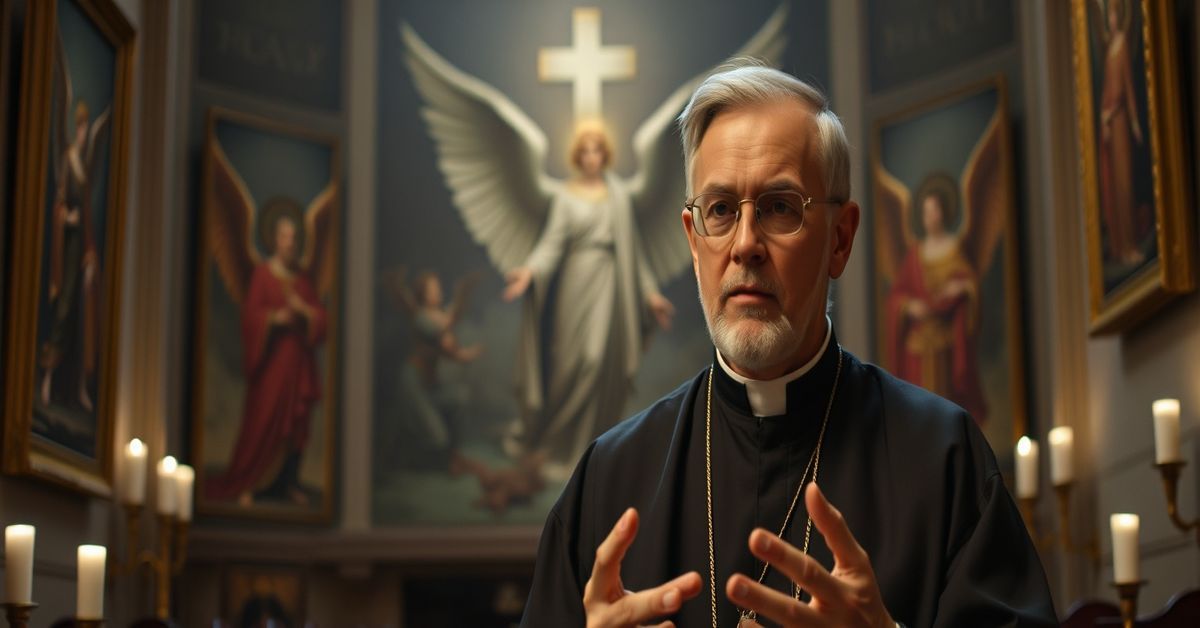
The VaticanNews portal reports that Bishop Erik Varden, OCSO, delivered the eighth reflection during the 2026 Lenten Spiritual Exercises for “Pope” Leo XIV, Cardinals residing in Rome, and heads of Dicasteries of the Roman Curia. His theme was “God’s Angels.” Varden’s reflection, drawn from the monastic tradition of St. Bernard of Clairvaux and Cardinal John Henry Newman, framed angels primarily as mediators of God’s providence, personal guides, and illuminators. He emphasized an angel’s role in guiding natural human yearnings (“cupiditas”) toward God and as a personal companion at the hour of death, contrasting this with impersonal digital media. The reflection concluded by linking the priest’s ministry to an “angelic enlightener” role, citing Newman as a Doctor of the Church. The entire presentation, while using traditional vocabulary, systematically omits the robust, supernatural, and hierarchical doctrine of angels as defined by the pre-conciliar Magisterium, replacing it with a soft, psychological, and anthropocentric model. This reflects the fundamental apostasy of the post-1958 “church”: the substitution of naturalistic religiosity for the supernatural deposit of faith.
Factual Deconstruction: A Selective and Anemic Portrayal
The article presents Bishop Varden’s reflection as a synthesis of Bernardine monastic spirituality and Newmanian thought. It correctly notes Bernard’s view of angels as mediators of providence and his exhortation to “descend, and show mercy to your neighbour; next… use all the cupiditas of your soul to rise towards the most high and eternal truth.” It then pivots to Newman’s vision of the priest as an “angelic enlightener” who brings wisdom in an age of digital alienation. The factual summary is accurate but shallow, cherry-picking mystical language while ignoring the doctrinal framework that gives such language meaning. The reflection treats angels as functional extensions of human psychology and pastoral methodology, not as a distinct, created order of pure spirits with a defined hierarchy, a specific role in the cosmic battle against demons, and a clear relationship to the sacramental and liturgical life of the Church.
Linguistic Analysis: The Tone of Subjective Experience over Objective Doctrine
The language employed is symptomatic of the conciliar revolution’s shift from dogma to experience. Key phrases reveal a naturalistic and immanentist bias:
- “Cupiditas… drawn towards fulfilment in God”: The use of the Latin term for “desire” or “love” (often with erotic connotations) is telling. It reduces the spiritual life to the direction and integration of natural human yearnings, a thoroughly Pelagian and anthropocentric starting point, contrary to the Thomistic doctrine that grace elevates and perfects nature, not merely directs it.
- “An angelic encounter is always personal. It cannot be replaced by a download or a chatbot.”: This sets up a false dichotomy between a “personal” (subjective, experiential) encounter and a mechanistic one. It ignores the Catholic doctrine that angels act as ministering spirits (Hebrews 1:14) according to God’s sovereign will, not as autonomous personal therapists. The emphasis is on human feeling and experience (“yearn to meet teachers”) rather than on the objective, hierarchical order of the celestial court.
- “Illumination is ever a twofold process: intellectual and essential, sacramental and pedagogical.”: This vague, hyphenated phrasing is classic conciliar obfuscation. It conflates the angel’s role as a messenger (intellectual illumination) with the sacramental system, which is the exclusive domain of Christ’s priesthood. It suggests a “pedagogy” of angels parallel to, rather than subordinate to, the sacraments, undermining the unique mediatorship of Christ.
The tone is contemplative, therapeutic, and vaguely poetic, avoiding the precise, juridical, and metaphysical language of pre-1958 angelology. It speaks of “enlighten, keep, govern, and guide” as personal services, not as the execution of specific offices within the economia salutis.
Theological Confrontation: Omissions That Reveal Apostasy
From the perspective of integral Catholic faith, the most damning aspect of the reflection is not what it says, but what it omits. Silence on core doctrines is a formal denial in the context of a teaching address. The following essential truths are completely absent:
1. **The Hierarchy of the Celestial Court:** No mention of the nine choirs of angels (Seraphim, Cherubim, Thrones, etc.) as defined by St. Dionysius the Areopagite and taught by the Church. This hierarchical structure reflects the order of the universe and God’s governance. Its omission reduces angels to an undifferentiated “ministerial” class, aligning with the modernist error of demythologizing the cosmos.
2. **Angels as Warriors Against Demons:** The article speaks of angels as guides and illuminators but is mutely silent on their role as milites Christi (soldiers of Christ) who fight the principalities and powers of darkness (Ephesians 6:12). This is a catastrophic omission. The pre-conciliar Church taught that angels, especially guardian angels, protect us from the assaults of the devil. The False Fatima Apparitions file, while rejecting that event, correctly notes the focus on “external threats” and spiritual warfare. Varden’s angelology has no room for cosmic combat, reflecting the “peace-and-love” pacifism of the conciliar sect that denies the existence of a personal, malevolent Devil as a present, active force.
3. **The Angelic Role in the Liturgy and Sacraments:** Angels are intrinsically linked to the Holy Sacrifice of the Mass. The Canon of the Mass, in every preface, concludes with the Sanctus: “Sanctus, Sanctus, Sanctus Dominus Deus Sabaoth… Hosanna in excelsis,” which is the hymn of the angelic choirs. The angels are present at the altar, as the Church has always believed. Varden’s reflection, while mentioning the Mass in passing (“within the canon of the Mass”), severs this connection, treating angels as adjuncts to personal devotion rather than integral participants in the one, true worship.
4. **Guardian Angels as a Doctrine of Faith:** The existence and office of guardian angels is a defined doctrine of the Church (Council of Lateran IV, 1215). It is not a pious opinion but a truth of faith that each soul is assigned a guardian angel from baptism (or birth) until death. Varden’s generic “guardian of holiness” language dilutes this to a vague spiritual companionship, avoiding the juridical and protective certainty of the traditional teaching.
5. **The Final Judgment and Particular Judgment:** The reflection ends with angels bearing us “through this world’s veil into eternity,” but says nothing of the particular judgment where the soul is judged by Christ, often with angels as witnesses or executors (Luke 16:22). This omission is part of a systematic silencing of the “last things” (death, judgment, heaven, hell) that characterizes the post-conciliar “church,” which prefers a vague “eternity” to the concrete, terrifying, and glorious realities of the afterlife. The Syllabus of Errors condemns the error that “the science of philosophical things and morals… may and ought to keep aloof from divine and ecclesiastical authority” (Error 57). By reducing angelic mediation to a psychological process, Varden’s reflection embodies this error, making “enlightenment” a matter of humanistic pedagogy rather than supernatural intervention.
6. **The Source of Authority: Christ the King:** The entire reflection operates within a vacuum of sovereignty. It speaks of angels mediating God’s providence but never anchors this in the absolute, universal kingship of Jesus Christ. Pope Pius XI, in Quas Primas, dogmatically defines Christ’s reign as encompassing all nations, states, families, and individuals, and that all authority is derived from Him. The absence of any reference to Christ’s Social Kingship is not accidental; it is the necessary corollary of the conciliar “church’s” rejection of the Syllabus and its embrace of religious liberty and secularism. An angelology that does not subordinate all mediation to the one Mediator, Jesus Christ, and to His reign over the social order, is a rebellion against the doctrine of Quas Primas.
Symptomatic Analysis: The Conciliar Revolution in Miniature
This single reflection is a perfect microcosm of the systemic apostasy of the post-1958 “church”:
- Hermeneutic of Continuity in Action: It uses the names of St. Bernard and Newman, traditional terms (“guardian,” “enlighten”), and a monastic setting to smuggle in a modernist, experience-centered spirituality. It is a textbook example of the “hermeneutic of continuity” condemned by the pre-conciliar Magisterium as a synthesis of all heresies.
- Anthropocentrism: The focus is on how angels serve human psychological needs (“yearn to meet teachers,” “personal encounter,” “govern and guide”). Theocentricity is lost. The angels are presented as resources for human fulfillment, not as a glorious part of God’s creation whose primary duty is to praise Him and execute His justice.
- Demythologization and Rationalization: The vivid, supernatural imagery of angels as fiery spirits, warriors, and members of a celestial hierarchy is replaced by the rationalized concepts of “mediation,” “illumination,” and “pedagogy.” This is the precise error condemned by St. Pius X in Lamentabili sane exitu, Proposition 57: “The Church is an enemy of the progress of natural and theological sciences.” Here, “theological science” about angels is sacrificed to a “progressive,” psychologically palatable narrative.
- The Newman Factor: The elevation of John Henry Newman as a “Doctor of the Church” and a model for “angelic” priesthood is a profound scandal. Newman is the intellectual father of doctrinal development and evolution, the bridge between Modernism and Catholicism. His private writings show his denial of the historicity of Genesis, his doubts about the Incarnation, and his belief in the “development of doctrine” as a Hegelian process. To hold him up as an exemplar for bishops and cardinals in 2026 is to openly proclaim allegiance to Modernism, which Lamentabili defines as “the synthesis of all heresies.”
- The ‘Pope’ and the ‘Curia’: The entire event is predicated on the legitimacy of the usurper “Pope Leo XIV” and his “Roman Curia.” From the perspective of integral Catholic faith, these are members of the conciliar sect, occupying the Vatican but lacking any true jurisdiction. Their “spiritual exercises” are a sacrilegious parody, as they are conducted by and for heretics and apostates who reject the immutable faith. The “bishop” Varden, a Benedictine monk, is a functionary of this sect. His reflections, however aesthetically pleasing, are the spiritual sustenance of apostates, leading souls away from the true, sacramental, hierarchical, and dogmatic faith.
Doctrinal Weapons: The Unchanging Standard
The true, pre-1958 Catholic doctrine on angels, which exposes the bankruptcy of Varden’s reflection, is clear and forceful:
- St. Thomas Aquinas, Summa Theologica I, Q. 50-64: Provides the definitive metaphysical treatment of angels as pure spirits, subsistent forms, with a strict hierarchy based on their proximity to God. They are not psychological counselors but powerful, intelligent beings with specific offices.
- Council of Lateran IV (1215), Canons 1-2: Defined the creation of angels and their status as pure spirits. The Lateran Canons are part of the ordinary and universal Magisterium.
- Pius XI, Quas Primas (1925): Establishes the absolute, universal kingship of Christ. Any theology of angels that does not explicitly subordinate them to Christ the King and His reign over all human societies is a rebellion against this dogma. “His reign… encompasses all non-Christians… the entire human race is subject to the authority of Jesus Christ.”
- Pius IX, Syllabus of Errors (1864), Error 57: Condemns the notion that “the science of philosophical things and morals… may and ought to keep aloof from divine and ecclesiastical authority.” Varden’s naturalistic, psychological approach to angels is a direct instance of this condemned error.
- Pius X, Lamentabili sane exitu (1907), Proposition 52: Condemns the Modernist error that “Christ did not intend to establish the Church as a community lasting for centuries on earth.” The angelic hierarchy is an integral part of that enduring, visible, hierarchical Church. To demythologize angels is to undermine the very structure of the Church Militant, which is composed of humans and angels in a single hierarchical order under Christ.
Conclusion: A Retreat into the Abyss
Bishop Varden’s reflection is not a harmless meditation on guardian angels. It is a deliberate, sophisticated act of theological subversion. By stripping the doctrine of angels of its supernatural, hierarchical, and martial content, and by reframing it in the language of personal development and pedagogical guidance, it accomplishes the Modernist goal of making Catholicism palatable to the natural man. It presents an angelology without Christ the King, without the Church’s hierarchical structure, without the reality of Hell and demonic warfare, and without the objective, sacramental means of grace. This is the “angelology” of the abomination of desolation: a comforting, therapeutic myth for an apostate age. The faithful are not being led to contemplate the glorious, terrifying, and obedient spirits who stand before the throne of God; they are being offered a spiritualized self-help technique. This is the logical outcome of the conciliar revolution’s rejection of the Syllabus and embrace of the world. The “spiritual exercises” in the Vatican are not exercises in Catholic asceticism but in the formation of the new, naturalistic, post-Catholic man. The only appropriate response is total rejection and a return to the unchanging, integral, and supernatural faith of the pre-1958 Church, which teaches us to pray with the Church: “Te igitur, clementissime Pater… per eundem Christum Dominum nostrum. Amen.“—through Christ the Lord, the sole King and Mediator, whose angelic court serves His sovereign will, not our psychological preferences.
Source:
Lenten Retreat: Bishop Varden reflects on 'God's Angels' (vaticannews.va)
Date: 26.02.2026