Bowman’s ‘Sainthood’ Apostasy Exposed
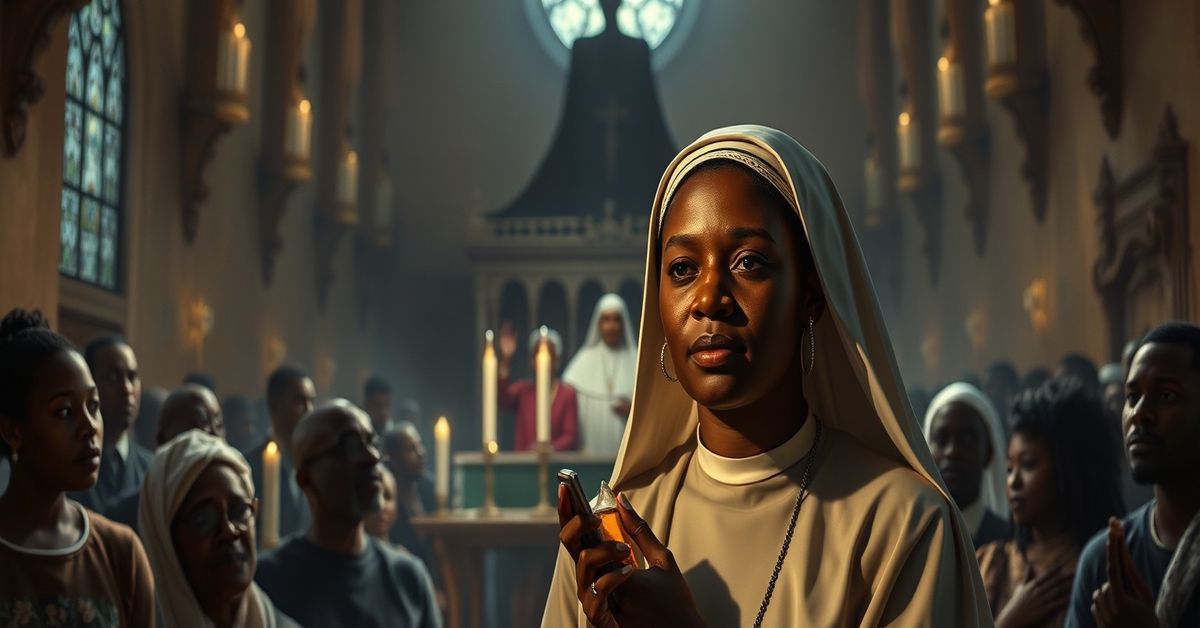
The EWTN News article of March 1, 2026, reports on the closing of the diocesan phase of the canonization cause for Servant of God Sister Thea Bowman, an African American religious sister active in the late 20th century. It praises her for “bridging divides,” embracing “all gifts and cultures,” and her “prophetic voice” on racial inclusion, suggesting her message is “needed more than ever” in today’s divisive society. The article frames her potential canonization as a pathway for other African Americans to sainthood and highlights her role in developing Black Catholic liturgy and music. The promotion of Bowman’s cause by the post-conciliar hierarchy, culminating in the Vatican’s Dicastery for the Causes of Saints, represents a decisive repudiation of Catholic exclusivism and an embrace of naturalistic humanism and religious indifferentism, demanding rejection by all faithful to integral Catholic doctrine.
The Invalidity of the Canonization Process Itself
The entire process described—from the diocesan inquiry to the transmission of records to the Vatican’s Dicastery—is fundamentally null and void. The 1917 Code of Canon Law, the normative law for the Church until the revolution of Vatican II, stipulated in Canon 188.4 that “Every office becomes vacant by the mere fact… if the cleric… Publicly defects from the Catholic faith.” The post-conciliar “Church” operates under a new, man-made canonical system that has abandoned the immutable principles of Catholic ecclesiastical law. More critically, the very authority proposing to canonize Bowman is illicit. As proven by St. Robert Bellarmine and canon law, a manifest heretic loses all jurisdiction ipso facto. The conciliar and post-concicular popes, from John XXIII through “Pope” Leo XIV (Robert Prevost), have publicly and obstinately embraced the errors of Modernism, religious liberty, and ecumenism—all solemnly condemned by St. Pius X in Lamentabili sane exitu and by Pope Pius IX in the Syllabus of Errors. Therefore, the “Dicastery for the Causes of Saints” is a department of an apostate sect, and any act it performs, including the consideration of a cause, is absolutely without effect in the true Church. As Pope Pius IX taught in Etsi Multa, a heretic pope’s acts are null; the same principle applies to his entire ecclesiastical apparatus.
Indifferentism and the Denial of Christ’s Kingship
The article’s core theme—Bowman’s “ability to see the dignity of each individual, and embrace all gifts and cultures”—is a precise restatement of the indifferentism condemned by Pius IX. The Syllabus declares: “Every man is free to embrace and profess that religion which, guided by the light of reason, he shall consider true” (Error 15) and “Man may, in the observance of any religion whatever, find the way of eternal salvation” (Error 16). Bowman’s “salad bowl” metaphor, where “people keep their identity,” directly contradicts the Catholic doctrine of the unity of the human race in Christ and the Social Kingship of Our Lord. Pope Pius XI, in Quas Primas, dogmatically defined that Christ’s reign “encompasses all men” and that “the entire human society had to be shaken, because it lacked a stable and strong foundation” when “God and Jesus Christ… were removed from laws and states.” The article’s emphasis on “dignity” apart from submission to Christ’s law is pure naturalistic humanism, the very “plague” of secularism Pius XI sought to combat with the feast of Christ the King. Bowman’s work, therefore, did not “bridge divides” in a Catholic sense; it promoted a relativistic equality that dissolves the necessary hierarchy of all things under Christ the King.
Liturgical Corruption and the Perversion of Sacred Music
Bowman is celebrated as a major contributor to the Black Catholic hymnal “Lead Me, Guide Me” and for teaching about “Black liturgy.” This is not a neutral cultural expression but a direct participation in the liturgical revolution condemned by St. Pius X. The Holy Office’s decree Lamentabili condemned the proposition that “The sacraments merely serve to remind man of the presence of the ever-benevolent Creator” (Proposition 41) and that “The Christian community introduced the necessity of baptism” (Proposition 42). The post-conciliar “liturgy” is a human creation, a “table of assembly” replacing the Unbloody Sacrifice of Calvary. Bowman’s inculturation of the Mass into “Black” forms is the logical outcome of the Modernist principle that dogma and worship evolve (condemned in Lamentabili Propositions 54-55). Her “charismatic personality” and use of music to “evangelize” aligns with the condemned errors of subjectivism and the reduction of religion to sentiment, which Pius X identified as the synthesis of all heresies in Pascendi Dominici gregis.
The Omission of Supernatural Salvation and the Emphasis on Earthly Identity
The article is utterly silent on the supernatural end of man. There is no mention of the necessity of the Catholic faith for salvation (Extra Ecclesiam Nulla Salus), the Sacraments as the exclusive means of grace, or the final judgment. Instead, it fixates on “identity,” “race,” “ethnicities,” and “civil rights.” This is the hallmark of the conciliar sect’s apostasy: replacing the doctrine of the City of God with the building of earthly, natural societies based on race and culture. Pius XI in Quas Primas stated that Christ’s kingdom “is opposed only to the kingdom of Satan and the powers of darkness—and requires its followers… to deny themselves and carry their cross.” Bowman’s program, by contrast, encouraged the celebration of racial identity as a primary good, a direct contradiction of St. Paul’s teaching that in Christ there is neither “bond nor free… male nor female” (Gal. 3:28). The article’s claim that her message is “universal” is a lie; it is a particularist, naturalistic message that fragments the Mystical Body into racial and cultural blocs, fulfilling the Modernist dream of a “church” divided into “national churches” (Syllabus Error 37).
The “Saintly Seven” and the Creation of a Parallel Church
The mention of the “Saintly Seven,” a group of African American Catholics with active causes, exposes the sectarian nature of the post-conciliar “canonization” project. The true Church, before the apostasy, recognized saints based on heroic virtue in communion with the immutable faith. The current process is a political tool to create “saints” who embody the conciliar ideals of ecumenism, inculturation, and the “humanization” of the Church. The fact that there are no canonized African American saints in the pre-1958 Church is irrelevant; the Church is not a democracy or a sociological body. The attempt to “balance” the roll of saints by race is a gnostic, modernist corruption of the very concept of sainthood, which is about conformity to Christ, not representation of human categories. This is the “evolution of the Christian community” condemned by Pius X (Lamentabili Proposition 53).
Conclusion: An Apostate Witness for an Apostate Church
Sister Thea Bowman’s life and work, as presented, are a perfect mirror of the post-conciliar apostasy. She championed “inculturation,” which is the heresy of adapting the faith to flesh rather than the flesh to the faith. She promoted “dialogue” and “welcoming all,” which is the indifferentism of the Syllabus. She contributed to the liturgical destruction that has made the “Mass” a “table of assembly.” Her cause is being advanced by a hierarchy that has publicly defected from the Catholic faith. Therefore, her promotion as a model of Catholic virtue is not merely an error; it is a blasphemous inversion, holding up an apostle of Naturalism as a model of supernatural holiness. The faithful must reject this entire process with absolute contempt, recognizing that the “conciliar sect” has no power to sanctify, only to corrupt. The only “voice needed more than ever” is the uncompromising proclamation of the Social Kingship of Christ, the exclusive salvific duty of the Catholic Church, and the absolute rejection of all naturalistic and modernist errors, for which Bowman’s legacy stands as a prominent monument.
Source:
Servant of God Sister Thea Bowman’s voice needed ‘more than ever’ (ewtnnews.com)
Date: 01.03.2026