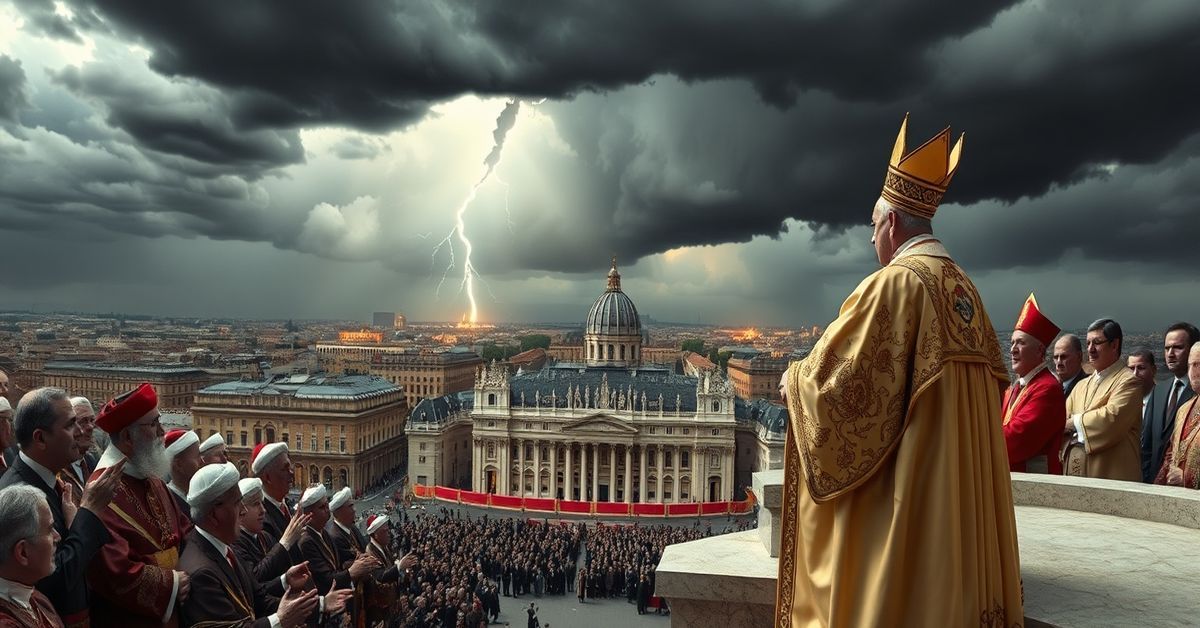
The “Peace” of Antichrist: Denying Christ’s Kingship to Embrace Naturalism
The Vatican News portal reports that “Pope” Leo XIV, during the Angelus on March 1, 2026, expressed “deep concern” over the escalation of violence in the Middle East following joint US-Israeli airstrikes on Iran. The antipope stated: “Stability and peace are not built with mutual threats, nor with weapons, which sow destruction, pain, and death, but only through a reasonable, authentic, and responsible dialogue.” He appealed to the parties to assume “moral responsibility” to stop the “spiral of violence” before it becomes an “irreparable abyss,” praying that diplomacy may recover its role and that the “good of peoples” may be promoted through “peaceful coexistence founded on justice.” This appeal comes after the reported death of Iran’s Supreme Leader Ayatollah Ali Khamenei following the attacks.
The thesis is clear: The conciliar “papacy” has exchanged the immutable Catholic doctrine of the Social Kingship of Christ for the naturalistic, modernist slogan of “dialogue,” thereby offering a false peace that is the precise opposite of the peace Christ alone can give.
The Naturalistic Heresy of “Dialogue” Over the Divine Right of Christ the King
The central error of the appeal is its complete omission of the primary, non-negotiable condition for any true peace: the public recognition and submission of all nations, rulers, and laws to the reign of Our Lord Jesus Christ. The antipope’s call for “reasonable, authentic, and responsible dialogue” is a pure expression of the naturalism condemned by Pope Pius IX in the Syllabus of Errors. Error #77 states: “In the present day it is no longer expedient that the Catholic religion should be held as the only religion of the State, to the exclusion of all other forms of worship.” Error #79 declares it false that “the civil liberty of every form of worship… conduce more easily to corrupt the morals and minds of the people.” Leo XIV’s appeal implicitly accepts the secular state’s neutrality, a direct contradiction of Catholic teaching.
Pope Pius XI, in his encyclical Quas Primas (December 11, 1925), on the feast of Christ the King, left no room for such ambiguity. He wrote that the plague of secularism, “so-called laicism,” began precisely with “the denial of Christ the Lord’s reign over all nations.” The Pontiff explained that when “God and Jesus Christ were removed from laws and states… the foundations of that authority were destroyed.” He explicitly addressed rulers: “Let rulers of states therefore not refuse public veneration and obedience to the reigning Christ, but let them fulfill this duty themselves and with their people, if they wish to maintain their authority inviolate and contribute to the increase of their homeland’s happiness.” The antipope’s speech contains not a single word about this duty. It is a sermon on natural ethics devoid of the supernatural end of man and the social order. It reduces the “moral responsibility” of nations to a vague, immanentist humanitarianism, stripping it of the first and greatest commandment: to love and obey God.
The Omission of Justice as the Foundation of True Peace
The antipope speaks of “peaceful coexistence founded on justice.” But what justice? The modern, secular concept of “justice” as mere procedural fairness or human rights is anathema to Catholic doctrine. True justice, as taught by the Church, is the rendering to each his due, beginning with the rendering to God of the worship and obedience due to Him as Creator and Redeemer. Pius XI in Quas Primas defined the reign of Christ as consisting of a “threefold authority”: legislative, judicial, and executive. “Concerning the judicial authority, which Jesus received from the Father, He Himself says… ‘for the Father judges no one, but has given all judgment to the Son.'” A peace that does not submit international relations, treaties, and conflicts to the judgment of Christ the King and His law is an injustice, as it denies God His rights. The antipope’s appeal silently endorses the Syllabus Error #56: “Moral laws do not stand in need of the divine sanction,” and Error #58: “all the rectitude and excellence of morality ought to be placed in the accumulation and increase of riches… and the gratification of pleasure.” The “justice” he invokes is the justice of the marketplace and international diplomacy, not the justice of the City of God.
The Silence on the Primary Danger: Apostasy and Modernism
The analysis of subtext reveals a damning silence. The “deep concern” is directed at the physical violence between nation-states. There is zero mention of the far greater, eternal tragedy: the apostasy of nations and peoples from the Catholic faith, the proliferation of false religions like Islam which denies the Incarnation and Kingship of Christ, and the modernist apostasy within the very structure occupying the Vatican. This is the exact diversion condemned by St. Pius X in his fight against Modernism. The 1907 decree Lamentabili sane exitu condemned the proposition: “The Church is an enemy of the progress of natural and theological sciences” (Prop. 57). The conciliar “papacy” has internalized this falsehood, presenting the Church as a mere partner in a global dialogue of “civilizations,” rather than the sole Ark of Salvation with the absolute duty to convert all nations to Christ. The antipope’s silence on the need for the conversion of Iran, Israel, and the United States to the one true faith is a deafening affirmation of the Syllabus Error #15: “Every man is free to embrace and profess that religion which, guided by the light of reason, he shall consider true.”
The False Authority of the Speaker: A Manifest Heretic Cannot Appeal for Catholic Peace
The entire appeal is rendered null and void by the status of the speaker. The individual known as Robert Prevost, who took the name “Leo XIV,” is a manifest heretic. According to the unchanging doctrine of St. Robert Bellarmine, cited in the Defense of Sedevacantism file: “a manifest heretic, by that very fact ceases to be Pope and head, just as he ceases to be a Christian and member of the body of the Church.” Bellarmine clarifies that a manifest heretic is *ipso facto* deprived of all jurisdiction, “NOT AFTER WARNINGS OR DECLARATION, BECAUSE heretics are already outside the Church before excommunication.” The life, teachings, and actions of the post-conciliar “popes,” from John XXIII through “Francis” to “Leo XIV,” constitute a public, notorious, and pertinacious adherence to the errors of Modernism—the “synthesis of all heresies” as labeled by St. Pius X. Their embrace of religious liberty (Dignitatis Humanae), ecumenism, and the democratization of the Church are direct contradictions of the Syllabus of Errors and the perennial teaching of the Church. Therefore, Prevost possesses no authority to teach, sanctify, or govern. His “appeal” is the appeal of a private individual, and a modernist one at that, whose moral framework is grounded in the very secularism the Church has always condemned. Canon 188.4 of the 1917 Code of Canon Law confirms: “Every office becomes vacant by the mere fact… if the cleric: … 4. Publicly defects from the Catholic faith.” The “pope” who promotes the conciliar cult of man has publicly defected.
The Conciliar Sect’s Abandonment of the Social Reign of Christ
The article showcases the fundamental shift in the post-Conciliar “Church’s” mission. Where Pius XI, in Quas Primas, saw the feast of Christ the King as a “special remedy against the plague that poisons human society” (secularism), the conciliar “papacy” sees its role as a generic promoter of “human development” and “dialogue.” The antipope’s language mirrors the naturalistic humanism of the United Nations, not the authoritative voice of the Vicar of Christ. He appeals to “moral responsibility” as if it were a generic human virtue, rather than the specific duty to recognize the sovereignty of Jesus Christ over every human society. This is the fulfillment of the “abomination of desolation” standing in the holy place: a structure in Rome that speaks the language of the world while wearing the vestments of the Church. The peace it offers is the false peace of the Antichrist, who will present a global political-religious unity built on the denial of the exclusive Kingship of Jesus Christ.
Conclusion: A Call to Reject the Conciliar Peace and Pray for the Triumph of the True King
The appeal from “Pope” Leo XIV is a masterpiece of diabolical ambiguity. It uses the language of peace and morality while emptying it of its supernatural, Catholic content. It presents a humanitarian platitude that any atheist, Muslim, or Buddhist could endorse, precisely because it is built on the sand of naturalism. The only foundation for peace is the one Pius XI proclaimed: the reign of Christ the King in individuals, families, and states. True peace is the peace of Christ, “which surpasseth all understanding” (Phil. 4:7), and it can only come about when “every tongue shall confess that our Lord Jesus Christ is in the glory of God the Father” (Phil. 2:11). The conciliar “papacy,” by refusing to confess this, becomes an accomplice to the very violence it decries, as it deprives nations of the only means of obtaining a stable and just order. The faithful are called to ignore the siren song of this antipope and his false peace, and to labor and pray for the day when the Sacred Heart of Jesus, and not the empty rhetoric of “dialogue,” will be universally acknowledged as the sole source of order, justice, and true peace on earth.
Source:
Pope on Iran: Peace not built with mutual threats or death-dealing arms (vaticannews.va)
Date: 01.03.2026