Interfaith Prayer: Apostasy in Action
The Lahore Gathering: A Scandalous Betrayal of Catholic Truth
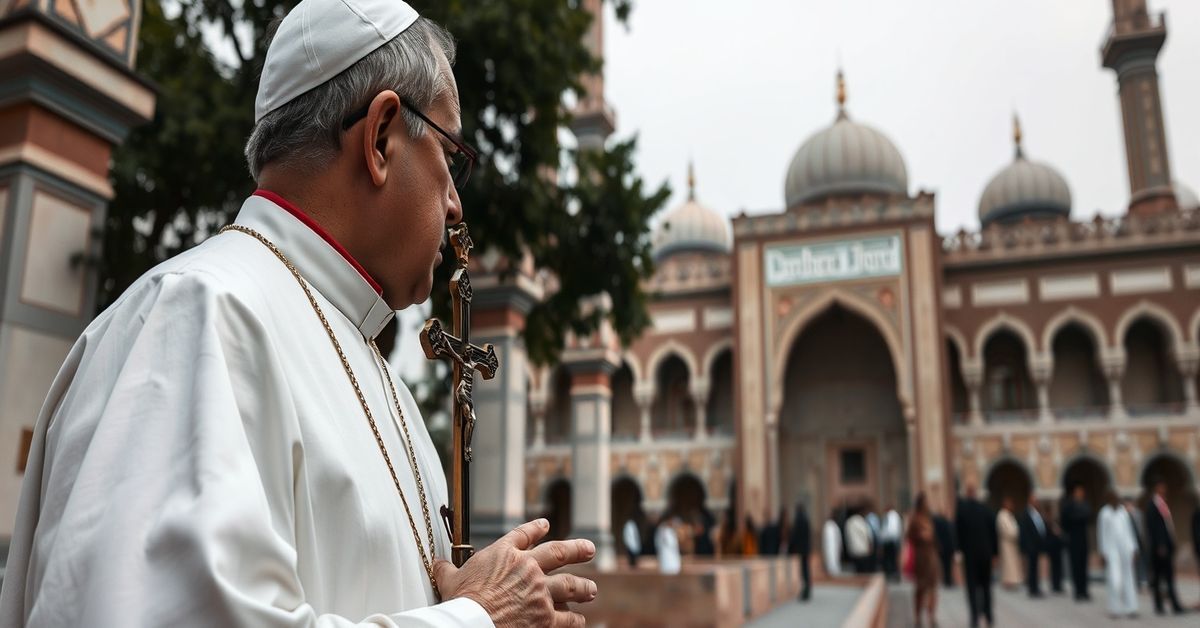
The cited article from Vatican News reports an interreligious prayer meeting in Lahore, Pakistan, where Christian and Muslim leaders gathered at the Badshahi Mosque during Lent and Ramadan to pray for peace amid the Afghanistan-Pakistan conflict. Fr. Asif Sardar, Vicar General of the Archdiocese of Lahore, and Fr. James Channan, a Dominican, participated alongside Muslim imams, sharing an iftar and promoting “shared values” of fasting and prayer. The event is framed as a sign of “interreligious harmony” and a bridge of unity, with calls for joint advocacy for peace and an end to violence. This analysis exposes the profound theological and spiritual errors inherent in such an initiative, which stands in direct contradiction to the integral Catholic faith as defined before the rupture of 1958.
Theological Contradictions: The Denial of Christ’s Exclusive Kingship
The very premise of the gathering—that Christians and Muslims can pray together as co-equal believers before the same God—is a formal repudiation of the dogma of Christ’s exclusive kingship. Pope Pius XI, in his encyclical Quas Primas (1925), established the feast of Christ the King precisely to combat the errors of secularism and religious indifferentism. He declared: “His reign, namely, extends not only to Catholic nations… but His reign encompasses also all non-Christians, so that most truly the entire human race is subject to the authority of Jesus Christ.” The reign of Christ the King is universal, but it is exclusively His. It demands the public recognition of His law and the submission of all human societies to His divine authority. The Lahore event utterly omits this fundamental truth. Instead of proclaiming Christ’s sovereignty over Pakistan and Afghanistan, it reduces faith to a vague “bridge of unity,” implying a common denominator between the true religion and a false one.
This omission is not accidental but symptomatic of the naturalistic humanism that defines post-conciliar ecumenism. The article’s focus is on human efforts for peace, justice, and reconciliation through shared spiritual practices. It speaks of “deepening roots of relations” and “living shared values,” yet remains utterly silent on the supernatural end of human society: the glory of God and the salvation of souls through the One, Holy, Catholic, and Apostolic Church. The Syllabus of Errors, promulgated by Pope Pius IX (1864), condemns this mindset with surgical precision:
Proposition 16: “Man may, in the observance of any religion whatever, find the way of eternal salvation, and arrive at eternal salvation.” — Condemned.
Proposition 17: “Good hope at least is to be entertained of the eternal salvation of all those who are not at all in the true Church of Christ.” — Condemned.
By praying with Muslims in a mosque, the participants implicitly deny these condemnations. They treat Islam as a legitimate path to God, a “shared value” system, when in reality it is a blasphemous rejection of the Incarnation and the Trinity. The event’s silence on the necessity of converting Muslims to the Catholic Faith is a betrayal of the Great Commission (Matt. 28:19-20). As St. Pius X taught in his encyclical Pascendi Dominici gregis (1907), the Modernist “reform” of religion consists in “regarding as the ultimate end of religion not God but man,” reducing faith to a “subjective feeling.” The Lahore gathering is a perfect illustration: peace among humans is elevated above the exclusive worship due to God through Christ.
Linguistic Analysis: The Language of Naturalism and Apostasy
The article’s vocabulary is a telltale sign of the theological decay it promotes. Phrases like “interreligious harmony,” “shared commitment to peace,” “faith can be a bridge of unity,” and “mutual respect” are the stock-in-trade of Vatican II’s Nostra Aetate and subsequent conciliar documents. This language is deliberately vague, designed to obscure the unbridgeable chasm between Catholic truth and Islamic falsehood. It speaks of “values” (fasting, reflection, sacrifice) while stripping them of their supernatural object: the sacrifice of Calvary made present in the Mass.
Note the naturalistic reduction of Lent and Ramadan. In Catholic theology, Lent is a penitential season oriented toward the Passion of Christ, the reception of sacraments, and the mortification of the body for the soul’s sanctification. Ramadan, from a Catholic perspective, is a works-based ritual of a false religion. To place them on a par as “shared seasons” is to level the unique sacrifice of the New Law with a pagan observance. The article quotes Fr. Channan saying they will “live the shared values of fasting, reflection, and sacrifice present in both Ramadan and Lent.” This is heretical syncretism. The sacrifice of the Mass is the unbloody re-presentation of Calvary; Islamic fasting is a mere human effort to merit paradise. To equate them is to deny the unique sufficiency of Christ’s sacrifice.
Furthermore, the event occurs in a mosque, a place dedicated to the worship of a false god. Canon 1258 of the 1917 Code of Canon Law (still the law of the Church before the revolution) strictly forbade Catholics from “assisting at non-Catholic worship.” The participation of a Vicar General and a Dominican priest in a mosque service, including an iftar (a ritual meal with specific Islamic prayers), constitutes scandalous cooperation in false worship. The article’s tone of celebration for this “dream” of harmony is therefore a public manifestation of apostasy.
Symptomatic of the Conciliar Revolution: The Systematic Rejection of “Extra Ecclesiam Nulla Salus”
This event is not an isolated incident but a fruit of the conciliar sect’s doctrinal revolution. The “abomination of desolation” spoken of by Daniel (Matt. 24:15) is precisely the substitution of the Catholic Church’s mission with a naturalistic, human-centered project of “dialogue” and “peacebuilding.” The Second Vatican Council’s declaration Nostra Aetate (1965) on the relation of the Church to non-Christian religions opened the floodgates to such syncretism, teaching that Muslims “adore the one God, living and subsisting in Himself” and “profess to hold the faith of Abraham.” This is a direct contradiction of Catholic teaching. The true God is the Most Holy Trinity; the God of Abraham is the same God of the Catholics, but Muslims, by denying the Son, worship a different, false god (1 John 2:22-23).
The article’s complete omission of any call to conversion is the gravest accusation. The Catholic Church, before 1958, was missionary by her very nature. Pope Pius IX, in the Syllabus, condemned the error that “the Church ought never to pass judgment on philosophy, but ought to tolerate the errors of philosophy” (Prop. 11). By the same token, she must never “tolerate” false religions but must seek the conversion of their adherents. The Lahore event does the opposite: it legitimizes Islam by treating it as a co-religionist. This is the logical outcome of the conciliar error of religious liberty, condemned by Pius IX (Syllabus, Props. 77-80), which teaches that all religions should have public freedom and that the state should not favor Catholicism. The event’s plea for “peace” as a “common goal of all humanity” abstracts from the only true peace: “Peace I leave with you, My peace I give unto you” (John 14:27), the peace of Christ in His Church.
The Role of the Modernist Clergy: Architects of Apostasy
The participation of Fr. Asif Sardar (Vicar General) and Fr. James Channan (Dominican) is not a minor scandal but a public act of schism and heresy. From the perspective of integral Catholic faith, these men—operating within the structures of the post-conciliar “Church”—are heretical ecclesiastics. Their actions demonstrate a complete rejection of Catholic exclusivity. As St. Robert Bellarmine taught, a manifest heretic ipso facto loses all jurisdiction (De Romano Pontifice). Their very presence in such an event proves they are not Catholic in the traditional sense.
Their language— “faith can be a bridge,” “deepen relations,” “shared values”—is the lingua franca of Modernism. Pope St. Pius X, in Pascendi, described the Modernist as one who “regards the world as the object of a continuous evolution” and “rejects everything that is absolute, immutable, and eternal.” The Lahore gathering embodies this: it rejects the absolute, immutable truth that “outside the Church there is no salvation” (Extra Ecclesiam nulla salus), and evolves a new, naturalistic religion of “peace” that includes all. The priests’ failure to mention the Real Presence, the sacrifice of the Mass, the necessity of baptism, or the duty to convert Muslims is a damning indictment of their apostasy. They have exchanged the supernatural end of the Church—the salvation of souls—for a worldly project of interreligious dialogue, which is nothing but apostasy in action.
Conclusion: A Call to Reject the Conciliar Sect and Return to Tradition
The interreligious prayer in Lahore is not a step toward peace but a sacrilegious betrayal of Christ the King. It is a concrete manifestation of the “errors of Modernism, the synthesis of all heresies,” condemned by St. Pius X. It violates the First Commandment by placing the true God on the same level as the false god of Islam. It denies the unique redemptive sacrifice of Calvary by equating Catholic Lenten penance with Islamic Ramadan. It scandalizes the faithful by having Catholic clerics participate in a mosque service, thereby giving the impression that Catholic worship and Islamic worship are equally acceptable to God.
From the perspective of integral Catholic faith, the only legitimate response to such an event is uncompromising rejection. The true Catholic, holding to the faith of Pius IX and Pius X, must refuse to participate in or endorse such syncretism. The duty of every Catholic is to pray for the conversion of Muslims, to support missions to evangelize them, and to maintain the absolute separation between the true religion and all false ones. The peace that the world seeks, as Pius XI taught, can only come through the public and social reign of Christ the King, not through interfaith prayer that denies His exclusive sovereignty. The Lahore gathering is a symptom of the abomination of desolation standing in the holy place—the conciliar sect has replaced the Catholic Church with a naturalistic, syncretistic parody. The faithful must flee this apostasy and adhere solely to the immutable Tradition of the Church, which has always taught that “the true religion is contained in the Catholic and Apostolic Church” (Pius IX, Quanta Cura).
Source:
Christians and Muslims join in Pakistan to pray for peace (vaticannews.va)
Date: 02.03.2026