Phoenix “Catholic” Counseling Center: Modernist Anthropology Exposed
The “Photina Center”: A Post-Conciliar Synthesis of Naturalism and Heresy
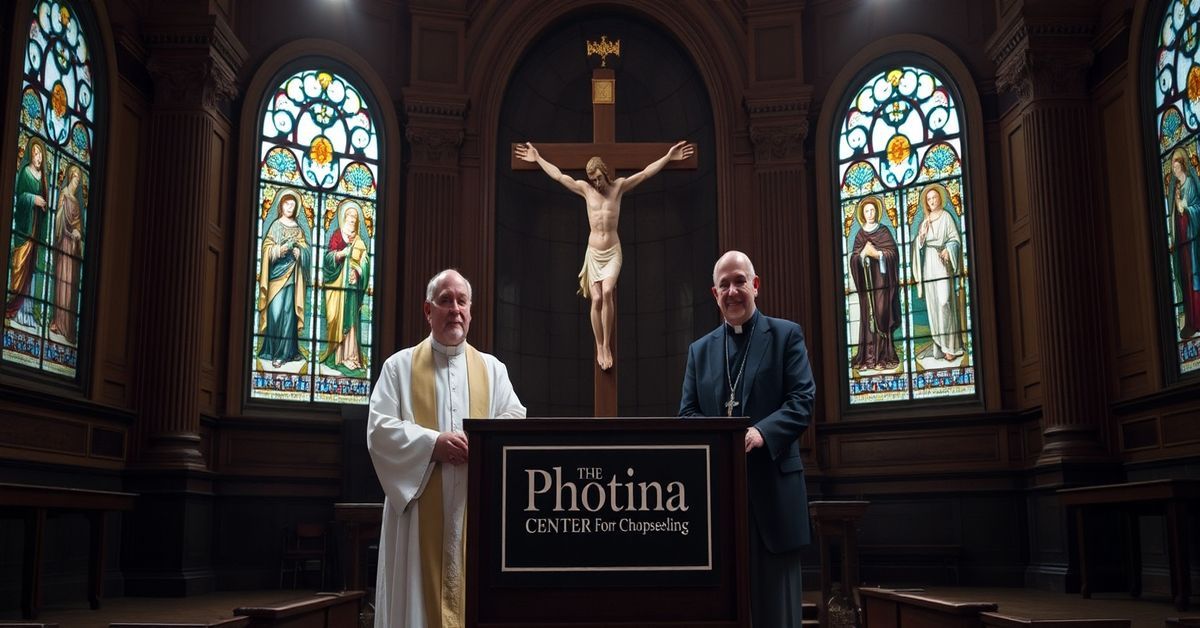
The EWTN News article of March 4, 2026, announces the creation of the Photina Center for Catholic Counseling, a collaboration between the University of Mary and the Diocese of Phoenix. Monsignor James Shea, president of the University of Mary, and Bishop John Dolan of Phoenix present this initiative as a response to the “limited” and “un-Christian lens” of secular mental health training, promising a therapy that recognizes the “spiritual element of our being” and affirms the “inestimable dignity” of the human person as “created in the image and likeness of God.” Ostensibly rooted in Catholic teaching, this project is, in reality, a sophisticated manifestation of the Modernist synthesis condemned by St. Pius X in Pascendi Dominici gregis and Lamentabili sane exitu. It represents the final stage of the “diversion from apostasy” warned of in the theological objections to false apparitions: a focus on external, naturalistic “well-being” that omits the primary danger of apostasy within and the supernatural means of salvation. This analysis will expose the theological and spiritual bankruptcy of this initiative by confronting its assumptions and omissions with the unchangeable Catholic doctrine of the pre-1958 Magisterium.
1. The “Spiritual Element” Fraud: A Naturalistic Religion Without Grace
Monsignor Shea states that the difficulty with modern training is that it considers the human person “in a very limited way” and fails to factor in “the spiritual element of our being.” This language is carefully chosen to sound Catholic while emptying the term “spiritual” of its supernatural, sacramental content. The pre-conciliar Magisterium defined the human person not as a composite of “physical, mental, and spiritual elements” in a vague harmony, but as a substantial union of a rational soul and a body, with the soul itself being the form of the body. More critically, the soul is the subject of sanctifying grace, a supernatural participation in the divine nature received through Baptism, which heals original sin and infuses the theological virtues. The “spiritual element” of a baptized Catholic is not a generic religious sentiment but a deifying grace that makes the soul a “temple of the Holy Ghost” (1 Cor. 6:19).
The article’s framework is entirely naturalistic. It speaks of “well-being,” “healing,” “counseling,” and “therapy” as ends in themselves, with the “spiritual” merely a component to be integrated for more effective care. This is the precise error condemned by Pope Pius IX in the Syllabus of Errors:
56. Moral laws do not stand in need of the divine sanction, and it is not at all necessary that human laws should be made conformable to the laws of nature and receive their power of binding from God.
The counseling center’s approach implies that the ultimate good of the person can be achieved through natural psychological means augmented by a vague “spiritual” awareness. It reduces the Catholic view of the human person to a superior form of humanism. The true Catholic end, as defined by the Council of Trent and Pope Pius XI in Quas Primas, is supernatural: “to be eternally happy in the contemplation of God.” The article is silent on sin, grace, the sacraments as necessary means of salvation, the redemptive sacrifice of Calvary, and the final judgment. This silence is the gravest accusation. A therapy that does not begin with the doctrine that “the Son of God became man to lead us to eternal happiness” (Trent, Sess. VI, Chap. 1) and that “outside the Church there is no salvation” (Boniface VIII, Unam Sanctam) is not Catholic; it is a demonic distraction. St. Pius X, condemning the errors of the Modernists, taught that they “separate the human from the divine, the natural from the supernatural” (Lamentabili, Prop. 64). The Photina Center does exactly this.
2. “Dignity” Without Baptism: The Error of Indifferentism and Natural Law
The center’s foundational principle is the “inestimable dignity” of the human person as “created in the image and likeness of God.” While true in a natural, philosophical sense (man’s rational nature), this truth in Catholic theology is radically transformed by the Fall and by Redemption. After original sin, man retains a certain natural dignity but is also a “child of wrath” (Eph. 2:3). The dignity that matters for eternal destiny is the supernatural dignity of being an adopted son of God through grace. This dignity is lost by mortal sin and can be forfeited by final impenitence. The article’s presentation treats dignity as an inherent, indelible property of every human being, irrespective of their state of grace or religious affiliation. This is the condemned error of indifferentism:
15. Every man is free to embrace and profess that religion which, guided by the light of reason, he shall consider true.
16. Man may, in the observance of any religion whatever, find the way of eternal salvation, and arrive at eternal salvation.
17. Good hope at least is to be entertained of the eternal salvation of all those who are not at all in the true Church of Christ. (Syllabus of Errors)
By focusing on a generic “dignity” that all humans possess by creation, the center implicitly denies that the fullness of that dignity, and the only means to its supernatural fulfillment, is found in the Catholic Church alone. Pope Pius XI, in Quas Primas, while stating that Christ’s reign “encompasses also all non-Christians,” immediately qualifies this by saying they are subject to His authority “so that most truly the entire human race is subject to the authority of Jesus Christ.” This subjection implies a duty to enter the Church, the “dispenser of salvation.” The article makes no mention of the necessity of the Church, the necessity of baptism, or the duty of states to recognize the Catholic religion as the sole true religion—points fiercely defended by Pius IX in the Syllabus (e.g., #21, #77). The “dignity” they proclaim is a naturalistic, Masonic concept, not the Catholic supernatural dignity rooted in grace and membership in the Mystical Body.
3. The Omission of the Supernatural Hierarchy and the Reign of Christ the King
The most damning omission is the complete absence of any reference to the kingship of Christ over societies and nations, a central theme of Catholic social doctrine before Vatican II. Pope Pius XI’s encyclical Quas Primas, establishing the feast of Christ the King, directly addresses the error of secularism and the necessity of public recognition of Christ’s sovereignty:
“It has long been customary to call Christ King… But, if we delve deeper into the matter itself, we shall realize that the name and authority of king in the proper sense belong to Christ the Man… The reign of our Redeemer encompasses all men… And it matters not whether individuals, families, or states, for men united in societies are no less subject to the authority of Christ than individuals.”
Further, Pius XI explicitly links the social disorder of his time to the rejection of this reign:
“When God and Jesus Christ… were removed from laws and states… the foundations of that authority were destroyed… the entire human society had to be shaken.”
The Photina Center’s language is entirely privatized and psychological. It speaks of “individuals, families, and communities” receiving “healing” and “hope.” There is not a single word about the duty of the State to publicly recognize Christ as King, to enact laws in conformity with His law, to protect the rights of the Church, and to punish blasphemy and heresy. This is the very error Pius IX condemned in the Syllabus:
39. The State, as being the origin and source of all rights, is endowed with a certain right not circumscribed by any limits.
55. The Church ought to be separated from the State, and the State from the Church.
77. In the present day it is no longer expedient that the Catholic religion should be held as the only religion of the State, to the exclusion of all other forms of worship.
By confining “Catholic counseling” to the private therapeutic relationship, the center accepts the Masonic principle of the separation of Church and State and the privatization of religion. It implicitly rejects the social kingship of Christ, reducing Catholicism to a personal spirituality useful for mental health. This is the “cult of man” and “democratization of the Church” in action: the Church’s mission is not to govern societies according to divine law but to provide “services” for individual well-being within a pluralistic, secular framework.
4. The “Catholic” Label as a Mask for Theological Evolution
The article repeatedly uses the adjectives “Catholic” and “Catholic anthropology.” What is this anthropology? It is defined negatively against “secular” and “un-Christian” lenses, but positively only by the vague phrases “image and likeness of God” and “inestimable dignity.” There is no positive definition from the pre-1958 Magisterium. It does not mention:
- The four last things (death, judgment, heaven, hell).
- The necessity of sanctifying grace and the mortal sin that destroys it.
- The sacraments as ex opere operato channels of grace, especially Penance and the Eucharist for spiritual health.
- The duty to make acts of faith, hope, and charity constantly.
- The primacy of the love of God over all things.
- The obligation to seek first the Kingdom of God (Matt. 6:33).
This is not an oversight; it is the essence of Modernism. St. Pius X described the Modernist as one who “regards dogmas as… symbols of the primitive Christian experience” (Pascendi). The “Catholic anthropology” here is a symbol, a vague set of affirmations about human worth that can be seamlessly integrated into the secular therapeutic paradigm. It is a “dogmaless Christianity,” as condemned by Pius X (Lamentabili, Prop. 65): “Contemporary Catholicism cannot be reconciled with true knowledge without transforming it into a certain dogmaless Christianity, that is, into a broad and liberal Protestantism.” The center’s program offers a “Catholic Certificate” that likely teaches a Catholicism stripped of dogma, reduced to ethical platitudes and a generic “spirituality.”
5. Collaboration with the “Conciliar Sect”: The Scandal of “Bishop” Dolan
The article presents “Bishop John Dolan” of Phoenix as a legitimate Catholic pastor. From the perspective of integral Catholic faith, this is a fatal error. The post-conciliar “bishops” who implement the policies of the “conciliar sect” (e.g., promoting ecumenism, religious liberty, collegiality, and the new rites) are, by their public adherence to these errors, guilty of manifest heresy. As St. Robert Bellarmine taught, a manifest heretic ipso facto ceases to be a bishop or pope. Canon 188.4 of the 1917 Code of Canon Law states that an office becomes vacant by “publicly defects from the Catholic faith.” The “Bishop” Dolan, by participating in the post-conciliar structures and promoting a naturalistic “Catholic” counseling, publicly defects from the faith. His personal tragedy (losing family to suicide) does not grant him authority; it may even be a just punishment for his apostasy. His advocacy for “mental health” within the conciliar framework is a work of Satan, leading souls to trust in natural means while neglecting the sacraments and the doctrine of redemptive suffering in union with Christ. The University of Mary’s collaboration with him is a formal cooperation with a manifest heretic, a grave sin against the faith.
6. The Patristic and Theological Void: No Mention of the Soul’s Battle or the Sacramental Cure
True Catholic counseling, as practiced by the saints and Doctors of the Church, was always an integral part of the Sacrament of Penance and spiritual direction. It assumed a clear understanding of the soul’s faculties (intellect, will, sensitive appetite), the capital sins, the gifts and fruits of the Holy Ghost, the necessity of actual graces, and the warfare against the world, the flesh, and the devil. The Fathers of the Church and the great spiritual writers (St. Augustine, St. Thomas Aquinas, St. Ignatius of Loyola, St. Francis de Sales) wrote extensively on the “cure of the soul” (cura animarum). This cure was supernatural, beginning with contrition for sin out of love for God, proceeding through confession with the intention to amend life, and culminating in the reception of the Eucharist and the practice of virtue through infused grace.
The Photina Center’s model is alien to this tradition. It borrows the terminology of “healing” and “encounter” from modern psychology and Christian mysticism (the “long conversation” with the Samaritan woman) but strips them of their dogmatic content. The Samaritan woman’s encounter with Christ was a call to conversion: “Go, call thy husband… thou hast had five husbands” (John 4:16-18). It resulted in her becoming an evangelist. There is no mention of sin, conversion, or evangelization in the center’s description. This is the “national conversion without evangelization” error noted in the Fatima objections, applied to the individual soul: a “healing” that ignores the need for repentance and faith. The center’s “light” is not the light of Christ that exposes sin (John 3:19-21) and calls to penance; it is the dim light of natural reason and human empathy.
Conclusion: The Synthesis of All Heresies in Pastel Colors
The Photina Center for Catholic Counseling is a perfect microcosm of the post-conciliar apostasy. It uses Catholic symbols (St. Photina, “image of God,” “dignity”) to package a thoroughly naturalistic, psychological program that is silent on the core supernatural realities of the Catholic faith: the necessity of the Church, the sacraments, grace, the redemption of the body, the final judgment, and the social reign of Christ. It represents the “evolution of dogmas” condemned by Pius X, where “Catholic” becomes a brand name for a mutable set of ethical and spiritual “insights” compatible with the world. It is the “ecumenism project” in practice: by reducing Catholicism to a generic reverence for human dignity, it opens the door to dialogue with any religion or secular humanism that affirms similar platitudes.
This initiative, backed by a “bishop” of the conciliar sect and a “monsignor” of a compromised university, is not a renewal but a final surrender. It is the “diversion from apostasy” made operational: while the world descends into madness and the “conciliar sect” dismantles the liturgy and doctrine, it offers a soothing, inoffensive “Catholic” therapy that makes no demands, calls for no conversion, and threatens no one with hell. It is a placebo for souls dying in sin. The true Catholic response, as taught by St. Pius X and Pope Pius IX, is to reaffirm the Syllabus of Errors and to reject any collaboration with the modernists. True healing for the soul comes only through the Unbloody Sacrifice of Calvary made present on the altar, through the sacrament that forgives sins, and through the grace that enables us to carry our cross in reparation. The Photina Center offers none of this. It is a wolf in sheep’s clothing, a masterpiece of the “disinformation strategy” noted in the analysis of false apparitions, designed to make Catholics feel good about their apostasy.
Phoenix “Catholic” Counseling Center: Modernist Anthropology Exposed
The EWTN News article of March 4, 2026, announces the creation of the Photina Center for Catholic Counseling, a collaboration between the University of Mary and the Diocese of Phoenix. Monsignor James Shea, president of the University of Mary, and Bishop John Dolan of Phoenix present this initiative as a response to the “limited” and “un-Christian lens” of secular mental health training, promising a therapy that recognizes the “spiritual element of our being” and affirms the “inestimable dignity” of the human person as “created in the image and likeness of God.” Ostensibly rooted in Catholic teaching, this project is, in reality, a sophisticated manifestation of the Modernist synthesis condemned by St. Pius X in Pascendi Dominici gregis and Lamentabili sane exitu. It represents the final stage of the “diversion from apostasy” warned of in the theological objections to false apparitions: a focus on external, naturalistic “well-being” that omits the primary danger of apostasy within and the supernatural means of salvation. This analysis will expose the theological and spiritual bankruptcy of this initiative by confronting its assumptions and omissions with the unchangeable Catholic doctrine of the pre-1958 Magisterium.
The “Spiritual Element” Fraud: A Naturalistic Religion Without Grace
Monsignor Shea states that the difficulty with modern training is that it considers the human person “in a very limited way” and fails to factor in “the spiritual element of our being.” This language is carefully chosen to sound Catholic while emptying the term “spiritual” of its supernatural, sacramental content. The pre-conciliar Magisterium defined the human person not as a composite of “physical, mental, and spiritual elements” in a vague harmony, but as a substantial union of a rational soul and a body, with the soul itself being the form of the body. More critically, the soul is the subject of sanctifying grace, a supernatural participation in the divine nature received through Baptism, which heals original sin and infuses the theological virtues. The “spiritual element” of a baptized Catholic is not a generic religious sentiment but a deifying grace that makes the soul a “temple of the Holy Ghost” (1 Cor. 6:19).
The article’s framework is entirely naturalistic. It speaks of “well-being,” “healing,” “counseling,” and “therapy” as ends in themselves, with the “spiritual” merely a component to be integrated for more effective care. This is the precise error condemned by Pope Pius IX in the Syllabus of Errors:
56. Moral laws do not stand in need of the divine sanction, and it is not at all necessary that human laws should be made conformable to the laws of nature and receive their power of binding from God.
The counseling center’s approach implies that the ultimate good of the person can be achieved through natural psychological means augmented by a vague “spiritual” awareness. It reduces the Catholic view of the human person to a superior form of humanism. The true Catholic end, as defined by the Council of Trent and Pope Pius XI in Quas Primas, is supernatural: “to be eternally happy in the contemplation of God.” The article is silent on sin, grace, the sacraments as necessary means of salvation, the redemptive sacrifice of Calvary, and the final judgment. This silence is the gravest accusation. A therapy that does not begin with the doctrine that “the Son of God became man to lead us to eternal happiness” (Trent, Sess. VI, Chap. 1) and that “outside the Church there is no salvation” (Boniface VIII, Unam Sanctam) is not Catholic; it is a demonic distraction. St. Pius X, condemning the errors of the Modernists, taught that they “separate the human from the divine, the natural from the supernatural” (Lamentabili, Prop. 64). The Photina Center does exactly this.
“Dignity” Without Baptism: The Error of Indifferentism and Natural Law
The center’s foundational principle is the “inestimable dignity” of the human person as “created in the image and likeness of God.” While true in a natural, philosophical sense (man’s rational nature), this truth in Catholic theology is radically transformed by the Fall and by Redemption. After original sin, man retains a certain natural dignity but is also a “child of wrath” (Eph. 2:3). The dignity that matters for eternal destiny is the supernatural dignity of being an adopted son of God through grace. This dignity is lost by mortal sin and can be forfeited by final impenitence. The article’s presentation treats dignity as an inherent, indelible property of every human being, irrespective of their state of grace or religious affiliation. This is the condemned error of indifferentism:
15. Every man is free to embrace and profess that religion which, guided by the light of reason, he shall consider true.
16. Man may, in the observance of any religion whatever, find the way of eternal salvation, and arrive at eternal salvation.
17. Good hope at least is to be entertained of the eternal salvation of all those who are not at all in the true Church of Christ. (Syllabus of Errors)
By focusing on a generic “dignity” that all humans possess by creation, the center implicitly denies that the fullness of that dignity, and the only means to its supernatural fulfillment, is found in the Catholic Church alone. Pope Pius XI, in Quas Primas, while stating that Christ’s reign “encompasses also all non-Christians,” immediately qualifies this by saying they are subject to His authority “so that most truly the entire human race is subject to the authority of Jesus Christ.” This subjection implies a duty to enter the Church, the “dispenser of salvation.” The article makes no mention of the necessity of the Church, the necessity of baptism, or the duty of states to recognize the Catholic religion as the sole true religion—points fiercely defended by Pius IX in the Syllabus (e.g., #21, #77). The “dignity” they proclaim is a naturalistic, Masonic concept, not the Catholic supernatural dignity rooted in grace and membership in the Mystical Body.
The Omission of the Supernatural Hierarchy and the Reign of Christ the King
The most damning omission is the complete absence of any reference to the kingship of Christ over societies and nations, a central theme of Catholic social doctrine before Vatican II. Pope Pius XI’s encyclical Quas Primas, establishing the feast of Christ the King, directly addresses the error of secularism and the necessity of public recognition of Christ’s sovereignty:
“It has long been customary to call Christ King… But, if we delve deeper into the matter itself, we shall realize that the name and authority of king in the proper sense belong to Christ the Man… The reign of our Redeemer encompasses all men… And it matters not whether individuals, families, or states, for men united in societies are no less subject to the authority of Christ than individuals.”
Further, Pius XI explicitly links the social disorder of his time to the rejection of this reign:
“When God and Jesus Christ… were removed from laws and states… the foundations of that authority were destroyed… the entire human society had to be shaken.”
The Photina Center’s language is entirely privatized and psychological. It speaks of “individuals, families, and communities” receiving “healing” and “hope.” There is not a single word about the duty of the State to publicly recognize Christ as King, to enact laws in conformity with His law, to protect the rights of the Church, and to punish blasphemy and heresy. This is the very error Pius IX condemned in the Syllabus:
39. The State, as being the origin and source of all rights, is endowed with a certain right not circumscribed by any limits.
55. The Church ought to be separated from the State, and the State from the Church.
77. In the present day it is no longer expedient that the Catholic religion should be held as the only religion of the State, to the exclusion of all other forms of worship.
By confining “Catholic counseling” to the private therapeutic relationship, the center accepts the Masonic principle of the separation of Church and State and the privatization of religion. It implicitly rejects the social kingship of Christ, reducing Catholicism to a personal spirituality useful for mental health within a pluralistic, secular framework. This is the “cult of man” and “democratization of the Church” in action: the Church’s mission is not to govern societies according to divine law but to provide “services” for individual well-being.
The “Catholic” Label as a Mask for Theological Evolution
The article repeatedly uses the adjectives “Catholic” and “Catholic anthropology.” What is this anthropology? It is defined negatively against “secular” and “un-Christian” lenses, but positively only by the vague phrases “image and likeness of God” and “inestimable dignity.” There is no positive definition from the pre-1958 Magisterium. It does not mention:
- The four last things (death, judgment, heaven, hell).
- The necessity of sanctifying grace and the mortal sin that destroys it.
- The sacraments as ex opere operato channels of grace, especially Penance and the Eucharist for spiritual health.
- The duty to make acts of faith, hope, and charity constantly.
- The primacy of the love of God over all things.
- The obligation to seek first the Kingdom of God (Matt. 6:33).
This is not an oversight; it is the essence of Modernism. St. Pius X described the Modernist as one who “regards dogmas as… symbols of the primitive Christian experience” (Pascendi). The “Catholic anthropology” here is a symbol, a vague set of affirmations about human worth that can be seamlessly integrated into the secular therapeutic paradigm. It is a “dogmaless Christianity,” as condemned by Pius X (Lamentabili, Prop. 65): “Contemporary Catholicism cannot be reconciled with true knowledge without transforming it into a certain dogmaless Christianity, that is, into a broad and liberal Protestantism.” The center’s program offers a “Catholic Certificate” that likely teaches a Catholicism stripped of dogma, reduced to ethical platitudes and a generic “spirituality.”
Collaboration with the “Conciliar Sect”: The Scandal of “Bishop” Dolan
The article presents “Bishop John Dolan” of Phoenix as a legitimate Catholic pastor. From the perspective of integral Catholic faith, this is a fatal error. The post-conciliar “bishops” who implement the policies of the “conciliar sect” (e.g., promoting ecumenism, religious liberty, collegiality, and the new rites) are, by their public adherence to these errors, guilty of manifest heresy. As St. Robert Bellarmine taught, a manifest heretic ipso facto ceases to be a bishop or pope. Canon 188.4 of the 1917 Code of Canon Law states that an office becomes vacant by “publicly defects from the Catholic faith.” The “Bishop” Dolan, by participating in the post-conciliar structures and promoting a naturalistic “Catholic” counseling, publicly defects from the faith. His personal tragedy (losing family to suicide) does not grant him authority; it may even be a just punishment for his apostasy. His advocacy for “mental health” within the conciliar framework is a work of Satan, leading souls to trust in natural means while neglecting the sacraments and the doctrine of redemptive suffering in union with Christ. The University of Mary’s collaboration with him is a formal cooperation with a manifest heretic, a grave sin against the faith.
The Patristic and Theological Void: No Mention of the Soul’s Battle or the Sacramental Cure
True Catholic counseling, as practiced by the saints and Doctors of the Church, was always an integral part of the Sacrament of Penance and spiritual direction. It assumed a clear understanding of the soul’s faculties (intellect, will, sensitive appetite), the capital sins, the gifts and fruits of the Holy Ghost, the necessity of actual graces, and the warfare against the world, the flesh, and the devil. The Fathers of the Church and the great spiritual writers (St. Augustine, St. Thomas Aquinas, St. Ignatius of Loyola, St. Francis de Sales) wrote extensively on the “cure of the soul” (cura animarum). This cure was supernatural, beginning with contrition for sin out of love for God, proceeding through confession with the intention to amend life, and culminating in the reception of the Eucharist and the practice of virtue through infused grace.
The Photina Center’s model is alien to this tradition. It borrows the terminology of “healing” and “encounter” from modern psychology and Christian mysticism (the “long conversation” with the Samaritan woman) but strips them of their dogmatic content. The Samaritan woman’s encounter with Christ was a call to conversion: “Go, call thy husband… thou hast had five husbands” (John 4:16-18). It resulted in her becoming an evangelist. There is no mention of sin, conversion, or evangelization in the center’s description. This is the “national conversion without evangelization” error noted in the Fatima objections, applied to the individual soul: a “healing” that ignores the need for repentance and faith. The center’s “light” is not the light of Christ that exposes sin (John 3:19-21) and calls to penance; it is the dim light of natural reason and human empathy.
Conclusion: The Synthesis of All Heresies in Pastel Colors
The Photina Center for Catholic Counseling is a perfect microcosm of the post-conciliar apostasy. It uses Catholic symbols (St. Photina, “image of God,” “dignity”) to package a thoroughly naturalistic, psychological program that is silent on the core supernatural realities of the Catholic faith: the necessity of the Church, the sacraments, grace, the redemption of the body, the final judgment, and the social reign of Christ. It represents the “evolution of dogmas” condemned by Pius X, where “Catholic” becomes a brand name for a mutable set of ethical and spiritual “insights” compatible with the world. It is the “ecumenism project” in practice: by reducing Catholicism to a generic reverence for human dignity, it opens the door to dialogue with any religion or secular humanism that affirms similar platitudes.
This initiative, backed by a “bishop” of the conciliar sect and a “monsignor” of a compromised university, is not a renewal but a final surrender. It is the “diversion from apostasy” made operational: while the world descends into madness and the “conciliar sect” dismantles the liturgy and doctrine, it offers a soothing, inoffensive “Catholic” therapy that makes no demands, calls for no conversion, and threatens no one with hell. It is a placebo for souls dying in sin. The true Catholic response, as taught by St. Pius X and Pope Pius IX, is to reaffirm the Syllabus of Errors and to reject any collaboration with the modernists. True healing for the soul comes only through the Unbloody Sacrifice of Calvary made present on the altar, through the sacrament that forgives sins, and through the grace that enables us to carry our cross in reparation. The Photina Center offers none of this. It is a wolf in sheep’s clothing, a masterpiece of the “disinformation strategy” noted in the analysis of false apparitions, designed to make Catholics feel good about their apostasy.
Source:
Monsignor Shea: New counseling center in Phoenix will focus on ‘inestimable dignity’ of human person (ewtnnews.com)
Date: 04.03.2026