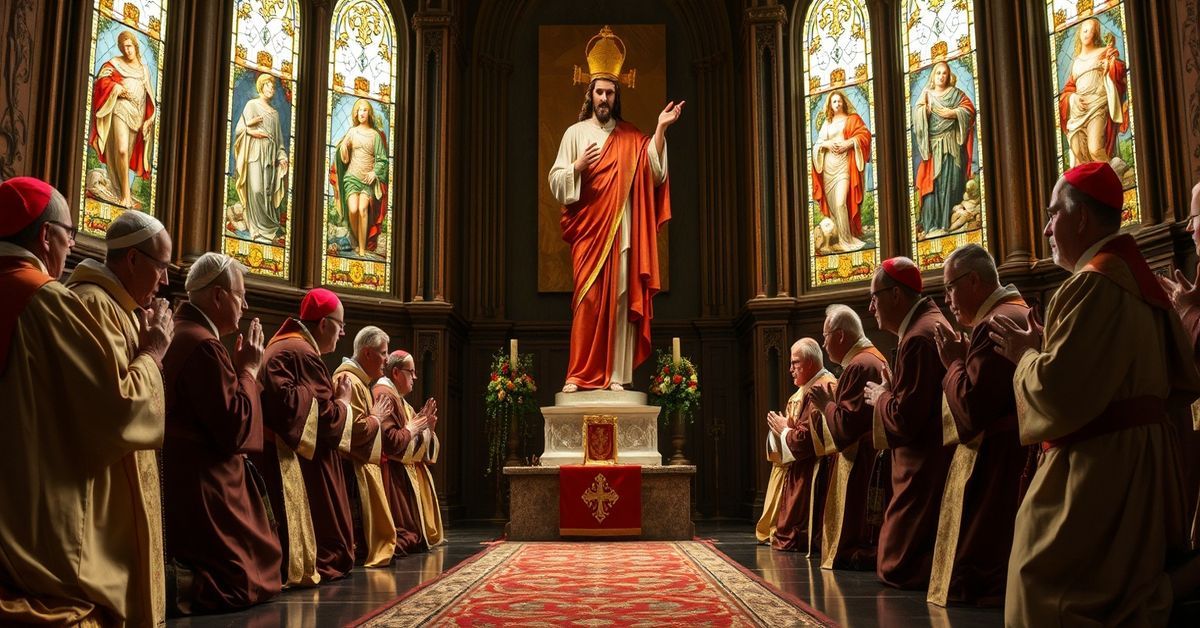
European Bishops’ Inadequate Abortion Opposition Reveals Modernist Foundations
The Commission of the Bishops’ Conferences of the European Union (COMECE), a post-conciliar body, issued a statement on March 4, 2026, expressing satisfaction that the European Commission rejected the “My Voice, My Choice” initiative to fund abortions with EU money. The statement affirms that abortion “is gravely contrary to the moral law” and that women “should never feel compelled to abort due to social or economic pressure,” urging instead “effective social, economic, and health care assistance.” However, this position, while superficially correct on the intrinsic evil of abortion, is fundamentally compromised by its modernist foundations, its naturalistic reduction of the problem, and its complete omission of the necessary public reign of Christ the King over all nations, as demanded by the unchanging Catholic faith before the conciliar apostasy.
Modernist Origin, Compromised Authority
The statement emanates from COMECE, an organization born of the post-Vatican II ecclesiological revolution that subordinates the Church to the secular order. The very premise that a body of “bishops” must negotiate with a secular political union like the EU, appealing to principles of “subsidiarity” and “EU competences,” betrays the syllabus errorum condemned by Pope Pius IX. The Syllabus explicitly rejects the idea that “the Church ought to be separated from the State, and the State from the Church” (Error 55) and that “the civil authority may interfere in matters relating to religion, morality and spiritual government” (Error 44). By engaging the EU on its own naturalistic, legalistic terms, these “bishops” accept the modernist premise that the State is the primary arbiter of social order, to which the Church may only offer a subordinate, “assistive” voice. This is a direct repudiation of the teaching of Pope Pius XI in Quas Primas, which insists that “the state must leave the same freedom to the members of Orders and Congregations” and that rulers have a duty to “publicly honor Christ and obey Him,” ordering all state relations on the basis of God’s commandments (¶31). Their statement is not a defense of the Social Reign of Christ, but a plea for a more “compassionate” secularism.
The Omission of the Supernatural: A Fatal Silence
The critique must focus on what is silently omitted, for this silence is the loudest testimony to apostasy. The pre-conciliar Magisterium always presented the fight against abortion within the context of:
1. The Divine Law and the eternal punishment due to the crime (Exodus 20:13; Council of Trent, Sess. V, can. 2 on mortal sin).
2. The Social Kingship of Christ, which demands that human laws conform to the Law of God and that the State has a positive duty to protect the innocent and punish the guilty (Pius XI, Quas Primas, ¶¶24-26, 31).
3. The Salvation of Souls, the primary end of the Church, which requires the preaching of the truth about mortal sin, the necessity of sacramental confession for forgiveness, and the eternal consequences of unrepented murder.
The COMECE statement contains not one word of the supernatural. There is no mention of:
* The soul of the unborn child.
* The mortal sin of procured abortion and the excommunication latae sententiae attached to it (Canon 1398 of the 1917 Code).
* The duty of Catholic rulers to punish abortionists as criminals against the common good (Pius IX, Quanta Cura/Syllabus, Error 67).
* The Last Judgment, where every secret thought will be revealed (Matthew 12:36).
* The Sacrifice of the Mass as the supreme reparation for the crime of “shedding innocent blood” (Isaiah 1:15-16).
Instead, the problem is reduced to “social or economic pressure” and the solution to “effective social, economic, and health care assistance.” This is pure Pelagian naturalism, the heresy that man can save himself by his own efforts, stripped of grace. It treats abortion as a tragic but ultimately sociological phenomenon, not as a criminal outrage against God that cries to heaven for vengeance. This is the logical fruit of the conciliar document Gaudium et Spes, which speaks of “the joys and hopes, the griefs and anxieties” of the modern world, but systematically avoids defining sin, calling sinners to repentance, or asserting the juridical authority of Christ the King over temporal legislation.
Contrast with Pre-Conciliar Papal Teaching
Pius XI, in Quas Primas, establishes the only viable Catholic framework: “The kingdom of our Redeemer encompasses all men… His reign extends not only to Catholic nations… but His reign encompasses also all non-Christians” (¶28). He continues, “Let rulers of states therefore not refuse public veneration and obedience to the reigning Christ, but let them fulfill this duty themselves and with their people, if they wish to maintain their authority inviolate and contribute to the increase of their homeland’s happiness” (¶31). The COMECE statement does not call EU rulers to “public veneration and obedience” to Christ the King. It does not demand that EU law conform to the Law of God. It merely argues for a different allocation of EU funds within the existing secularist paradigm. This is a betrayal of the immutable doctrine that “the State has not the right to enact laws which are contrary to the divine law, nor to tolerate such laws if they are already in force” (Pius IX, Quanta Cura, Error 54).
Furthermore, the bishops’ emphasis on “support for families” and “social inclusion” echoes the naturalistic, Masonic-inspired “social doctrine” of the post-conciliar period, which seeks to build a “more just” world without first rebuilding the City of God. Pope Pius X, in Pascendi Dominici Gregis, condemned the Modernist who “regards the Church as a human institution which can be perfected by human means” (¶34). The COMECE statement operates entirely within this humanistic framework, where the Church is a “stakeholder” in EU social policy, not the sole Ark of Salvation with the right and duty to govern all aspects of life according to the mind of Christ.
The “Assistance” Model vs. the “Justice” Model
The pre-1958 Church taught that the primary duty of the State regarding abortion is justice, not “assistance.” The State must execute the penalty of the law against the abortionist and protect the innocent by force if necessary. “Assistance” is a secondary, charitable duty of individuals and the Church, not the primary function of the State. By making “effective social, economic, and health care assistance” the central demand, the bishops:
1. Accept the secularist premise that the State’s role is distributive welfare, not retributive justice.
2. Implicitly deny the State’s duty to punish grave crimes against the natural law.
3. Reduce the Church’s prophetic voice to that of a social worker’s lobby, begging for “programs” instead of commanding kings to bend the knee to Christ.
This is the essence of the “abortion debate” in the conciliar sect: a technical discussion about “women’s health” and “economic supports,” with the ontological status of the unborn child and the divine prohibition against murder relegated to a vague, unenforceable “moral opposition.” Pius IX’s Syllabus condemns the error that “it is lawful to refuse obedience to legitimate princes, and even to rebel against them” (Error 63) and that “the violation of any solemn oath… is not only not blamable but is altogether lawful and worthy of the highest praise when done through love of country” (Error 64). The modern State, by funding or permitting abortion, commits precisely such a violation of the divine law. The duty of a Catholic ruler is to resist this with all legitimate authority, not to negotiate “funding mechanisms” within a system that has already apostatized from Christ.
Conclusion: A Call to Integral Catholicism
The COMECE statement is a classic example of Modernist compromise: it uses traditional-sounding language (“gravely contrary to the moral law”) to cloak a fundamentally naturalistic and subservient approach to a grave moral evil. It is an opus alienum (alien work) that, by its omissions and its acceptance of the secularist framework, actively perpetuates the crime it pretends to oppose. It offers the “assistance” of the concupiscence of the flesh (Galatians 5:16-21) while remaining silent on the justice of God (Romans 1:18).
The integral Catholic faith, as taught before the death of Pope Pius XII, demands:
1. The public confession that Jesus Christ is King of kings and Lord of lords, and that His law is supreme over every parliament (Pius XI, Quas Primas).
2. The doctrine that the State has a grave obligation to punish abortion as a crime against the common good, deriving its authority from God, not the people (Pius IX, Quanta Cura).
3. The preaching of the terrors of hell and the necessity of sacramental confession for those who have committed or procured an abortion.
4. The absolute refusal to collaborate with “initiatives” that treat the murder of the innocent as a matter of “healthcare access” or “women’s choice.”
The “bishops” of COMECE, as members of the conciliar sect, are guilty of austerae legis neglectum (neglect of the strict law) and of leading souls astray by a false, naturalistic “pro-life” stance that is, in practice, a capitulation to the culture of death. Their statement is not a victory, but a symptom of the profound apostasy: they fight a symptom (funding) while denying the cause (the rejection of Christ’s Kingship) and the cure (the Sacraments, penance, and the public profession of the Extra Ecclesiam Nulla Salus dogma). The only true response is the total rejection of the conciliar anti-church and its pseudo-bishops, and a return to the immutable Tradition of the pre-1958 Roman Catholic Church, which alone possesses the authority, the doctrine, and the grace to combat the modern world’s “sins that cry to heaven for vengeance.”
Source:
European bishops: Women ‘should never feel compelled to abort’ (ewtnnews.com)
Date: 05.03.2026