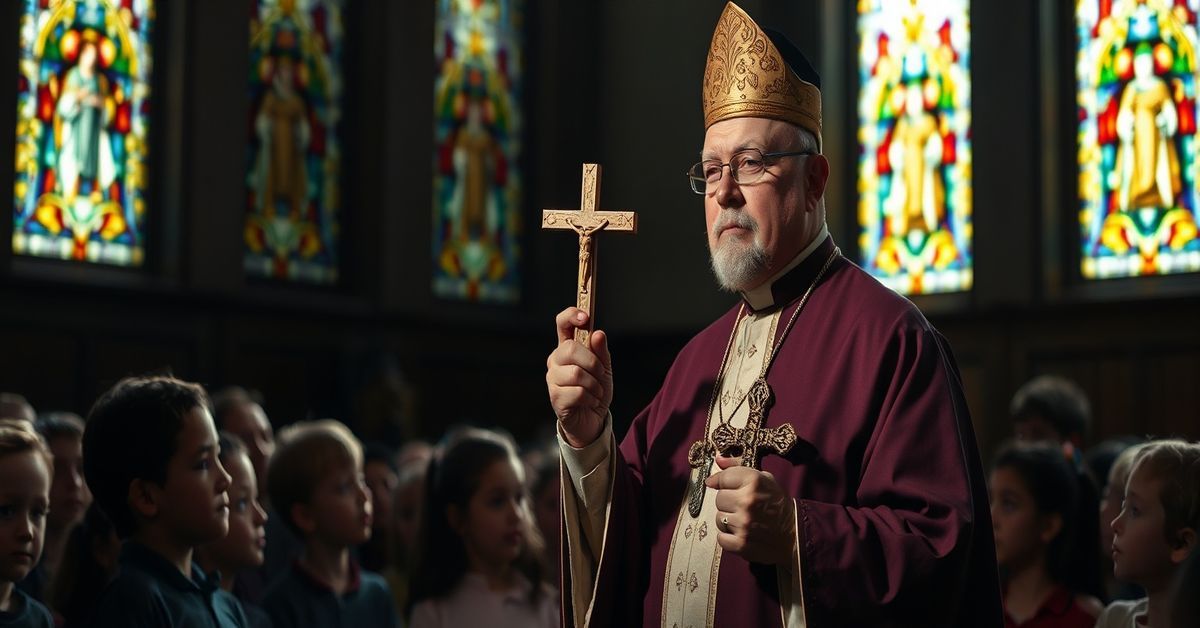
EU’s Digital Heresy: Children as Data, Not Souls
The Brussels-based EWTN News reports on European Union regulatory efforts to restrict minors’ access to social media platforms like TikTok and Snapchat, citing concerns over compulsive use and mental health. Polish officials propose banning accounts for users under 15, joining Italy, Germany, Spain, France, and Australia in implementing age-based limits. The European Commission is investigating TikTok for potential breaches of the Digital Services Act (DSA) due to design features like infinite scroll and personalized algorithms. Catholic experts, including Alessandro Calcagno of COMECE and Prof. Annemie Dillen of KU Leuven, frame the issue in terms of protecting children’s emotional development and fostering “authentic human connection,” warning against “social hermit” tendencies. The article notes debates over age verification efficacy and EU regulatory fragmentation under the “country-of-origin rule,” quoting civil society groups that stress regulating platform design over restricting access.
The cited article, emanating from the conciliar sect’s communication network, presents a superficial analysis that fundamentally rejects the supernatural end of man. While feigning concern for children, it systematically omits the only true foundation for education and formation: the reign of Our Lord Jesus Christ. The experts quoted operate entirely within the naturalistic, psychological paradigm of Modernism, reducing the crisis to one of “emotional and relational life” and “meaningful relationships.” This is a deliberate evasion of the primary duty of any Catholic authority: to form children for eternity, to instill the fear of God, and to equip them for the combat against the world, the flesh, and the devil. The entire discourse is a symptom of the apostasy described by St. Pius X in *Pascendi Dominici gregis* and the *Syllabus of Errors*, where the Church’s mission is supplanted by a secular concern for “well-being” and “progress.” The question posed in the title—”What are we protecting them for?”—is answered not with the salvation of souls, but with a vague, immanentist goal of becoming “free, responsible” beings within a technocratic framework. This is the heresy of Modernism in action: the evolution of doctrine and the adaptation of the Church’s mission to the “needs of the times,” precisely condemned.
The Naturalistic Heresy of “Protection”
The article’s core error is its complete confinement to the natural order. Calcagno speaks of “weakening the skills needed for a healthy emotional and relational life.” Dillen calls for helping young people “grow in freedom, responsibility, and authentic human connection.” The COMECE Youth Net warns of becoming “social hermits.” These are the goals of a philosophical society, not the Catholic Church. The *Syllabus of Errors* (1864) condemns this mindset exhaustively. Error #58 states: “All the rectitude and excellence of morality ought to be placed in the accumulation and increase of riches by every possible means, and the gratification of pleasure.” The modern variant replaces “riches” with “engagement metrics” and “pleasure” with “digital validation,” but the principle is identical: a morality measured by temporal, psychological well-being, devoid of reference to God’s law and the supernatural end.
Pius XI’s encyclical *Quas Primas* (1925), on the feast of Christ the King, provides the true Catholic framework: “When God and Jesus Christ… were removed from laws and states… the foundations of that authority were destroyed, because the main reason why some have the right to command and others have the duty to obey was removed.” The article and the experts it quotes operate as if Christ’s kingship over the intellect, will, and heart of every child is irrelevant. They discuss “platform design” and “systemic risks” while remaining silent on the greatest danger: the loss of the soul through mortal sin, the neglect of the sacraments, and the rejection of grace. This silence is not neutrality; it is a positive denial of the supernatural order, the hallmark of the conciliar revolution’s “hermeneutics of continuity” fraud. The pre-1958 Church would have asked: “Are children being formed in the detestation of sin, the love of virtue, the knowledge of the catechism, and the frequent reception of the sacraments?” The neo-church asks: “Are their neural pathways being healthily stimulated?”
The Omission of Sin, Grace, and the Sacraments
The gravest accusation against the article and the “Catholic” thinkers it features is their total omission of the supernatural means of sanctification. There is not a single mention of:
* The state of grace and the necessity of avoiding mortal sin.
* The sacrament of Baptism as the gateway to salvation.
* The sacrament of Confession for the remission of sins and spiritual health.
* The Holy Eucharist as the source and summit of the Christian life, the antidote to sin and the food for eternity.
* The necessity of forming the conscience according to the unchangeable moral law of God, not according to the fluid “ethical perspectives” of the age.
* The reality of the final judgment and the eternal consequences of one’s actions.
This omission is not accidental; it is doctrinal. It flows directly from the Modernist principle condemned by St. Pius X in *Lamentabili sane exitu* (1907), Proposition #26: “The dogmas of faith should be understood according to their practical function, i.e., as binding in action, rather than as principles of belief.” The “Catholic” experts here treat the faith as a mere set of “practical functions” for social harmony and mental health, stripping it of its ontological reality as revealed truth binding on the intellect. They practice the “immanentist” philosophy Pius X identified as the soul of Modernism, which “regards and rejects as foreign to the mind of the Church… the supernatural.”
Furthermore, the focus on “platform design” and “algorithmic compulsion” shifts the blame for sin and vice from the human will to external mechanisms. Catholic doctrine, defined at the Council of Trent (Session VI, Chapter 15), teaches that sin is a voluntary, personal offense against God. The article’s framework, by emphasizing “compulsive use” and “design features,” implicitly denies free will and personal responsibility, reducing man to a biological-psychological automaton. This is a return to the pantheistic and naturalistic errors condemned in the *Syllabus* (Propositions #1-4), where human action is determined by material forces, not by a free will called to obey God’s law.
The Heresy of “Authentic Human Connection” vs. The Catholic Concept of Charity
Dillen’s stated goal of “authentic human connection” is a Trojan horse for religious indifferentism and the destruction of Catholic social order. The Catholic concept of charity (*caritas*) is ordered to the ultimate end: the love of God above all things, and the love of neighbor *for the love of God*. It is supernatural, infused by grace, and directed toward the salvation of the other’s soul. “Authentic human connection,” in the post-conciliar lexicon, is a natural, immanentist bond based on mutual affirmation, emotional resonance, and shared experience. It has no necessary reference to God, to truth, or to the moral law. It is the very “humanitarianism” and “cult of man” condemned by Pius XI in *Quas Primas* and Pius IX in the *Syllabus* (Error #40: “The teaching of the Catholic Church is hostile to the well-being and interests of society”).
This “connection” is the foundation of the neo-church’s ecumenical and interreligious projects, where all “meaningful relationships” are deemed equally valid regardless of the truth professed. It directly contradicts the Catholic doctrine of the *extra Ecclesiam nulla salus* (outside the Church there is no salvation), and the Church’s exclusive right to teach, govern, and sanctify. The article’s experts, by elevating this vague “connection” as the supreme good, are preaching the error of the *Syllabus*, Proposition #16: “Man may, in the observance of any religion whatever, find the way of eternal salvation, and arrive at eternal salvation.” They are building a “kingdom of man” while paying lip service to a “Christian perspective.”
The Political Heresy: Subordination of the Church to the State and “Rights”
The entire article is predicated on a framework of “children’s rights,” “human rights,” and state/regulatory (“EU”) action. This is the precise inversion of Catholic social order. The *Syllabus* (Errors Concerning Civil Society) systematically demolishes this:
* Error #39: “The State, as being the origin and source of all rights, is endowed with a certain right not circumscribed by any limits.”
* Error #41: “The civil government… has a right to an indirect negative power over religious affairs.”
* Error #55: “The Church ought to be separated from the State, and the State from the Church.”
The experts appeal to the EU and national governments to act, implicitly accepting the state’s sovereignty over the education and formation of children—a sovereignty that belongs solely to the family and the Church. Pius XI in *Quas Primas* declared: “The state must leave the same freedom to the members of Orders and Congregations… The annual celebration of this solemnity will also remind states that not only private individuals, but also rulers and governments have the duty to publicly honor Christ and obey Him.” The modern Catholic “expert” has inverted this: the state must regulate the digital environment, and the Church’s role is to offer “ethical perspectives” to the regulators, not to command the state to recognize Christ’s kingship. This is the heresy of the “two powers” where the spiritual is subordinated to the temporal, condemned by the *Syllabus* and the encyclical *Immortale Dei* of Leo XIII.
The Conciliar Roots of the Error: From “Signs of the Times” to Digital Age
The language used—”shaping the development of children,” “capacity for meaningful relationships,” “structural responsibility of companies”—is pure conciliar and post-conciliar jargon. It echoes Gaudium et Spes’s focus on “reading the signs of the times” and adapting the Church’s message to modern man. It is the practical outworking of the “evolution of dogma” and “development of doctrine” heresies condemned by St. Pius X. The “Catholic” thinkers here are applying the principles of *Rerum Novarum* and *Gaudium et Spes* to the digital sphere, treating the internet as a new “social question” to be addressed by Catholic social teaching updated for the 21st century.
But this is a fraud. The unchanging Catholic faith does not “adapt” its moral teachings to new technologies; it judges them by the eternal law. The proper Catholic response to social media is not to ask how to make it “healthier” for children, but to denounce it as a primary tool of the world, the flesh, and the devil for the corruption of intellect and will. It should call for its total rejection by Catholic families, the promotion of the contemplative life, and the restoration of Christ’s kingship over the entire digital sphere—which means its subordination to the moral law and its use solely for the glory of God and the salvation of souls. The article’s premise—that children’s engagement with these platforms is a given, and the question is merely one of “protection”—is a surrender to the world. It is the “immanentist” and “philanthropic” religion Pius X condemned, where the Church becomes a “humanitarian agency” instead of the pillar and ground of truth (1 Tim. 3:15).
Conclusion: The Apostasy of the “Conciliar Sect” in Brussels
The EWTN News article is a perfect microcosm of the post-conciliar apostasy. It takes a pressing issue—the digital enslavement of youth—and addresses it with the tools of secular psychology, regulatory policy, and naturalistic ethics. The “Catholic” voices it amplifies are those of the conciliar sect’s “experts,” who have exchanged the supernatural wisdom of the Church for the foolishness of the world (1 Cor. 1:20). They ask, “What are we protecting them for?” and answer with the goals of a well-adjusted, connected, and productive citizen of the globalist order. The true Catholic answer, from the unchanging faith, is: “We are protecting them for God. We are forming them for heaven. We are arming them against the devil. We are teaching them to love Jesus Christ above all things, to hate sin, to frequent the sacraments, and to work zealously for the restoration of all things in Christ—*Restaurare omnia in Christo*—as Pope Pius XI declared.”
The silence on these supernatural realities is a damning indictment. It proves that the COMECE, KU Leuven, and the “Catholic” experts cited are not defenders of the faith but agents of the “abomination of desolation” standing in the holy place (Matt. 24:15). They speak the language of the beast, not the language of the Church. The EU’s regulatory debates, while perhaps achieving some temporal good, are ultimately meaningless if they do not serve the ultimate end: “The fear of the Lord is the beginning of wisdom” (Prov. 9:10). Without that foundation, all “protection” is a futile exercise in rearranging deck chairs on the Titanic, while souls—the only immortal thing in the article’s universe—are lost forever.
The article’s failure is total. It is a document of the “neo-church,” a sect that has abandoned the mission Christ gave to His Church: “Going, therefore, teach ye all nations… teaching them to observe all things whatsoever I have commanded you” (Matt. 28:19-20). What is commanded? Not “emotional health” or “authentic connection,” but the entire moral and supernatural law, the sacraments, and the profession of the Catholic faith as the sole path to salvation. Until this is proclaimed by valid bishops and priests—those in communion with the pre-1958 faith—all such “Catholic” commentary is but the sounding brass and tinkling cymbal of a apostate generation.
Source:
As EU acts on children and social media, experts ask: What are we protecting them for? (ewtnnews.com)
Date: 11.03.2026