Conciliar ‘Education’ Reduces Faith to Social Media Ethics
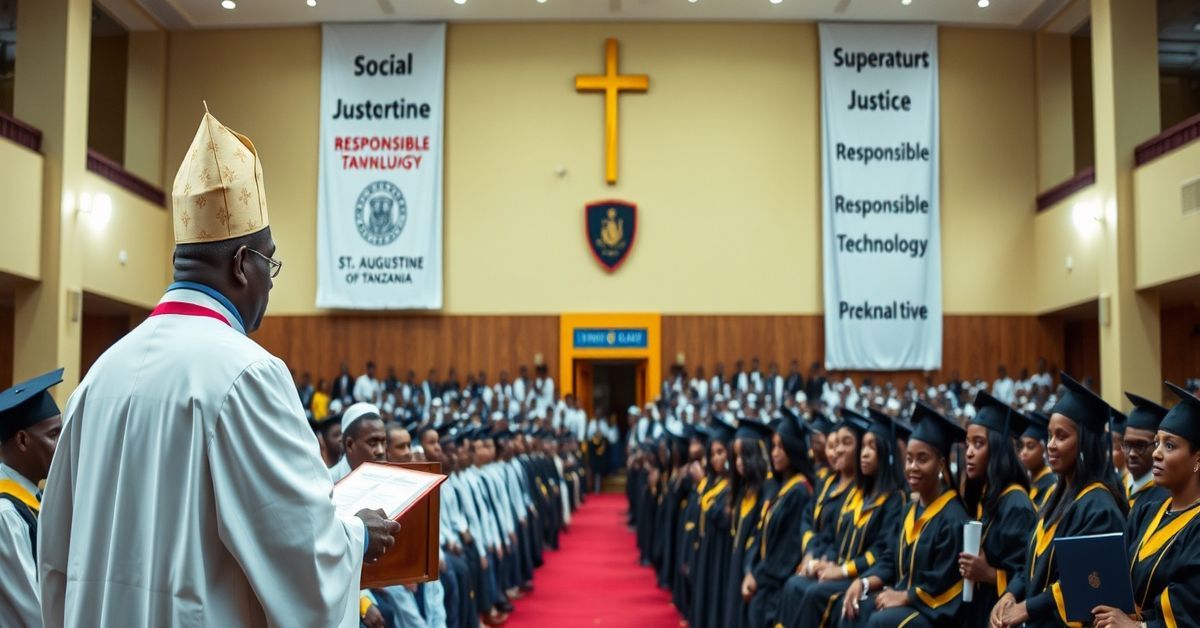
Vatican News reports on a graduation ceremony at St. Augustine University of Tanzania (SAUT), where “Bishop” Simon Masondole of Bunda Diocese, speaking as Guest of Honour, urged graduates to use social media responsibly, cautioning against misinformation, hatred, and the risks of artificial intelligence. The “bishop” framed the university’s mission—owned by the Tanzania Episcopal Conference—as complementing efforts to address poverty and social justice “in accordance with the Gospel values,” positioning the local “Church” as a key state partner in development. This article exemplifies the post-conciliar sect’s systematic replacement of supernatural Catholic doctrine with naturalistic humanism, reducing the Church’s mission to worldly social engineering while remaining utterly silent on the non-negotiable reign of Christ the King over all aspects of life.
Factual Deconstruction: The Naturalistic Framework
The article presents a graduation address that confines its moral exhortations to the temporal order. “Bishop” Masondole’s advice focuses on “pros and cons of new technologies,” “vigilance about its risks,” and “responsible” engagement with platforms. He reduces artificial intelligence to a mere “tool,” warning against over-reliance but never invoking the imago Dei or the moral obligation to subordinate all technology to the law of God. The university’s stated mission—to “address poverty and social justice issues in accordance with the Gospel values”—is a classic modernist equivocation, using “Gospel” to baptize secular socio-economic agendas while emptying the term of its supernatural content: redemption from sin, the necessity of sanctifying grace, and the ultimate end of eternal life. The “bishop” and the Vice-Chancellor speak entirely in the language of “academic excellence,” “partnerships,” “development,” and “peacebuilding”—the vocabulary of the United Nations, not of the Catholic Church. The supernatural is conspicuously absent: no mention of the Holy Sacrifice of the Mass, the Sacraments as necessary means of salvation, the reality of mortal sin, the danger of damnation, or the obligation to seek the conversion of souls. This is not an oversight but a systematic omission, symptomatic of a religion of man, not of God.
Linguistic Analysis: The Tone of Apostasy
The language employed is cautious, bureaucratic, and managerial. Phrases like “responsibly harnessing technology’s benefits,” “safeguarding the quality of education,” “ethical judgment,” and “key state partner in development” mirror the discourse of NGOs and corporate social responsibility programs. There is no prophetic urgency, no call to repentance, no reference to divine law or the judgment to come. The “bishop” uses the first-person plural (“we all agree”) to create a false consensus around a naturalistic worldview. The tone is that of a motivational speaker or a development consultant, not a successor of the Apostles. This linguistic shift is not innocent; it is the very “hermeneutics of continuity” condemned by St. Pius X in Lamentabili sane exitu (Proposition 58: “Truth changes with man, because it develops with him, in him, and through him”). The article’s prose reflects the “evolution of dogmas” and the “democratization of the Church” that constitute the core of Modernism.
Theological Confrontation: Christ’s Kingship vs. Naturalistic Humanism
The article’s fundamental error is its complete omission of the social reign of Christ the King, a doctrine defined by Pope Pius XI in Quas Primas (1925). Pius XI taught that Christ’s kingdom “encompasses all men” and that “not only private individuals, but also rulers and governments have the duty to publicly honor Christ and obey Him.” The “bishop” of Bunda, however, speaks only of “responsible social media use” and “social justice,” never demanding that social media platforms, artificial intelligence, or national development policies be subjected to the lex Christi. He does not call for the consecration of Tanzania to the Sacred Heart, nor does he remind civil authorities that their laws must conform to the Ten Commandments. This is a direct repudiation of Quas Primas, which states: “The state must leave the same freedom to the members of Orders and Congregations… [and] the annual celebration of this solemnity will also remind states that… all relations in the state be ordered on the basis of God’s commandments and Christian principles.” The conciliar “bishop” has reduced the Kingship of Christ to a vague “Gospel value” that can be harmonized with any secular ideology.
The article also violates the doctrine of the Syllabus of Errors (Pius IX, 1864). Error #40: “The teaching of the Catholic Church is hostile to the well-being and interests of society.” By presenting “Gospel values” as compatible with and even productive of “development and peacebuilding,” the article implicitly accepts the modernist error that the Church’s mission is primarily temporal. Pius IX condemned this: the Church’s mission is the salvation of souls, not the eradication of poverty (though charity is a consequence). The article’s emphasis on “addressing poverty” as the university’s primary mission aligns with Error #55: “The Church ought to be separated from the State, and the State from the Church.” Here, the “bishops’ conference” is a “key state partner,” a fusion of ecclesiastical and secular power that the Syllabus condemns as a dangerous confusion of orders. The “bishop” never reminds the state of its duty to recognize the Catholic religion as the sole religion of the state (Syllabus Error #77), nor does he defend the Church’s right to independence from state control (Syllabus Errors #19-24). Instead, he collaborates in a project of naturalistic “development,” which is precisely the secularism Pius XI lamented in Quas Primas: “When God and Jesus Christ… were removed from laws and states… the foundations of that authority were destroyed.”
Symptomatic Analysis: The Fruit of the Conciliar Revolution
This article is a perfect specimen of the post-conciliar apostasy. The “bishop” and the university operate within the “conciliar sect,” which has replaced the salus animarum with the “preferential option for the poor” and “integral human development.” The focus on “social media ethics” and “AI as a tool” is a descent into the “cult of man” condemned by Pius XI. The complete silence on the sacraments, the state of grace, the danger of eternal damnation, and the necessity of membership in the true Church (outside of which there is no salvation) is the gravest possible accusation. As St. Pius X taught in Lamentabili, the Modernist “aims at such a development of dogmas as appears to be their corruption” (Introduction). Here, “Gospel values” are corrupted into a program of social work. The article’s subtext is that the Church’s relevance lies in its contribution to worldly “development,” not in its divine commission to teach, sanctify, and govern for the life to come. This is the “abomination of desolation” standing in the holy place: a “Catholic” institution that speaks the language of the world while betraying the faith once delivered to the saints.
Exposure of the Modernist Mentality
The “bishop” assumes a naturalistic epistemology: “AI is not a human being; it cannot think or make decisions independently.” This is a trivial observation that any secular ethicist could make. A true Catholic prelate would have added: “Therefore, man, created in the image of God, must use AI in conformity with the eternal law and the teachings of the Church, which alone can guide conscience.” But he does not, because the conciliar “Church” has embraced religious liberty (Syllabus Errors #15-18) and thus abandoned the duty to impose the law of Christ on society. The “bishop” warns against “spreading misinformation, hatred, manipulation, and humiliation,” but he does not define these terms according to Catholic moral theology. “Hatred” in Catholic doctrine is a sin against charity; but in the modern usage, it often means “disagreement with progressive ideologies.” The “bishop” thus implicitly endorses the secular definition of “hate speech,” which is used to persecute Catholics who proclaim the Gospel’s moral teachings on homosexuality, abortion, and religious exclusivity. His call for “research on the emergence and growth of social media use” is a demand for more sociological studies, not for a Thomistic analysis of the sin of scandal or the virtue of prudence in communication. This is the “synthesis of all errors”: the replacement of supernatural theology with the natural sciences and social sciences.
The university’s partnership with “local and international universities” through “academic exchange programmes” is another symptom. In the pre-1958 Church, Catholic universities maintained strict doctrinal boundaries and avoided “exchange” with institutions that teach errors. Today, SAUT likely partners with secular and even “Catholic” institutions that are hotbeds of Modernism, thereby contaminating the faith of its students. The “Vice Chancellor” boasts of this “culture” of exchange, betraying the Catholic principle of ne quid detrimenti capiat Ecclesia (let the Church suffer no detriment). The “bishop” and the “Vice Chancellor” are not defenders of the Faith; they are functionaries of the “paramasonic structure” that occupies the Vatican, promoting a “broad and liberal Protestantism” (Lamentabili, Proposition 65) under a Catholic veneer.
Conclusion: A Call to Reject the Conciliar Sect
The article from Vatican News is a stark revelation of the theological and spiritual bankruptcy of the post-conciliar “Church.” It presents a “Catholic” university whose graduates are called not to convert souls, defend the Faith, or establish the social reign of Christ, but to be “responsible” users of technology and partners in secular “development.” This is the logical outcome of the “errors” condemned by Pius IX and Pius X. The “bishop” of Bunda, the Tanzania Episcopal Conference, and the entire conciliar hierarchy are, according to the doctrine of St. Robert Bellarmine (as cited in the provided file on Sedevacantism), manifest heretics who have “ceased to be Pope and head” and “are deprived ipso facto of their personal jurisdiction.” They preach a “Gospel” without the Cross, a “faith” without dogma, and a “Church” without the Kingship of Christ. The faithful must flee this “neo-church” and seek refuge in the true Catholic Faith, preserved by those bishops and priests who have never accepted the heresies of Vatican II. As Pius XI declared in Quas Primas: “Then at last… so many wounds can be healed, then there will be hope that the law will regain its former authority, sweet peace will return again, swords and weapons will fall from hands, when all willingly accept the reign of Christ and obey Him.” The conciliar “bishops” and their universities are actively preventing this return. They must be rejected with the same firmness with which Pius IX rejected the “errors” of his day, for they are the same errors, now enthroned in the sanctuary.
Source:
St. Augustine University of Tanzania graduates called to lead in responsible social media use (vaticannews.va)
Date: 12.03.2026