Synodality: African Bishops Promote Apostate Horizontalism
The Conciliar Sect’s “Synodal” Poison Infiltrates Africa
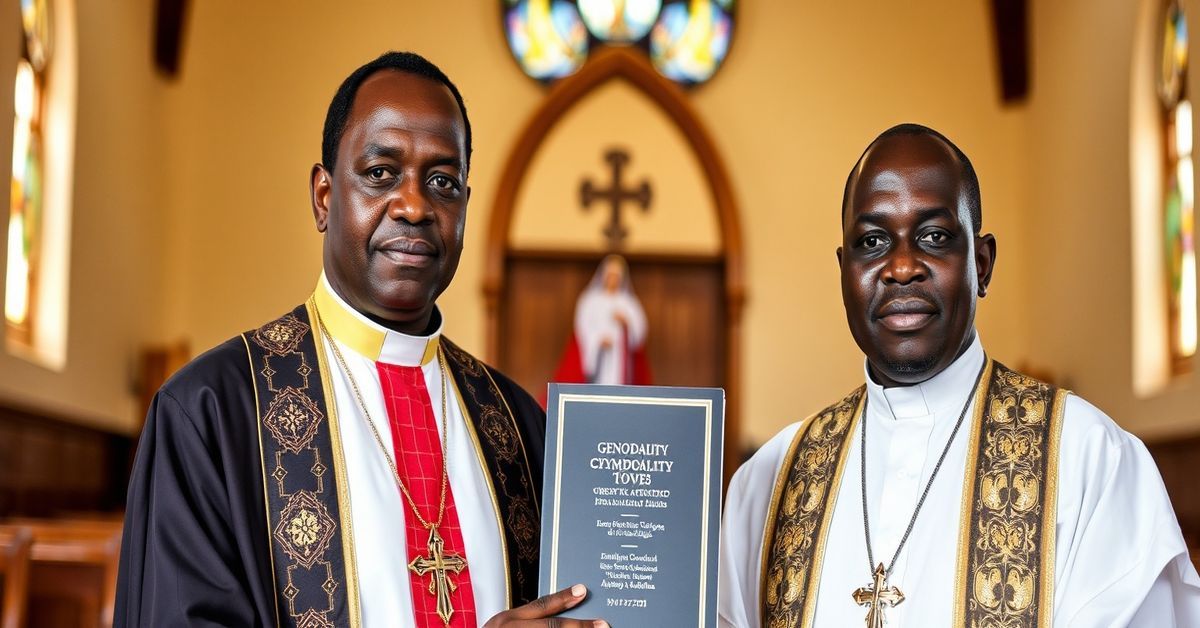
The cited article from VaticanNews (March 15, 2026) reports on the launch of a synodality formation manual by the Association of Member Episcopal Conferences in Eastern Africa (AMECEA). Bishop Bernardin Francis Mfumbusa of Kondoa Diocese, Tanzania, whose address was delivered by Bishop Edwin Mwansa Mulandu of Mpika Diocese, Zambia, stated that the success of synodality implementation depends entirely on the bishops. The manual, developed through a “collaborative” process involving clergy, religious, and laypeople, is presented as the tool for this transformation. Priests are identified as “the first point of encounter” for the synodal vision. The article frames this as a continuation of the “journey” mandated by the antipope “Leo XIV” and rooted in the “spirit” of Vatican II’s Optatam Totius and Presbyterorum Ordinis.
The thesis is clear: the conciliar sect is actively exporting its revolutionary, apostate principle of “synodality”—a disguised form of democratic naturalism—to the African continent, using local bishops as agents of the revolution and framing the destruction of hierarchical, monarchical Church governance as “formation.”
1. Factual Deconstruction: The Myth of “Collaborative Wisdom”
The article celebrates a manual written by a “collaborative” process involving “the People of God.” Bishop Mfumbusa states: “This was not a document written about the People of God; the People of God wrote it.” This is a direct repudiation of the hierarchical, teaching Church divinely instituted by Christ. The true Catholic Church has always taught that doctrine and pastoral practice are defined by the hierarchical authority—the Pope and bishops in communion with him—not by “consultative” assemblies of the laity and religious. The Syllabus of Errors of Pope Pius IX (1864) condemns the very notion that the Church’s authority is derived from or answerable to the people:
Error #15: Every man is free to embrace and profess that religion which, guided by the light of reason, he shall consider true.
Error #19: The Church is not a true and perfect society, entirely free… but it appertains to the civil power to define what are the rights of the Church…
Error #77: In the present day it is no longer expedient that the Catholic religion should be held as the only religion of the State…
The “collaborative” process described is the precise operationalization of these condemned errors: it reduces revealed truth and ecclesiastical governance to a human, democratic project. The “urgency” cited is the urgency of apostasy, not of faith.
2. Linguistic Analysis: The Vocabulary of Apostasy
The language is dripping with the naturalistic, psychological, and organizational jargon of the modern world, utterly alien to Catholic tradition:
- “Implementation phase,” “systematic formation,” “formation programmes,” “deploying it”: This is the lexicon of corporate management and NGO project rollout, not of supernatural evangelization. It treats the Faith as a program to be executed, not a truth to be believed and a grace to be received.
- “Synodal vision,” “synodal Church,” “synodal transformation”: These are neologisms designed to replace the immutable concept of the Una Sancta Catholica et Apostolica Ecclesia with a vague, evolving, horizontal “communion” defined by process.
- “First point of encounter”: This reduces the priesthood to a functional, customer-service role within a “synodal” structure, contradicting the Catholic doctrine of the priest as an alter Christus, a sacrificer and teacher with ontological character, not a mere facilitator.
- “Urgency,” “must continue,” “direct mandate”: The frantic, quasi-obligatory tone mimics the relentless pressure of modernist movements. It is the language of revolution, not of contemplative, tradition-preserving faith.
The silence on supernatural realities is deafening: no mention of sin, grace, the Sacraments (especially the Holy Sacrifice of the Mass), the state of souls, the Four Last Things, the absolute necessity of the Catholic Faith for salvation, or the Social Kingship of Christ. This is the hallmark of the “abomination of desolation” standing in the holy place: a religious structure that speaks only in human, sociological terms while emptying the supernatural content from the Faith.
3. Theological Confrontation: Synodality vs. Catholic Monarchy
The entire “synodal” paradigm is a systematic attack on the divinely instituted, monarchical, hierarchical constitution of the Catholic Church. This is not a matter of discipline but of faith.
a) The Nature of the Church: The Church is not a “synodal” communion evolving through “listening” sessions. It is the Mystical Body of Christ, a perfect society with a divinely appointed Head (Christ) and visible head on earth (the Roman Pontiff). Its governance is monarchical and hierarchical, as defined by the Council of Trent and countless papal documents. The Encyclical Quas Primas of Pope Pius XI (1925), on the Feast of Christ the King, explicitly links the rejection of Christ’s Kingship to the social and ecclesiastical chaos of the modern world. The conciliar sect’s synodality is the ecclesiastical embodiment of the secularism Pius XI lamented:
“When God and Jesus Christ… were removed from laws and states and when authority was derived not from God but from men, the foundations of that authority were destroyed…”
Synodality removes Christ as the sole, immediate, and sovereign Lawgiver and Teacher, replacing Him with a “listening” process where the “People of God” (a modernist term) co-determine doctrine and discipline. This is the logical conclusion of the errors condemned in the Syllabus (#20, #21, #23, #24).
b) The Role of Bishops: The article places the “keys to implementation” on the bishops. This is a subtle but deadly error. In Catholic doctrine, bishops are vicars and legates of Christ in their dioceses, not administrators of a “synodal” program. Their authority is ordinary, immediate, and comes from God, not from a “mandate” of a “synodal journey” or an “apostolic letter” of an antipope. They are to teach, sanctify, and rule in persona Christi, not to “implement” a bottom-up revolutionary model. The Lamentabili sane exitu of St. Pius X (1907) condemns the modernist proposition that:
Proposition 7: The Church listening cooperates in such a way with the Church teaching in defining truths of faith, that the Church teaching should only approve the common opinions of the Church listening.
This is precisely the “synodal” model: the “listening” Church (laity, religious, clergy) supposedly guides the “teaching” Church (hierarchy). This is heresy. The teaching Church defines; the listening Church submits. The bishops in the article are being recast from pastors into functionaries of this inverted structure.
c) The Priesthood: Calling priests the “first point of encounter between the faithful and the synodal vision” is a direct contradiction of their sacramental character and primary role as offerers of the Holy Sacrifice and ministers of the Sacraments. It reduces them to community animators for a “vision” that is human, not divine. This aligns with the modernist error condemned by St. Pius X:
Proposition 50: The elders fulfilling supervisory functions at Christian gatherings were appointed by the Apostles as priests or bishops to ensure order in the developing communities, but they did not, in the proper sense, continue the apostolical mission and authority.
The “synodal” priest is the “elder” of the community, not the ontological priest acting in persona Christi.
4. Symptomatic Analysis: The Cancer of Conciliarism
This article is not an anomaly; it is the logical fruit of the “conciliar revolution” (1958-). The entire “synodal” process, from the “listening” phases to the “implementation” manuals, is the practical outworking of the modernist heresies condemned by St. Pius X in Pascendi Dominici Gregis (1907) and Lamentabili. It embodies the “synthesis of all errors.”
The invocation of the antipope “Leo XIV” and his “apostolic letter” on the 60th anniversary of Vatican II’s Optatam Totius and Presbyterorum Ordinis is the ultimate seal of condemnation. Those Vatican II documents already introduced the seeds of collegiality, episcopal conferences, and the “people of God” language that have now blossomed into full-blown synodality. The article’s authors and the bishops it quotes are, whether knowingly or not, agents of the abomination of desolation—a pseudo-Catholic structure occupying the Vatican and its satellite episcopates, teaching the doctrines of Modernism under a Catholic veneer.
The “formation” being promoted is not Catholic formation. It is the indoctrination into a new, humanistic, horizontal religion. The “manual” is a tool for the systematic eradication of traditional Catholic faith, practice, and piety from the souls of the African faithful, replacing it with the empty shell of “dialogue,” “listening,” and “journeying together.” This is the final stage of the infiltration: using the very bishops who should be defending the Faith to become its executioners in the name of “renewal.”
5. The Unpardonable Omission: The Kingdom of Christ vs. The Kingdom of Man
The gravest sin of this article—and the entire synodal project—is its total silence on the Social Kingship of Christ as defined by Pope Pius XI in Quas Primas and Pope Leo XIII in Annum Sacrum. The article speaks of “synodal transformation” but never mentions that all human societies, including the Church, must be ordered to Christ the King. It never proclaims that outside the Catholic Church there is no salvation (Extra Ecclesiam Nulla Salus). It never calls for the public confession of Christ’s Kingship in laws and constitutions.
Instead, it promotes a “Church” that is a self-referential, self-updating human project. This is the ultimate triumph of the errors listed in the Syllabus: the separation of Church and State (#55), the relegation of religion to private opinion (#15, #16), and the subordination of divine law to human consensus. The “synodal” Church is the ecclesiastical mirror of the secular, liberal, apostate state.
Conclusion: A Call to Resistance and Separation
The African bishops launching this manual are not shepherds of the Catholic flock. They are functionaries of the conciliar sect, promoting a heresy that destroys the very nature of the Church. Their “formation” is de-formation. Their “implementation” is the implementation of apostasy.
The true Catholic, adhering to the integral Catholic faith as it existed before the death of Pope Pius XII in 1958, must have nothing to do with this “synodal” abomination. He must flee from these “bishops” and their “manuals.” He must cling to the unchanging Faith, the Traditional Latin Mass, the catechism of St. Pius X, and the true Magisterium of the pre-conciliar Popes. The only “formation” that matters is that which leads to the explicit, conscious rejection of Modernism and all its works, including this African synodal initiative, and to the fervent, traditional practice of the one, true, Catholic Faith, outside of which there is no salvation.
Source:
Bishops should lead the implementation of Synodality, says Bishop Mfumbusa (vaticannews.va)
Date: 15.03.2026