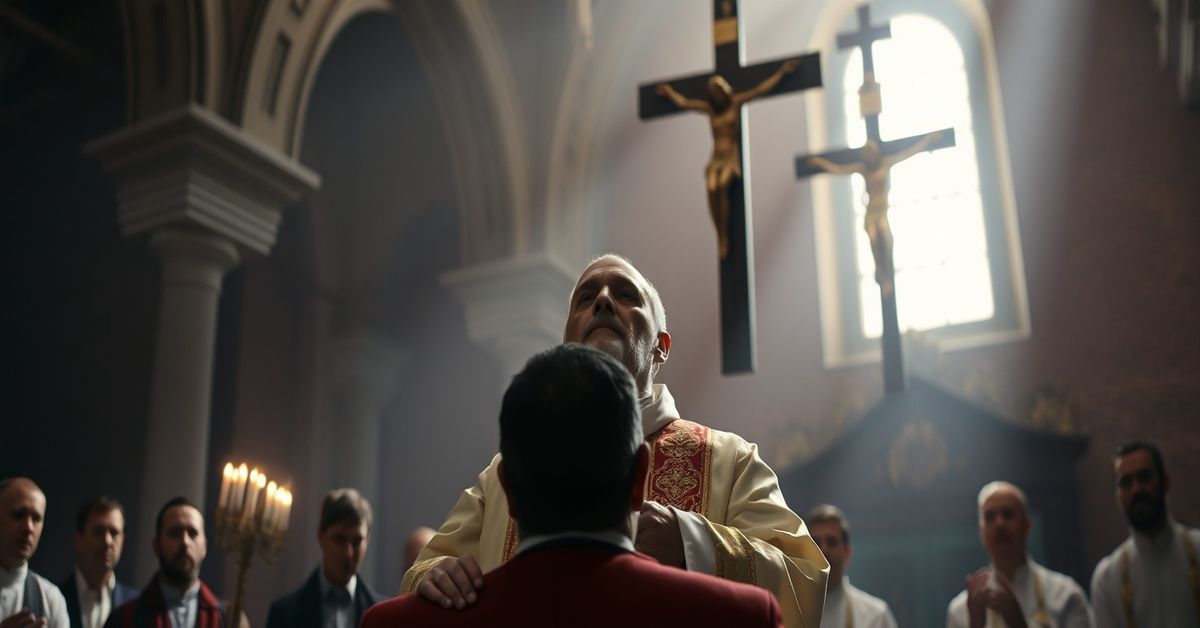
Exorcism Bureaucracy in the Conciliar Sect: The Fraud of “Trained Practitioners”
The Naturalistic Reduction of a Sacramental Power
The cited article from the National Catholic Register (March 24, 2026) reports that the International Association of Exorcists (AIE), meeting with the antipope known as “Leo XIV,” has requested that every diocese of the conciliar sect appoint “one or more” trained exorcists. This proposal, framed as a response to a rise in occult practices, is presented as a pastoral necessity. From the perspective of integral Catholic faith—the unchanging faith of the Church before the revolution of Vatican II—this entire scenario is a profound and dangerous illusion, a symptom of the apostasy that has consumed the structures occupying the Vatican.
The analysis must begin by identifying the fundamental, unspoken premise: the article assumes the legitimacy of the post-conciliar hierarchy and its “dioceses.” This is the first and greatest error. As St. Robert Bellarmine teaches, a manifest heretic loses all jurisdiction ipso facto. The men who have succeeded one another on the throne of Peter since Angelo Roncalli (“John XXIII”) have been, by their own repeated and public adherence to the errors of Modernism condemned by St. Pius X, manifest heretics. Therefore, they have no legitimate authority, and the dioceses they govern are not part of the Catholic Church. The very concept of a “diocese” in this context is a juridical fiction of the conciliar sect. Consequently, any “exorcist” appointed by such a “bishop” operates without the necessary sacramental authority and jurisdiction that flows from membership in the true Church. The ministry of exorcism is not a technical skill to be deployed by a certified professional within a bureaucratic structure; it is a sacred power conferred by the Church’s divine Founder, exercised in Her name and by Her authority. That authority is absent where the Faith itself is denied.
Omission of the Supernatural Foundation: Sin, Grace, and the Sacramental Life
The article’s language is revelatory. It speaks of “spiritual distress,” “extraordinary action of the devil,” “occult sects,” and “painful… situations.” This is the vocabulary of psychology and sociology, not of Catholic theology. The most glaring omission is the total silence on sin and the state of grace. The traditional Catholic explanation for diabolical oppression and obsession is, first and foremost, personal sin—especially the deliberate, habitual practice of the occult, which is a mortal sin crying out for divine vengeance. The remedy is not primarily the ritual of exorcism but the sacrament of Penance, restoring the soul to a state of grace and friendship with God. The article mentions no call to conversion, no emphasis on the Sacraments of Baptism and Confession as the primary defenses against the devil. This is a deliberate, modernist silencing of the supernatural order.
Pius XI, in his encyclical Quas Primas on the Kingship of Christ, states that the maladies of society flow from the rejection of Christ and His law: “this kind of outpouring of evil has afflicted the whole world because very many have removed Jesus Christ and His most holy law from their customs, from private, family, and public life.” The AIE report, by focusing solely on the “extraordinary action of the devil” as a proximate cause, omits the ultimate cause: the apostasy of nations and individuals from the Reign of Christ the King. It treats the demonic as a natural phenomenon to be managed, rather than a consequence of sin and a punishment permitted by God. This is pure naturalism, condemned by Pius IX in the Syllabus of Errors (Errors #1-7), which denies the necessity of divine revelation and reduces religion to human reason.
Furthermore, the article makes no distinction between ordinary and extraordinary diabolical influence. The ordinary influence of the devil is resisted by the sacramental life, frequent confession, devotion to the Blessed Virgin, and the practice of virtue. The extraordinary (obsession, oppression, possession) is, in traditional theology, rare and almost always linked to grave, explicit sin, particularly the practice of magic or occultism. The AIE’s framing of an “unprecedented” and “increasing” problem suggests a sensationalism that diverts attention from the ordinary means of sanctification and the catastrophic collapse of Catholic life. The “solution” proposed—more trained exorcists—is a bureaucratic fix for a spiritual crisis whose root cause is the loss of Faith itself.
The Modernist Hermeneutics of a “Ministry”
The call for “expanded formation at multiple levels of Church life” and “mandatory prior training for priests designated as exorcists, in line with the Church’s official ritual” is a textbook example of Modernist pragmatism. It reduces a sacred, supernatural power to a ministerial function requiring standardized training. This reflects the condemned proposition from St. Pius X’s decree Lamentabili sane exitu: “The view that the sacraments are merely symbolic actions which serve to remind man of the presence of the ever-benevolent Creator” (Proposition 41). While not explicitly denying the sacramental nature, the entire tone treats exorcism as a specialized pastoral technique, akin to counseling or crisis management.
The request for a “brief course in exorcism ministry for newly appointed bishops” is particularly poignant. In the Catholic Church, a bishop receives the fullness of the priesthood and the power to ordain and to confirm. His authority to oversee the ministry of exorcism is inherent in his office, provided he is a validly consecrated bishop in communion with the true Church. The need for a “course” implies that this power is not inherent but must be imparted by a higher authority—which, in the conciliar sect, is a body of men who lack jurisdiction themselves. This creates an infinite regress of illegitimacy. The entire structure is a hollow simulacrum, a “ministry” without the power that gives it meaning.
The article quotes Father Bamonte: “The future priest must be prepared to face the real pastoral situations he will encounter in his ministry, including the growing number of faithful who request the intervention of exorcists.” This statement, seemingly reasonable, is deeply flawed. It assumes that the “faithful” within the conciliar structures are actually Catholic and that their requests are necessarily legitimate. Catholic theology, however, demands rigorous discernment. Many cases presented as “demonic” are psychological or psychiatric in nature. The traditional rule, as taught by St. Thomas Aquinas and the ritual itself, is extreme caution. To train priests to respond to every request is to risk superstition, scandal, and the neglect of proper medical and psychological care. It also presumes a level of diabolical activity that may be exaggerated, feeding a culture of fear that distracts from the central call to repentance and holiness.
The Cult of the Personality and the “Amorth” Phenomenon
The article’s reference to “Father Gabriele Amorth” is not incidental. Amorth became a global celebrity for his exorcism ministry, publishing books and appearing in media. This is a classic feature of the post-conciliar church: the replacement of doctrine and sacramental grace with charismatic personalities and anecdotal experiences. The AIE was founded by Amorth in 1994, during the pontificate of the antipope John Paul II, a figure whose own theological and ecumenical errors are notorious. The cult of Amorth represents the “spiritual” aspect of the conciliar revolution: an emphasis on spectacular, extraordinary phenomena over the quiet, persevering practice of the Faith. This mirrors the errors condemned in the Syllabus regarding the “worship of the visible and the sensible” (cf. Errors on Christian Marriage #65-74, where the supernatural is reduced to the natural).
The article states that “Pope Leo XIV” told the AIE he had known and appreciated Amorth. This “appreciation” from an antipope is itself a condemnation. Amorth’s methods, his frequent public statements, and his association with the charismatic movement and other dubious phenomena place him outside the safe boundaries of traditional Catholic practice. His work, while perhaps well-intentioned, operated within a ecclesial framework that had already abandoned the strict discipline and supernatural outlook of the pre-Conciliar Church. To hold him up as a model is to endorse the very naturalism and sensationalism that Pius X condemned in Pascendi Dominici gregis (1907) against the Modernists, who “lose no opportunity of speaking against the Church, of ridiculing the Church’s discipline, of decrying the Church’s laws as antiquated and useless.” The “laws” here are the strict canonical and theological norms governing exorcism, which the conciliar sect has loosened into a “ministry” open to broader consultation and training.
The Missing Reign of Christ the King and the Political Order
Perhaps the most damning omission is any reference to the social reign of Christ the King, a doctrine solemnly defined by Pius XI in Quas Primas. The encyclical teaches that the evils of society—discord, selfishness, the shaking of society to its foundations—flow from the rejection of Christ’s kingship in public life. It explicitly states that rulers and governments have a duty to publicly honor Christ and obey Him. The AIE’s concern is with individual “cases” of occult oppression, but it says nothing about the occultism that is institutionalized in modern states: the secularism, the abortion laws, the promotion of gender ideology, the state sponsorship of pagan rituals. These are not private “occult sects” but public, legalized apostasy.
Pius XI wrote: “The state must leave the same freedom to the members of Orders and Congregations… [and] it is necessary that Christ reign in the mind of man… in the will… in the heart… in the body.” The conciliar sect, by its formal endorsement of religious liberty at Vatican II (Dignitatis Humanae), has anathematized this doctrine. It now preaches that all religions have a right to public expression, which is the precise opposite of the Social Kingship of Christ. Therefore, the very “dioceses” the AIE wants to serve are embedded in a conciliar structure that has formally renounced the public reign of Christ. How can an exorcist operating within such a structure effectively combat the demonic when the highest authorities of that structure are promoting the errors that invite the demonic? The AIE’s proposal is to put bandaids on a gangrenous limb while the head of the body—the papacy—is itself infected with the disease of Modernism.
The Symptom of Apostasy: A Church Without a Pope
The entire article is predicated on the existence of a legitimate “Pope Leo XIV” to whom a request can be made. This is the linchpin of the deception. The “papacy” since 1958 is occupied by a series of antipopes. The true Catholic Church, as Bellarmine explains, cannot have a heretic as its head. The “International Association of Exorcists” is therefore a body within a schismatic sect, petitioning a man who holds the office of the papacy without having the authority. This is the final, tragic irony: those who wish to combat the devil are appealing to a hierarchy whose very existence is a victory of the “synagogue of Satan” (Apoc. 2:9, 3:9), as Pius IX warned in the Syllabus.
The AIE’s document “Guidelines for the Ministry of Exorcism,” reviewed by “several Vatican dicasteries,” is therefore a text without magisterial weight. It is a human document from a human organization within a human sect. It cannot bind the conscience of a Catholic. True Catholic exorcism is governed by the Rituale Romanum, promulgated by the authority of a true Pope. The conciliar sect’s “official ritual” is an adaptation, likely stripped of its explicit references to the triumph of Christ and the authority of the Church, to suit the ecumenical and naturalistic spirit of the New Advent.
Conclusion: The True Remedy
The article exposes the bankruptcy of the conciliar approach to the supernatural. It replaces the theology of sin, grace, and the sacraments with a sociology of occultism. It replaces the hierarchical, sacramental authority of the Church with a professionalized “ministry.” It replaces the call to the Social Kingship of Christ with a privatized, individualistic “spiritual warfare.” And it does all this while operating within a structure that has publicly repudiated the Faith.
The true remedy is not more “trained exorcists” in the conciliar dioceses. The remedy is a return to the integral Catholic Faith, outside of which there is no salvation, no legitimate hierarchy, and no valid sacraments. The faithful must be taught that their primary defense is a life of grace: frequent confession, devout communion, daily prayer, the rosary, consecration to the Immaculate Heart of Mary, and the public profession of the Social Kingship of Christ. They must understand that the “demonic” activity in the world is a punishment for the apostasy of the nations and the sins of individuals. The only “exorcist” who can act with certainty is a priest who is himself in a state of grace, ordained by a bishop in the true (pre-1958) line of succession, and operating with the explicit permission of a legitimate ecclesiastical authority—which currently exists only in the remnant of the true Church, not in the conciliar sect.
The AIE’s request, therefore, is not a sign of vitality but a symptom of the deep spiritual sickness of the post-Conciliar era: a desperate attempt to manage the consequences of apostasy while refusing to renounce the apostasy itself. It is a satanic diversion, offering a technical solution to a moral and theological crisis. The faithful are called not to support this bureaucratic expansion within a false church, but to detach themselves from it completely and adhere to the immutable Faith, which alone has the power to save souls from the demonic and from the eternal fires of hell.
Source:
Exorcists Urge Pope to Appoint Trained Practitioners in Every Diocese (ncregister.com)
Date: 25.03.2026