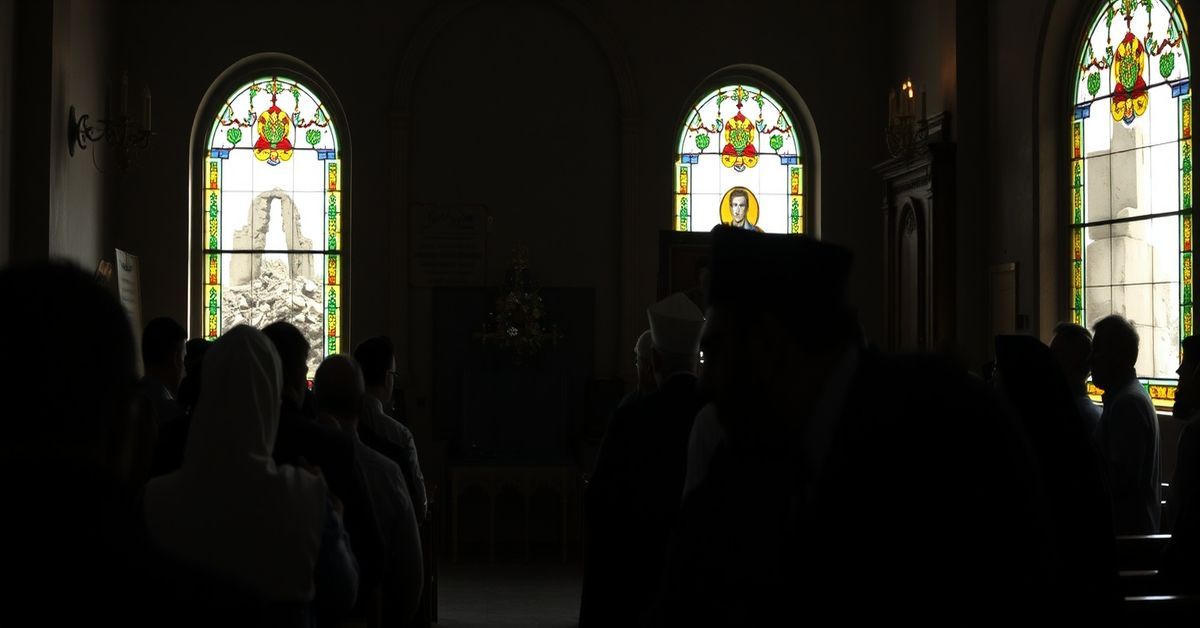
Easter Without Christ: The Apostasy of Post-Conciliar Structures
Summary: The EWTN News article from April 1, 2026, reports that Syria’s Christian communities, led by the Melkite Greek Catholic Patriarchate of Antioch and the Greek Orthodox Patriarchate of Antioch, have scaled back Easter celebrations to “prayers inside churches only” following an attack on Al-Suqaylabiyah. The responses focus on demands for state security, investigation, and compensation, framing the incident within secular concepts of citizenship and civil rights. The article treats these post-conciliar patriarchates and the antipope “Leo XIV” as legitimate Catholic authorities. The complete absence of any supernatural perspective—the reign of Christ the King, the propitiatory sacrifice of the Mass, the state of grace, or the final judgment—exposes a profound apostasy, reducing the sacred Triduum to a mere social ritual under the auspices of a modernist sect.
Naturalistic Reduction of the Sacred Triduum
The article’s core premise is that the assault on Al-Suqaylabiyah, a “predominantly Christian town,” warrants a response centered on human security and civil accountability. The ecclesial reaction, as presented, is to cancel public Easter festivities and confine worship to “prayers inside churches only,” citing “the current discouraging circumstances.” This is not a Catholic response but a naturalistic one. The pre-conciliar Church, in the face of persecution, would have called for public penance, processions, and the solemn celebration of the Unbloody Sacrifice of Calvary as the ultimate act of reparation and triumph over evil. Pope Pius XI, in Quas Primas (1925), instituted the feast of Christ the King precisely to counteract the secularism that removes God from public life: “When God and Jesus Christ were removed from laws and states… the foundations of that authority were destroyed.” The article’s churches, however, silently accept the secular framework where “security” and “state institutions” are the primary referents, utterly ignoring the dogma that all authority in heaven and on earth is given to Christ (Matt. 28:18). Their “prayers” are rendered meaningless because they proceed from invalid authorities who have abandoned the integral faith.
The Omission of Christ’s Kingship in Favor of Secular Security
The patriarchates’ statements are a study in theological vacuum. The Greek Orthodox Patriarchate calls for “official investigation, accountability… and compensation,” while the Melkite Greek Catholic Patriarchate joins “most Churches in Syria” in scaling back celebrations. Both stress “citizenship and integration among all components of Syrian society, far from the logic of majority and minority.” This is exactly the Modernist, secular humanism condemned by Pope Pius IX in the Syllabus of Errors. Proposition #39 states: “The State, as being the origin and source of all rights, is endowed with a certain right not circumscribed by any limits.” The article’s churches implicitly endorse this error by demanding that the state fulfill its “duty” to protect, as if political power were autonomous and not subject to the Social Reign of Christ the King. Pius XI in Quas Primas thunders: “Let rulers of states therefore not refuse public veneration and obedience to the reigning Christ, but let them fulfill this duty themselves and with their people, if they wish to maintain their authority inviolate.” The complete silence on Christ’s royal dignity—that He must rule families, states, and all human associations—is the gravest indictment. These “churches” have exchanged the Kingdom of God for the idolatry of “human security” and “civil rights,” a direct fruit of the conciliar apostasy.
Invalid Authorities, Null Decrees
The article treats the Melkite Greek Catholic Patriarchate and the Greek Orthodox Patriarchate of Antioch as legitimate ecclesial bodies. From the perspective of integral Catholic faith, this is a fatal error. The Melkite Church is in formal communion with the antipope “Leo XIV” (Robert Prevost), the latest in the line of usurpers beginning with Angelo Roncalli (“John XXIII”). As St. Robert Bellarmine proves, a manifest heretic loses his office ipso facto (*De Romano Pontifice*): “a Pope who is a manifest heretic, by that very fact ceases to be Pope and head.” The antipope and all bishops in communion with him, including the Melkite patriarch, are public heretics who have embraced the errors of Vatican II (religious liberty, ecumenism, collegiality). Therefore, any “decree” or “condemnation” they issue is null and void. Canon 188.4 of the 1917 Code of Canon Law confirms: “Every office becomes vacant by the mere fact… if the cleric: 4. Publicly defects from the Catholic faith.” The Greek Orthodox Patriarchate, while schismatic, at least rejects the antipope’s claims; however, it remains outside the Catholic Church and possesses no jurisdiction. The article’s presentation of their statements as authoritative is a symptom of the abomination of desolation—the faithful are led to believe that these conciliar and schismatic structures are the Church, when in reality they are “paramasonic structures” occupying sacred buildings.
Modernist Hermeneutics in Ecclesial Response
The language of the patriarchates’ statements is dripping with Modernist equivocation. Phrases like “citizenship and integration,” “logic of majority and minority,” and “red line” for “public and private freedoms” are borrowed from secular political discourse. This is the hermeneutics of continuity in action: the attempt to synthesize Catholic identity with liberal, naturalistic principles. St. Pius X, in the decree Lamentabili sane exitu (1907), condemned such errors. Proposition #59: “Truth changes with man, because it develops with him, in him, and through him.” The churches’ redefinition of Easter—from the commemoration of the Resurrection, the cornerstone of faith (1 Cor. 15:14)—to a muted “prayer service” based on “circumstances,” is a live demonstration of dogmatic evolution. The Lamentabili also condemned the notion that “the dogmas which the Church proposes as revealed are not truths of divine origin but are a certain interpretation of religious facts” (Prop. #22). By subordinating the sacred liturgy to “discouraging circumstances,” these patriarchates treat dogma as negotiable, a blasphemous reduction of the immutable faith.
The Silence on Sacramental Reality and Supernatural Ends
The article’s most damning feature is its complete omission of the supernatural. There is no mention of:
- The Holy Sacrifice of the Mass as the true reparation for sin and the triumph over evil.
- The state of grace and the necessity of sacraments (Confession, Holy Communion) for salvation.
- The final judgment and the eternal consequences of apostasy.
- The intercession of the Blessed Virgin Mary and the saints.
- The reign of Satan in the world, which is the true cause of such attacks, not mere “sectarianism” or “uncontrolled weapons.”
This silence is not accidental; it is doctrinal. The post-conciliar church, as defined by the “abomination of desolation,” has replaced the supernatural with the natural, the eschatological with the sociological. Pius XI in Quas Primas explains that Christ’s kingdom is “primarily spiritual and relates mainly to spiritual matters.” The article’s churches have inverted this: they are concerned with “temporal” security while abandoning the spiritual battle. Their “prayers inside churches” are devoid of efficacy because they are not offered in communion with the true Church, which endures only in those who profess the integral faith and are led by valid bishops who have not defected. The “Easter” they celebrate is a syncretistic ritual, a mockery of the Resurrection, because it proceeds from a schismatic and heretical hierarchy.
Conclusion: A Call to Repudiate the Conciliar Sect
The EWTN article, in its presentation of the Syrian churches’ response, is a textbook case of post-conciliar apostasy. It accepts the legitimacy of modernist “patriarchates,” reduces the most sacred feast of the liturgical year to a social casualty, and frames the crisis in purely naturalistic terms of “security” and “citizenship.” This is the logical outcome of the errors condemned in the Syllabus and Lamentabili. The only Catholic response to such attacks is public penance, the solemn offering of the Traditional Latin Mass, and the uncompromising proclamation of the Social Reign of Christ the King. The faithful must flee these conciliar structures and seek refuge in the true Church, which subsists in the remnant of bishops and priests who have never defected from the integral faith. The “scaling back” of Easter is not a prudent measure; it is a public admission of spiritual defeat by a sect that has exchanged the Kingdom of Heaven for the idolatry of earthly peace.
Source:
Syria’s churches scale back Easter celebrations after attack on Christian town (ewtnnews.com)
Date: 01.04.2026