Nigerian Bishops Abandon Easter Vigil Symbolism for Naturalistic Security
Nigerian Bishops Abandon Easter Vigil Symbolism for Naturalistic Security
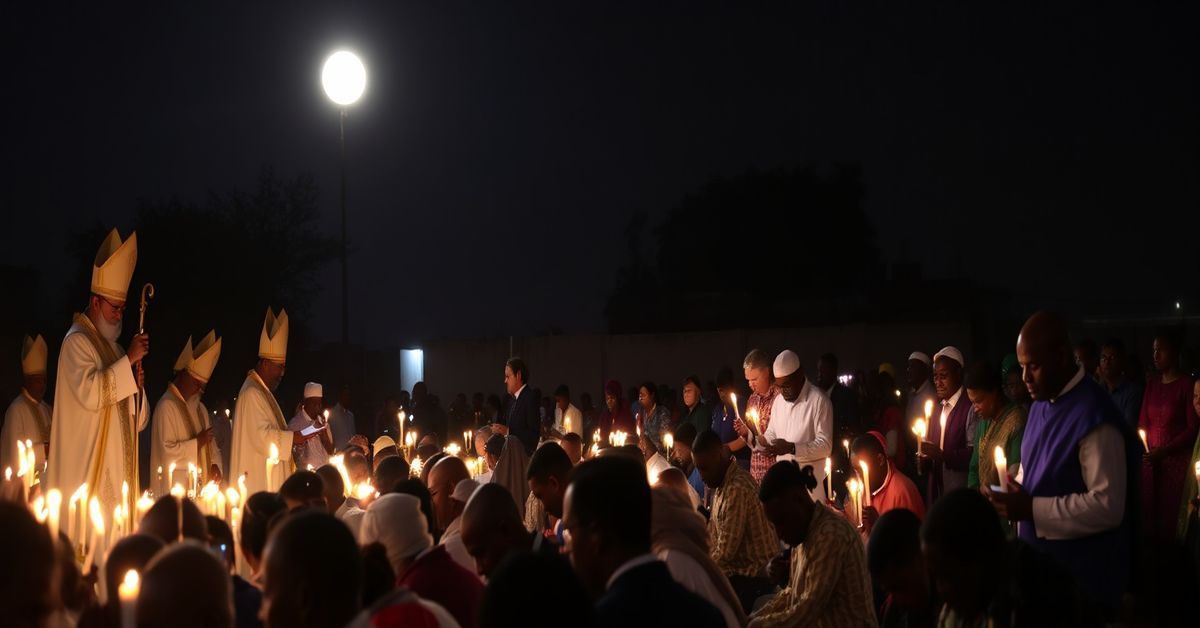
The Vatican News portal reports that following a Palm Sunday attack in Jos North, Nigeria, which left at least 27 dead, several Catholic dioceses have decided to move their Easter Vigil Masses from nighttime to earlier in the day on Holy Saturday. The Diocese of Ondo, for example, rescheduled the celebration to 5 p.m., citing “the realities of our time, particularly the prevailing insecurity in our country and our State and in response to pastoral prudence and sensitivity.” The diocesan message urges security vigilance and prayer for peace, while interfaith leaders—including the Plateau State Chapter of Jama’atu Nasril Islam (JNI) and the Christian Association of Nigeria (CAN)—condemned the attack. This decision, framed as a security measure, epitomizes the conciliar sect’s substitution of naturalistic humanism for supernatural Catholic worship, revealing a complete theological and spiritual bankruptcy.
Naturalistic “Pastoral Prudence” Replaces Supernatural Faith
The bishops’ justification—“pastoral prudence and sensitivity”—is a modernist euphemism for the abandonment of Catholic supernatural confidence. The Easter Vigil is the “mother of all vigils,” a night when the Church liturgically reenacts Christ’s victory over sin and death, culminating in the triumphant chanting of the Exsultet and the reception of the sacraments of initiation. To move it earlier for fear of human violence is to deny the very mystery it celebrates: that Christ, the King of kings, has already conquered principalities and powers (Col 2:15). Pope Pius XI, in Quas Primas, explicitly ties the social reign of Christ to the ordering of all human affairs, including public worship, under divine law: “When God and Jesus Christ… were removed from laws and states… the foundations of that authority were destroyed.” The bishops’ decision assumes the modern secularist error condemned in the Syllabus of Errors (#39-44), namely that temporal concerns (security) must override spiritual ones. Their “prudence” is not Catholic prudence, which subordinates human calculations to divine providence; it is the prudence of the “synagogue of Satan” (Apoc 2:9), which fears man more than God.
Silence on Christ’s Royal Dignity and the Duty of Public Worship
The article’s entire narrative is framed within the naturalistic paradigm of “security” and “peace” as purely temporal goods. There is not a single reference to the kingship of Our Lord Jesus Christ, to the obligation of rulers and peoples to publicly honor Him, or to the supernatural protection promised to those who uphold His reign. This omission is not accidental but symptomatic of the conciliar sect’s apostasy. Pius XI in Quas Primas taught that the feast of Christ the King was instituted precisely to combat the “secularism of our times” which “denied Christ the Lord’s reign over all nations.” He warned that when states “think they can do without God,” they invite chaos and destruction. The Nigerian bishops, by adjusting the most solemn liturgy of the year to accommodate human fear, effectively concede that Christ has no sovereign authority over temporal affairs. They act as if the Resurrection has no power to deter violence, contradicting St. Paul’s declaration that Christ “must reign until he hath put all his enemies under his feet” (1 Cor 15:25). Their silence on this dogma is a damning admission of unbelief.
Ecology of Error: Security, Interfaith Dialogue, and the Abandonment of the Supernatural
The article’s reporting itself propagates the errors of the conciliar sect. First, it presents interfaith condemnation of violence by JNI and CAN as a positive development. Yet the Syllabus of Errors (#18) anathematizes the notion that “Protestantism is nothing more than another form of the same true Christian religion.” By treating all religious leaders as equally credible moral authorities, the article promotes the false ecumenism that Pius XI condemned as “religious relativism” and that Pius IX labeled “indifferentism” (#15-17). Second, the focus on “security strategies” and “prayer for peace” reduces the Church’s mission to a naturalistic humanitarian agency, echoing the modernist error condemned by St. Pius X in Lamentabili sane exitu (#58-59): “Truth changes with man… Christian doctrine was initially Jewish, but through gradual development…” The bishops’ action assumes that the Church’s primary duty is temporal safety, not the salvation of souls through the unbloody sacrifice of Calvary. This is the exact opposite of the Church’s teaching that “the Church… has been divinely instituted for the sake of souls and of eternal salvation” (Syllabus, preface). Third, the article’s tone is bureaucratic and managerial, devoid of any mention of sin, judgment, hell, or the need for sacramental grace—the very realities that the Easter Vigil proclaims. This is the “silence about supernatural matters” that marks the spiritual bankruptcy of the conciliar sect.
The Duty of Rulers and the False “Prudence” of the Conciliar Clergy
Pius XI in Quas Primas did not hesitate to declare that “rulers of states… have the duty to publicly honor Christ and obey Him,” and that their laws must be “ordered on the basis of God’s commandments and Christian principles.” The Nigerian state, plagued by Islamic violence, clearly fails in this duty. But the response of the “bishops” is not to demand the state’s conversion and the public reign of Christ, but to accommodate the state’s failure by altering the liturgy. This is a betrayal of the Church’s prophetic role. The true Catholic response, as taught by Pope Leo XIII in Immortale Dei, is to insist that “the Church… demands for itself… full freedom and independence from secular authority.” Instead, these prelates submit the sacred rites to the secular calculus of risk, thereby participating in the very “secularism” that Pius XI said “has long been hidden in the soul of society.” Their “pastoral sensitivity” is actually pastoral cowardice, a refusal to bear witness to the Resurrection’s power in the face of death. As St. Pius X taught in Pascendi Dominici gregis, Modernists “show contempt for authority” and “reduce the supernatural to the natural.” In moving the Vigil, they reduce the supernatural event of the Resurrection to a mere commemorative ceremony that can be rescheduled like a community meeting.
Conclusion: The Conciliar Sect’s Apostasy in Microcosm
This single decision by Nigerian dioceses—to move the Easter Vigil for security reasons—is a microcosm of the entire conciliar apostasy. It demonstrates: 1) The substitution of naturalistic “prudence” for supernatural faith; 2) The silencing of Christ’s kingship and the Church’s duty to teach nations; 3) The embrace of interfaith error under the guise of peace; 4) The reduction of liturgy to a human program subject to temporal contingencies. All of this flows directly from the “errors of Modernism” condemned by St. Pius X, which synthesize all heresies by making religion a human construct rather than a divine revelation. The true Catholic, adhering to the integral faith before 1958, must reject these “bishops” and their “liturgies” as part of the “abomination of desolation” (Matt 24:15). The only legitimate response to persecution is the one given by the martyrs: to hold the Vigil in the dark, trusting in the light of Christ that no human violence can extinguish. The security of the Church has never been in human strategies but in the promise: “Be of good cheer, I have overcome the world” (John 16:33).
Source:
Nigerian dioceses to hold Easter Vigil earlier for security concerns (vaticannews.va)
Date: 01.04.2026