Easter Message of Antipope Leo XIV: Naturalistic Peace vs. Christ the King
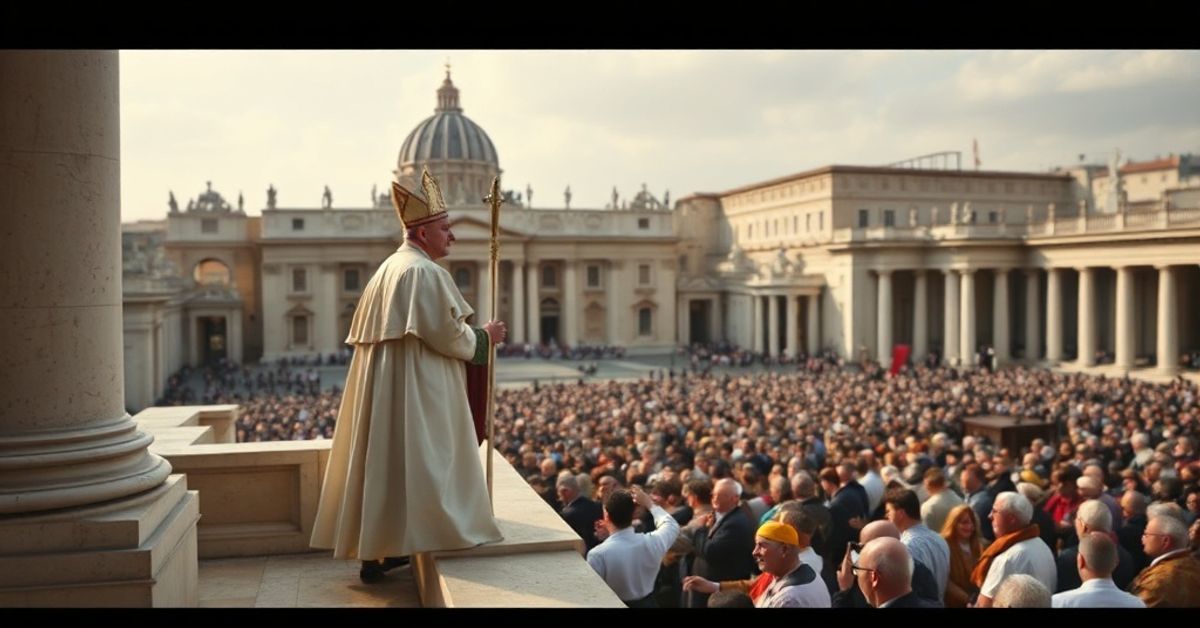
[VATICAN CITY] The article reports that “Pope Leo XIV” delivered his Easter Urbi et Orbi message on April 5, 2026, from St. Peter’s Square, calling for world leaders to “lay down weapons” and choose “peace through dialogue” rather than force. The message framed Christ’s resurrection as an example of “nonviolent power” that fosters “respectful relationships” and the “common good.” The antipope notably avoided naming specific conflicts or countries, departing from traditional papal practice. He condemned the “globalization of indifference” to war and suffering, announced a prayer vigil for peace, and delivered greetings in multiple languages. In his homily, he spoke of Easter hope against the “power of death” present in personal despair and social ills like injustice and war.
The thesis is clear: this Easter message is a quintessential product of the post-conciliar apostasy, reducing the supernatural mystery of the Resurrection and the Kingship of Christ to a vague, naturalistic plea for humanistic peace, utterly silent on the sin that offends God, the necessity of conversion, and the social reign of Christ the King as taught by the pre-conciliar Magisterium.
Naturalistic Humanism Masquerading as Christian Proclamation
The entire message of “Pope Leo XIV” operates on a purely naturalistic and immanentist plane. The call to “abandon every desire for conflict, domination, and power” and to build peace through “dialogue” and “encounter” is a sterile humanism that ignores the root cause of war and disorder: sin and the rejection of the social reign of Jesus Christ. This is a direct repudiation of the Catholic doctrine so clearly taught by Pope Pius XI in his encyclical Quas Primas, which instituted the feast of Christ the King precisely to combat the secularism that “began with the denial of Christ the Lord’s reign over all nations.”
Pius XI explained that when “God and Jesus Christ were removed from laws and states,” the very “foundations of authority were destroyed.” The antipope’s message, by contrast, speaks of power that “does not seek to impose its own plan, but to help design and carry out a plan together with others”—a description of democratic consensus-building, not of the divine law to which all human authority must submit. The pope’s “peace” is a temporal, political peace negotiated among equals, not the pax Christi in the Kingdom of Christ, which requires the submission of all societal structures to the law of God. The Syllabus of Errors of Pope Pius IX condemned the very notion that “the civil authority may interfere in matters relating to religion, morality and spiritual government” (Error #44). Leo XIV’s message, by promoting a “peace” utterly detached from the explicit recognition of Christ’s sovereignty and the Church’s authority to teach, governs, and sanctify, is an implicit endorsement of the secularist error.
Silence on the Supernatural: The Omission That Betrays Apostasy
The most damning aspect of the message is its complete silence on the supernatural order. There is no mention of:
* The necessity of the Catholic Church for salvation (Extra Ecclesiam nulla salus).
* The reality of mortal sin and its eternal consequences (hell).
* The sacraments as the ordinary means of grace.
* The final judgment of Christ as King.
* The obligation of states to publicly recognize and worship the true God.
This silence is not neutrality; it is the hallmark of Modernism, condemned by St. Pius X in Lamentabili sane exitu. Proposition #26 of that decree states: “Faith, as assent of the mind, is ultimately based on a sum of probabilities.” Leo XIV’s Easter message reduces the “certainty” of the Resurrection to a psychological “hope” against despair, stripping it of its objective, historical, and salvific reality. He speaks of Easter as “a new beginning; it is life finally made eternal by God’s victory over the ancient enemy” in terms of personal optimism, not as the definitive, historical event that objectively redeems the human race and establishes Christ’s dominion.
The homily’s description of “death” as “injustices, partisan selfishness, the oppression of the poor” is a purely socio-economic analysis. The “cry of pain” is attributed to “abuses that crush the weakest” and “the idolatry of profit.” While these are evils, the Catholic analysis, as in Quas Primas, roots them in the rejection of Christ’s law: “When God and Jesus Christ… were removed from laws and states… the entire human society had to be shaken.” The antipope’s analysis is materialist, focusing on symptoms (economic injustice) while ignoring the spiritual disease: the loss of the soul, the rejection of grace, and the absence of the Church’s teaching authority. This is the “globalization of indifference” he decries, but he is its chief architect, indifferent to the supernatural truths that alone can heal society.
The Heresy of Implicit Liberalism and Religious Indifferentism
The call for peace “not with the desire to dominate others, but to encounter them” and the framing of Christ’s power as non-imposing is a direct echo of the errors condemned in the Syllabus. Error #77 states: “In the present day it is no longer expedient that the Catholic religion should be held as the only religion of the State, to the exclusion of all other forms of worship.” Error #79 claims: “It is false that the civil liberty of every form of worship… conduce more easily to corrupt the morals and minds of the people.” By urging a peace built on “dialogue” and “encounter” without any requirement for the Catholic faith to be publicly professed and protected by the state, Leo XIV preaches the indifferentism of Error #16: “Man may, in the observance of any religion whatever, find the way of eternal salvation.”
Pius XI in Quas Primas was unequivocal: Christ’s reign “encompasses all men” and requires that “rulers and governments have the duty to publicly honor Christ and obey Him.” He explicitly warned that states which forget God become “heading towards destruction.” The antipope’s message is the precise opposite: it suggests that peace is achievable through pluralistic dialogue among competing “powers” and “plans,” with no supreme sovereign lawgiver. This is the naturalism of liberal democracy, anathematized by the Church. The “common good” he seeks is the temporal, secular common good of the Masonic lodges, not the supernatural common good of the City of God.
The Usurper’s Legitimacy and the Sedevacantist Reality
The entire premise of the article—that “Pope Leo XIV” is a legitimate pontiff—is a fundamental lie. The theological arguments from the file on the Defense of Sedevacantism, based on St. Robert Bellarmine and Canon Law, demonstrate that a manifest heretic automatically loses the papal office. The current occupant of the Vatican, Robert Prevost, and his predecessors since John XXIII, have consistently, publicly, and obstinately taught and practiced the errors of Modernism, ecumenism, and religious liberty. They have violated the first commandment by promoting religious indifferentism (as seen in this very Easter message’s implicit universalism) and have shattered the Church’s unity by endorsing false religions.
Bellarmine’s teaching is clear: “a manifest heretic… is not a Christian… therefore, a manifest heretic cannot be Pope.” The Syllabus of Errors, which is part of the unchanging Magisterium, condemns every single principle underlying the conciliar and post-conciliar “church.” The “canonizations” of heretics like John Paul II and the “beatifications” of figures like the false mystic Faustina Kowalska are null and void acts performed by a body lacking authority. The structure occupying the Vatican since 1958 is the “abomination of desolation” (Matt. 24:15), a paramasonic structure that has replaced the true worship of God with a naturalistic, human-centered liturgy and doctrine.
Conclusion: The Call to Return to Immutable Tradition
The Easter message of “Pope Leo XIV” is a masterpiece of apostate rhetoric. It takes the most supernatural event in history—the Resurrection of the God-Man—and drains it of all objective, dogmatic, and juridical content, reducing it to a metaphor for personal and social optimism. It offers a peace that is merely the absence of war, not the peace that comes from the reign of Christ the King in individuals, families, and states. It is a peace without conversion, without the sacraments, without the Church, and without God as its formal object.
This is the logical fruit of the conciliar revolution, which replaced the Credo with a “hermeneutics of continuity” that is a lie, and the Social Reign of Christ the King with the “brotherhood of man” under the banner of human rights. The true Catholic, adhering to the faith of Pius IX, Pius X, and Pius XI, must reject this message with utter contempt. The only Easter hope is the return to the immutable Tradition, the rejection of the conciliar sect, and the fervent prayer for the restoration of the true Church and the legitimate hierarchy, so that once again the world may hear the uncompromised proclamation: “Jesus Christus, Rex Gloriosus!“—not as a vague inspiration, but as the absolute, universal, and obligatory sovereign of all nations and all aspects of human life.
Source:
On Easter, Pope Leo urges world leaders to lay down weapons and 'choose peace' (ncronline.org)
Date: 05.04.2026