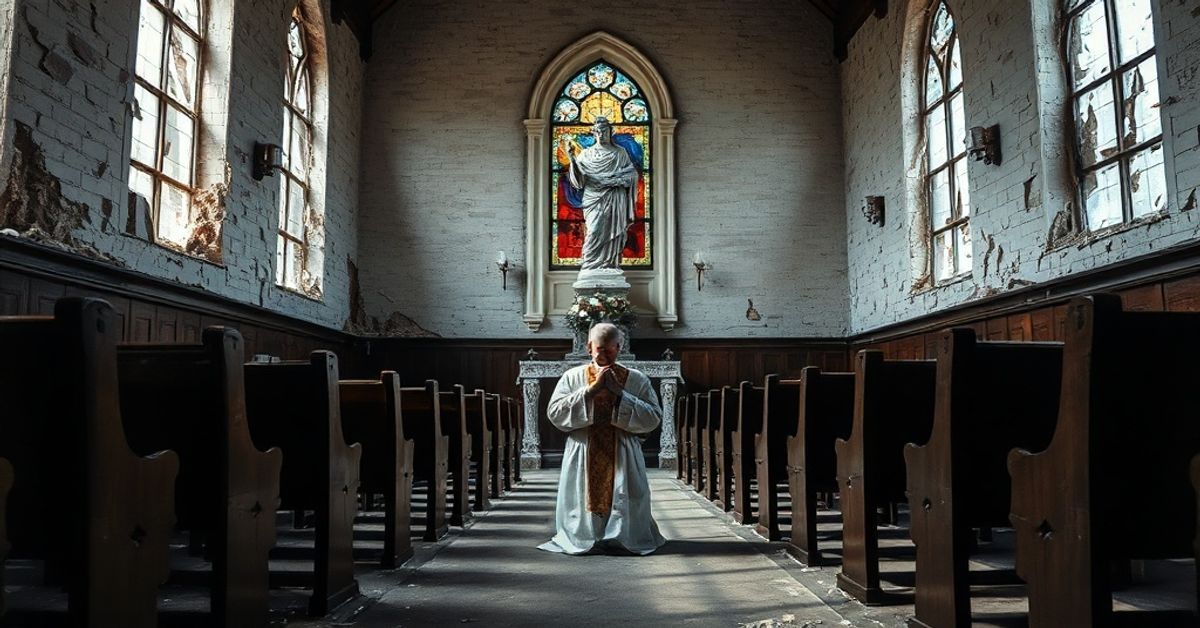
Baltimore Bankruptcy: Apostasy’s Financial Fruit
The EWTN News report details the Hartford Insurance Group’s proposed $100 million contribution toward a settlement for victims of clerical abuse within the Archdiocese of Baltimore, a structure occupying the Vatican since its 2023 bankruptcy filing. This follows the Maryland Child Victims Act and precedes the archdiocese’s plan to close over half its parishes, citing infrastructure decay. The article presents these as administrative and legal matters, omitting the profound theological and ecclesiological catastrophe they represent. The settlement is not merely a financial transaction; it is the inevitable,腐敗 (fǔbài – corruption) fruit of a church that has abandoned its divine constitution and the social kingship of Christ.
The Bankruptcy of Doctrine, The Doctrine of Bankruptcy
The article treats the archdiocese’s financial state as a practical problem of “leaking roofs, crumbling walls, and failing electrical and plumbing systems,” as stated by Archbishop William Lori. This naturalistic reduction of the Church’s mission to property management is a direct symptom of the Modernist infection. Pope Pius XI, in Quas Primas, established the feast of Christ the King precisely to combat the secularism that removes God from public life: “When God and Jesus Christ… were removed from laws and states… the foundations of that authority were destroyed.” The conciliar sect, by embracing the errors of the Syllabus of Errors (e.g., Error #39: “The State… is endowed with a certain right not circumscribed by any limits”), has rendered itself incapable of fulfilling its supernatural purpose. Its “mission and ministry” is now indistinguishable from a secular non-profit, its primary concern being the preservation of temporal assets rather than the salvation of souls. The bankruptcy court is the logical tribunal for an entity that has voluntarily subjected itself to the laws of the world, not the laws of God.
Silence on the Supernatural: The Gravest Accusation
The article’s most damning feature is its total silence on the supernatural. There is no mention of:
- The state of mortal sin in which the perpetrators and the hierarchy that enabled them acted, violating the First Commandment and the Sixth.
- The Sacrament of Penance, the only means for reconciliation with God, which was scandalously neglected.
- The final judgment, wherein all these abusers and their protectors will answer to Christ the King, whose vicar on earth they falsely claim to be.
- The doctrine of the Mystical Body of Christ, wherein a member’s sin wounds the whole Body (1 Cor. 12:26).
This silence is not neutrality; it is apostasy. St. Pius X, in Lamentabili sane exitu, condemned the proposition that “The interpretation of Holy Scripture given by the Church… is subject to more exact judgments and corrections by exegetes” (Proposition #2). The modern “church” applies this same relativism to its own moral law and its understanding of sin. The article’s clinical language (“abuse victims,” “settlement,” “insurance policies”) performs the same function as Modernist exegesis: it drains the blood from the Body of Christ, reducing sacred realities to sociological and legal categories.
Insurance as the Sacrament of Conciliar Secularism
The centrality of insurance to the payout mechanism is profoundly significant. Professor Marie Reilly explains that post-1996 policies no longer covered “employee liability” for sex abuse. The conciliar hierarchy, having fully embraced the “world” (1 John 2:15-17), operates entirely within the framework of worldly risk management and liability. This is the antithesis of the Catholic Church, which, as Pius XI taught, “cannot depend on anyone’s will” and must demand “full freedom and independence from secular authority.” The “huge component” of insurance is a false sacrament, a secular ritual that replaces the duty of bishops to guard the purity of the clergy with the duty of actuaries to calculate risk. It is the logical outcome of the conciliar error, condemned by Pius IX in the Syllabus (#24: “The Church has not the power of using force, nor has she any temporal power”), which has left the Church defenseless against the world’s legal systems.
The “Parish Closure” as Ecclesiastical Cannibalism
The reduction of 61 parishes to 23 is presented as a prudent response to demographic decline. This is a lie. It is the ritualistic sacrifice of the sacred (the parish church, the locus of the Sacrifice of the Mass and sacramental life) to the profane god of financial viability. The true Catholic Church, as defined by the Council of Trent, is “a society perfect in its kind” (Sess. XXIII, Chap. I). A perfect society does not cannibalize its own members to survive. This closure plan is the spatial manifestation of the theological “evolution” condemned by St. Pius X: “Dogmas, sacraments, and hierarchy… are merely modes of explanation and stages in the evolution of Christian consciousness” (Lamentabili, Prop. #54). The “mission” that remains is a shell, a “church” of the New Advent that worships at the altar of sustainability, not at the altar of God.
The Sedevacantist Diagnosis: A Church Without a Pope
From the perspective of integral Catholic faith, the entire edifice described is a conciliar sect operating in a state of sede vacante. The arguments for this are not speculative but doctrinal, as proven by St. Robert Bellarmine: “A manifest heretic… by that very fact ceases to be Pope and head, just as he ceases to be a Christian and member of the body of the Church” (De Romano Pontifice). The current occupant of the Vatican, “Pope” Leo XIV, and his predecessors since John XXIII, have publicly embraced the errors of Modernism, religious liberty, and ecumenism—all condemned by St. Pius X and Pius IX. Canon 188.4 of the 1917 Code of Canon Law states that an office becomes vacant if a cleric “Publicly defects from the Catholic faith.” The public, persistent, and magisterial defense of the errors listed in the Syllabus and Lamentabili constitutes such a public defection. Therefore, the See of Rome has been vacant for decades. The “Archdiocese of Baltimore” is a corporation of the “Church of the New Advent,” a paramasonic structure that has no legitimate jurisdiction. Its “bishops” are mere administrators of a bankrupt (in every sense) human institution.
Conclusion: Return to the Immutable Rock
The $100 million settlement is blood money. It is the price of a century of apostasy, calculated by the world’s courts and paid by the world’s insurers. It buys silence for victims while the true scandal—the loss of the Faith and the vacancy of the Holy See—remains unaddressed. The article’s focus on dollars and parishes is a deliberate distraction from the only issue that matters: the salvation of souls. Pius XI warned that without Christ’s reign, “the whole society profoundly shaken and heading towards destruction.” The society of the “church” in Baltimore is Exhibit A. The only remedy is the one Pius XI prescribed: the public, unwavering confession that “Jesus Christ is King,” not of a bankrupt corporation, but of the one, holy, Catholic, and apostolic Church that endures in those who hold the integral Faith, outside all communion with the conciliar usurpers. There is no healing, no true justice for victims, and no hope for the world until this fundamental truth is recognized and acted upon.
Source:
Archdiocese of Baltimore Insurer Proposes $100-Million Settlement for Abuse Victims (ncregister.com)
Date: 07.04.2026