Record Baptisms in Estonia: Conciliar Sect’s Hollow Triumph
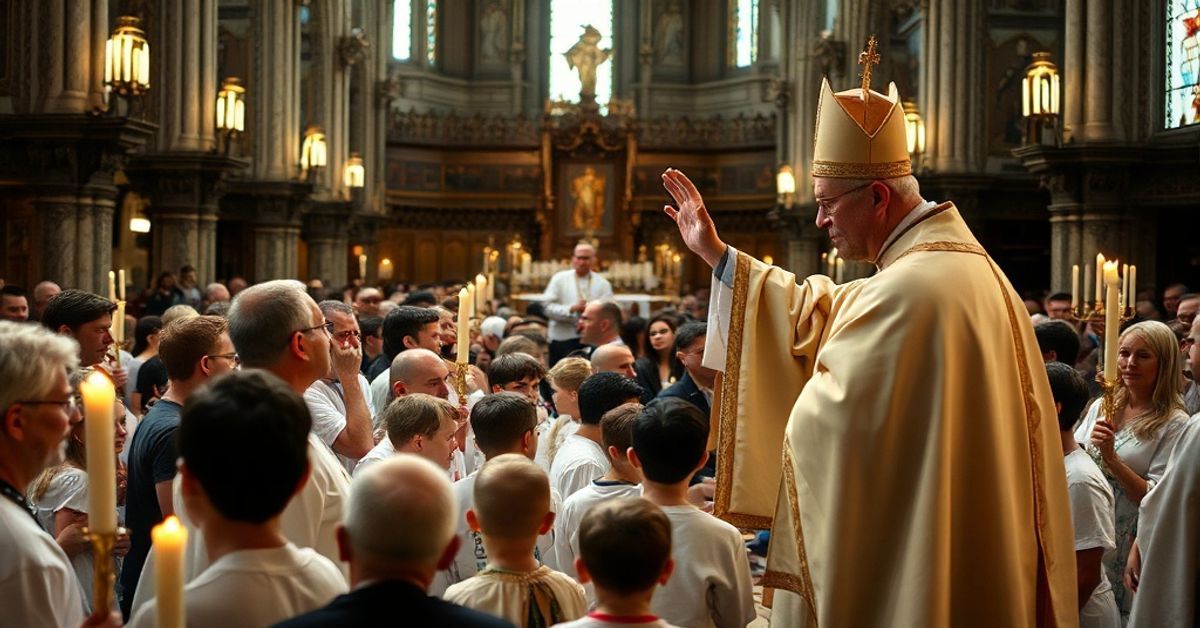
Vatican News portal reports a record number of baptisms at the Easter Vigil in the Cathedral of the Diocese of Tallinn, celebrated by “Bishop” Philippe Jourdan. The article attributes this growth to the 2025 beatification of “Blessed” Eduard Profittlich by the current usurper antipope and to the “fruitful work” of the conciliar bishop. It presents the event as a sign of renewal, quoting the bishop on the “path of holiness” accompanied by sacraments and saints. The article concludes by noting other adults preparing for baptism next Easter, framing this as organic growth of the “Catholic Church” in one of Europe’s least religious nations.
This narrative is a meticulously crafted piece of propaganda for the conciliar sect, designed to mask the profound theological and sacramental bankruptcy of the post-Vatican II structure. The reported “baptisms” are, at best, dubiously valid rites performed by a cleric whose very office is null and void, and at worst, sacrilegious simulations that further the apostasy. The celebration of a “beatification” by an antipope compounds the error, demonstrating a complete rupture from Catholic tradition.
The Nullity of the Minister and the Invalidity of the Rites
The central, unspoken fact is that “Bishop” Philippe Jourdan, as a consecrated bishop in the conciliar church after the death of the last true pope in 1958, holds no legitimate jurisdiction. According to the unchanging doctrine of St. Robert Bellarmine, a manifest heretic—which any post-conciliar “bishop” necessarily is, given their public adherence to the errors of Vatican II—ipso facto ceases to hold office. As Bellarmine states in De Romano Pontifice: “A manifest heretic… by that very fact ceases to be Pope and head, just as he ceases to be a Christian and member of the body of the Church.” This extends to all bishops in communion with a heretical hierarchy. Therefore, Jourdan acts without any authority from Christ. His administration of sacraments is a purely external, lay-like function, lacking the necessary hierarchical power. The “baptisms” he performed are consequently of doubtful validity, as the minister lacked the required intention to do what the Church does, and certainly lacked the jurisdiction to act in the name of Christ’s Church. The article’s silence on this fundamental issue of ex opera operato and ministerial authority is the gravest accusation, revealing a naturalistic focus on numbers and community sentiment rather than on supernatural efficacy.
The “Beatification” of Profittlich: A Profanation by an Antipope
The article’s other pillar, the beatification of Eduard Profittlich in 2025, is an act of supreme impiety. It was performed by “Pope” Leo XIV (Robert Prevost), the latest in a line of antipopes beginning with John XXIII. Pope Paul IV’s bull Cum ex Apostolatus Officio declares unequivocally that any promotion or elevation of a heretic to the papacy or cardinalate is “null, void, and of no effect” even if it be by the unanimous assent of all Cardinals. The bull applies to all who “have defected from the Catholic Faith or fallen into some heresy.” The entire post-1958 hierarchy, having embraced the modernist errors of Vatican II—errors condemned by St. Pius X in Lamentabili sane exitu and Pascendi Dominici gregis—operates under this nullity. Therefore, the “beatification” of Profittlich is an act without force or effect in the true Church. It is a demonic parody, used by the conciliar sect to create new “saints” for its false religion, thereby deceiving the faithful and legitimizing its own apostasy. The article’s presentation of this event as a cause for joy is a direct participation in this profanation.
Omission of Supernatural Truths: The Naturalistic “Church” of the Conciliar Sect
The article’s language is dripping with the naturalism condemned by Pope Pius IX in the Syllabus of Errors. It speaks of “growth and renewal,” “visibility in society,” “fruitful work,” and people seeking “hope and love” in a time of “fragility and pain.” This is the language of sociology and human psychology, not of Catholic theology. There is not a single word about sin, the necessity of grace, the horror of Hell, the exclusive salvific mandate of the Catholic Church (Extra Ecclesiam nulla salus), or the Social Kingship of Christ as defined by Pius XI in Quas Primas. The article reduces the Catholic faith to a comforting community experience, a “path of holiness” accompanied by saints, devoid of its essential character as a via crucis requiring mortification and combat against the world, the flesh, and the devil. This is the precise evolution of Modernism against which Pius X thundered: the transformation of the supernatural religion of Christ into a natural, humanistic “religious movement” (cf. condemned proposition #59 of Lamentabili: “Christ did not proclaim any specific, all-encompassing doctrine…”).
The Hermeneutics of Discontinuity in Action
The article’s entire premise rests on the conciliar principle of discontinuity—the idea that the Church can “grow,” “renew,” and achieve new “impetus” through new beatifications and episcopal initiatives. This is the heresy of dogmatic development and evolution, condemned by Pius IX and Pius X. The unchanging Catholic Church does not “grow” in terms of doctrine or sanctifying power; it remains the same immaculate Bride of Christ. What is presented as “growth” is, in reality, the expansion of a new, modernist sect that has usurped Catholic buildings and titles. The article’s silence on the catastrophic apostasy since Vatican II—the “smoke of Satan” entering the Church, the collapse of vocations, the loss of faith—is not an oversight; it is a deliberate strategy of disinformation. It focuses on a single, statistically anomalous event in a tiny nation to create a false narrative of vitality, while ignoring the global hemorrhage of souls and the universal abandonment of Catholic practice and belief.
The True Catholic Response: Contempt for the Conciliar Sect’s Works
From the perspective of integral Catholic faith, the only appropriate response to such an article is one of profound sorrow and militant opposition. The baptisms, performed without proper authority and likely with defective form and intention following the post-conciliar revisions of the rite, cannot be recognized as efficacious. The faithful in Estonia are not being shepherded into the true Church, but are being incorporated into the “abomination of desolation” standing in the holy place. The true Church, as defined by the Council of Trent and the popes before 1958, is a perfect society with immutable doctrine and sacraments. It is not defined by statistical “growth” in conciliar structures or by the “beatifications” of antipopes. The path to holiness is not a vague “journey” accompanied by dubious “blesseds,” but the narrow way of the via crucis, the frequent reception of the valid sacraments (which are absent in the new rite), and absolute fidelity to the unchanging Magisterium.
The article is a symptom of the Antichrist’s final deception: a false church that mimics the external works of the true Church (baptisms, beatifications, episcopal celebrations) while emptying them of their supernatural content and authority. It is a call not for celebration, but for the faithful to flee this conciliar sect and seek refuge in the traditional Catholic faith, wherever it survives in small communities and with valid clergy who reject the modernists. The only “growth” that matters is the growth of sanctifying grace in souls, which can only come through the unadulterated faith, sacraments, and discipline of the Catholic Church as it existed before the catastrophic rupture of Vatican II.
Source:
Estonia: Dozens of people welcomed into the Church at Easter (vaticannews.va)
Date: 07.04.2026