The “Easter People” Heresy: Modernist Naturalism Masquerading as Catholic Domesticity
The “Easter People” Heresy: Modernist Naturalism Masquerading as Catholic Domesticity
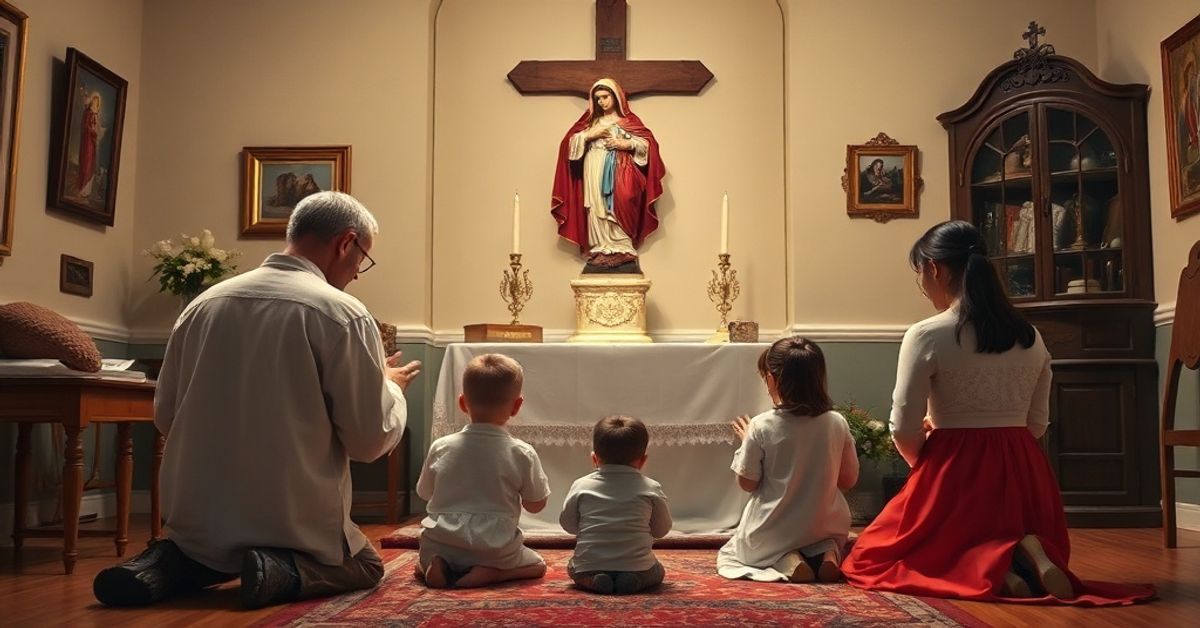
The cited article from the National Catholic Register, dated April 8, 2026, promotes a devotional concept of the “Easter home” and the “Easter people,” attributing the slogan to the antipope “John Paul II.” It presents a vision of Catholic family life centered on interiority, prayer, and sacred art, framing suffering as a “dying to self” within a cyclical pattern of “crucifixion and resurrection.” While using pious language, the article fundamentally embodies the Modernist, naturalistic, and immanentist errors condemned by the pre-Conciliar Magisterium, reducing the supernatural end of man to a therapeutic, domestic humanism. Its silence on the necessity of the Church as the sole ark of salvation and the absolute primacy of Christ’s Kingship over all temporal order reveals its apostate core.
1. The Source of the Error: A Slogan from an Antipope
The article’s foundational premise is already corrupt because it cites “St. John Paul II” as its source. From the integral Catholic perspective, “John Paul II” (Karol Wojtyła) is not a saint or a legitimate pope but the first of the series of antipopes occupying the Vatican since the death of Pope Pius XII in 1958. His “canonization” by the conciliar sect further confirms his status as a promoter of the very Modernism condemned by St. Pius X. Therefore, any slogan emanating from him is intrinsically suspect and must be examined through the lens of the Syllabus of Errors and Lamentabili sane exitu. The phrase “an Easter people and alleluia is our song” is not a development of Catholic tradition but a piece of sentimental, ecumenical rhetoric designed to flatten the Paschal Mystery into a generic optimism, divorced from the redemptive sacrifice and the necessity of the Church.
“We do not pretend that life is all beauty. We are aware of darkness and sin, of poverty and pain. But we know Jesus has conquered sin and passed through his own pain to the glory of the Resurrection.”
This phrasing is dangerously ambiguous. It speaks of “knowing” Christ’s victory in a psychological or experiential sense (“we know”) rather than through the dogmatic faith defined by the Church. It reduces the objective, historical, and sacrificial reality of the Resurrection to a subjective “glory” that we can allegedly access through our own “pain.” This is the error of subjectivist religion, condemned by Pope Pius IX in the Syllabus (Error 4: “All the truths of religion proceed from the innate strength of human reason”) and by St. Pius X in Lamentabili (Proposition 25: “Faith, as assent of the mind, is ultimately based on a sum of probabilities”). The article’s Easter is not the Easter of the Unbloody Sacrifice of Calvary made present on the altar, but an Easter of personal resilience.
2. The Reduction of the Church to the “Domestic Church”: A Modernist Hermeneutic
The article’s core project is the establishment of a “domestic culture” and the “theology of home.” It states: “The home serves as the foundational school for learning to love.” This inverts the Catholic order. The Church is the “foundational school” for learning to love, because sanctifying grace, the theological virtues, and the true knowledge of God are communicated exclusively through her sacraments and her teaching authority. The home, while a natural society with a right to autonomy in its temporal affairs, derives its supernatural purpose and efficacy only from its incorporation into the Mystical Body of Christ. To speak of the home as a “sacramental home” in isolation from the true Church is to create a false sacramentality, a Pelagian reliance on natural means for supernatural ends.
This emphasis on the “domestic church” is a hallmark of post-Conciliar theology, which democratizes and naturalizes the Church’s mission. It aligns with the errors condemned in the Syllabus:
- Error 19: “The Church is not a true and perfect society, entirely free… but it appertains to the civil power to define what are the rights of the Church.” By making the home the primary site of formation, the article implicitly subordinates the Church’s hierarchical, dogmatic authority to the autonomous family unit.
- Error 55: “The Church ought to be separated from the State, and the State from the Church.” The “Easter home” project is a blueprint for building a separate, self-sufficient religious sphere within the domestic cell, mirroring the liberal separation of Church and State on a micro-level.
The article’s silence on the necessity of the Church for salvation is deafening. It speaks of “cycles of both crucifixion and resurrection” and “growth in holiness” without a single reference to Baptism, Confession, or the Most Holy Sacrifice of the Mass as the sole channels of grace. This is the “synthesis of all heresies” – Modernism – which, as St. Pius X taught in Pascendi Dominici Gregis, “consists in the denial of objective truth, and consequently in the denial of the possibility of any absolute, immutable, and universal dogmatic definition.”
3. The Naturalistic and Immanentist “Theology” of Suffering and Love
The article attempts to define the “Easter people” through a naturalistic psychology of suffering and love:
“To be an Easter people is to embrace crucifixion, not only through the sufferings of life which undoubtedly come, but primarily by the daily dying to self in order to will the good of others, as Christ modeled.”
This is not Catholic theology. Catholic theology teaches that we participate in Christ’s Crucifixion and Resurrection primarily and necessarily through the sacraments and the state of grace. “Dying to self” is a supernatural act accomplished by the theological virtue of charity, which is infused by God, not a natural effort of the will. The article’s framework is pure moralism and human effort, echoing the Jansenist rigorism it superficially claims to oppose. It makes the “good of others” the measure, not the love of God as the primary end.
Furthermore, the article’s garden metaphor for cultivating a “domestic culture” is a paradigm of immanentism:
“The development of a domestic culture is comparable to cultivating a garden… seeds are planted, nurtured and shielded from external dangers… tangible growth becomes apparent.”
This reduces the supernatural life of the soul to a natural process of cultivation, where “graces” are like nutrients and “weeds” are bad influences. It is a Pelagian vision where the kingdom of God is built by human industry within the home, rather than received as a gift through the Church. This is precisely the “evolution of Christian consciousness” condemned by St. Pius X (Proposition 54: “Dogmas, sacraments, and hierarchy… are merely modes of explanation and stages in the evolution of Christian consciousness”). The “harvest” is not eternal life, but a functional, happy family unit – a purely naturalistic goal.
4. The Omission of the Social Kingship of Christ: The Gravest Sin
The most damning evidence of the article’s apostasy is its total silence on the doctrine of the Social Reign of Christ the King, so clearly and forcefully taught by Pope Pius XI in the encyclical Quas Primas (1925), from which we quote:
“If men were ever to recognize Christ’s royal authority over themselves, both privately and publicly, then unheard-of blessings would flow upon the whole society, such as due freedom, order, and tranquility, and concord and peace.”
The article speaks of the home as a “foundational school” and a “garden,” but never as a little kingdom subject to the universal kingship of Christ. It never states that the primary purpose of the family is to cooperate with the Church in the sanctification of its members for the glory of God and the extension of His reign on earth. Instead, it focuses on “interior peace,” “meaningful reminders of faith,” and “a diverse expression of beauty.” This is the error of privatized religion, condemned by Pius IX (Error 15: “Every man is free to embrace and profess that religion which, guided by the light of reason, he shall consider true”) and the very secularism Pius XI fought against in Quas Primas:
“The Church’s authority to teach men, to issue laws, to govern nations… was denied. And then, slowly, the Christian religion began to be equated with other false religions…”
The article’s “Easter people” are a people without a king, a church without a hierarchy, a faith without a dogmatic content. They are an “alleluia” people who have forgotten the Judgment that follows the Resurrection, the necessity of making amends for sin, and the duty to submit all human affairs to the law of Christ. This is the “plague of secularism” (Pius XI) internalized and baptized with sacramental language.
5. The Sacramental Lie: “Sacramental Home” Without the True Sacraments
The article declares: “The Easter home is a sacramental home, one that dedicates the week and the rhythms of daily life to proper spiritual preparation for Sunday Mass.” This is a cruel deception. The “Sunday Mass” referred to is the post-Conciliar “Novus Ordo Missae,” which, while sometimes valid in form, is a perversion of the Holy Sacrifice of the Mass. Its prayers have been gutted of sacrificial and propitiatory language, its orientation is toward a “meal” rather than a true sacrifice, and it is celebrated versus populum in the vernacular, destroying the sacred symbolism of the priest acting in persona Christi Capitis. As the theologians of the pre-Conciliar Church taught, the Mass is the unbloody sacrifice of Calvary. To prepare for a “Mass” that is essentially a Protestant memorial supper is not to prepare for the Paschal Mystery but for a human ceremony.
Furthermore, the article’s emphasis on “sacred art” and “devotions” is meaningless if not ordered to the true sacrifice. Without the True Mass and the valid sacraments administered by priests in communion with the true Church (which endures only in those who maintain the integral Catholic faith outside the conciliar structures), all domestic piety is a vain superstition. The article promotes a “sacramental” life that is, in reality, sacrilegious because it is detached from the one true sacrifice and the one true Church. It is a “sacramental” life of the abomination of desolation standing in the holy place.
6. Conclusion: The “Easter People” as Apostates in Domestic Disguise
The article’s vision of the “Easter home” is a masterpiece of Modernist infiltration. It takes the language of Catholic piety – Easter, sacrifice, prayer, sacraments – and empties it of its supernatural, hierarchical, and dogmatic content. It replaces the Church Militant (the totality of the Catholic faithful on earth) with the domestic cell. It replaces the Sacrifice of the Altar with a “preparation for Sunday Mass” (i.e., the invalid Novus Ordo). It replaces the Social Kingship of Christ with a private, therapeutic spirituality. It replaces grace with effort, and the Communion of Saints with the “family unit.”
This is not a call to Catholic family life. It is a symptom of the Great Apostasy foretold by St. Pius X. The true “Easter people” are those who, in the darkness of the post-Conciliar desert, cling to the True Faith, the True Mass, and the True Church, recognizing that all other “alleluias” are the songs of the harlot of Babylon. The true “Easter home” is one where the Unbloody Sacrifice is offered on a worthy altar by a valid priest, where the Rosary is prayed in union with the Immaculate Heart of Mary, and where the children are taught that their ultimate citizenship is in Heaven, and their duty on earth is to reconciled all things to Christ the King, not to cultivate a private garden of feel-good religiosity.
To be an “Easter people” in the Catholic sense is to live in the hope of the Resurrection while doing penance for sins, in communion with the one true Church, under the sole reign of Christ the King. The article presents the opposite: a worldly, domestic, self-congratulatory “alleluia” that has no room for the Cross, no need for the Church, and no fear of the Judgment. It is a sedia vacante of the soul, a spiritual vacuum dressed in the vestments of tradition.
Source:
The Home of the Easter People (ncregister.com)
Date: 08.04.2026