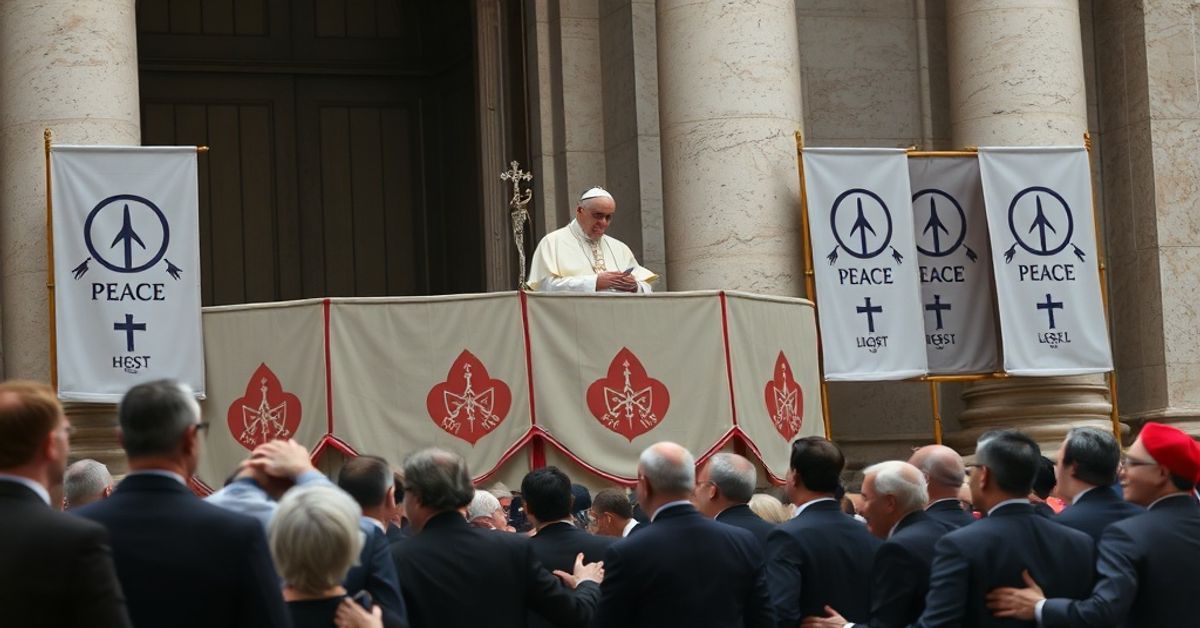
The “Non-Violent” Easter of the Usurper: A Modernist Distortion of Peace and Kingship
The cited article from the Vatican News portal (April 7, 2026) reports on the Holy Week and Easter appeals for peace made by the individual occupying the See of Rome, “Pope Leo XIV.” It portrays his message as a radical, Gospel-centered call for non-violence and dialogue, centered on the Resurrection. The thesis of this analysis is that this presentation is a sophisticated, modernistic re-framing of the Catholic doctrine of peace, which systematically omits the indispensable foundation of the Social Kingship of Christ and the duty of the State to recognize the Catholic Church, thereby promoting a naturalistic, indifferentist humanism utterly condemned by the pre-conciliar Magisterium.
Factual Deconstruction: A Gospel Stripped of Its Social and Sacramental Context
The article presents “Pope Leo XIV’s” appeals as the pure echo of Christ’s own non-violence. It quotes him: “This is our God: Jesus, King of peace. A God who rejects war, whom no one can use to justify war.” While Christ indeed rejected the use of force to establish His earthly kingdom (John 18:36), the article’s framing deliberately isolates this truth from the full, unadulterated Catholic context. It ignores the very next logical consequence taught by the Church: that the peace of Christ the King must be realized in society through the submission of all human authority—including political authority—to the law of God and the teaching authority of the Church.
The article notes the Pope’s reference to “the imperialist occupation of the world” and “the violence that until now has been the law.” This is a classic modernist inversion, blaming “imperialism” and abstract “violence” while remaining silent on the primary, divinely-ordained order: the duty of the State to serve the Church and enact laws in conformity with the Ten Commandments. The Syllabus of Errors (1864) explicitly condemns the notion that “the State… is endowed with a certain right not circumscribed by any limits” (Error 39) and that “the civil authority may interfere in matters relating to religion, morality and spiritual government” (Error 44). Leo XIV’s vague denunciation of “abuse of power” without defining the legitimate use of power according to Catholic doctrine is a perfect example of the “moderate rationalism” (Syllabus, Chapter II) that treats political power as autonomous from the supernatural.
Linguistic Analysis: The Tone of Naturalistic Humanism
The language employed is consistently vague, emotional, and focused on human experience rather than divine law and supernatural ends. Phrases like “dark hour of history,” “cracks of resurrection,” “new world of peace and unity,” and “hands that embrace” are evocative but theologically imprecise. They appeal to sentiment and a vague hope, not to the clear, objective rights of God and His Church. The term “non-violent” is repeated as a mantra, divorcing the concept of peace from its necessary foundation in the just war tradition and the Church’s right to defend itself and the common good, a right implicitly denied by the article’s presentation.
Most critically, the vocabulary of the Social Kingship of Christ—so central to Pius XI’s Quas Primas—is entirely absent. There is no mention of “nations,” “states,” “laws,” “governments,” “public order,” or “the duty of rulers to publicly honor Christ.” Instead, the focus is on individual conversion (“our hearts”), dialogue between leaders, and a generalized “peace.” This is the language of the post-conciliar “humanism” condemned by Pius X in Pascendi Dominici gregis (1907), which places “man and his welfare” at the center, not God and His glory.
Theological Confrontation: Omission as Heresy
The gravest errors in the article are not what it says, but what it omits. From the perspective of integral Catholic faith, silence on essential doctrines in a context that claims to teach on peace is a damning admission of apostasy.
- The Social Kingship of Christ: Pius XI, in Quas Primas, dogmatically teaches that Christ’s reign “encompasses all men” and that “rulers of states… have the duty to publicly honor Christ and obey Him.” The encyclical states unequivocally: “The state must leave the same freedom to the members of Orders and Congregations…” and “It will remind them of the final judgment, in which Christ… will very severely avenge these insults, because His royal dignity demands that all relations in the state be ordered on the basis of God’s commandments and Christian principles.” Leo XIV’s appeals contain not a whisper of this. He does not command rulers to “publicly honor Christ” as Pius XI did. He asks them to “come back to the table, to dialogue.” This is a direct rejection of the mandatum of Quas Primas.
- The Condemnation of Religious Indifferentism: The Syllabus of Errors (Errors 15-18) condemns the idea that “every man is free to embrace and profess that religion which… he shall consider true” (15) and that “Man may… find the way of eternal salvation… in the observance of any religion whatever” (16). Leo XIV’s generic appeals for peace, addressed to all “world leaders” without distinction, and his failure to affirm that extra Ecclesiam nulla salus, functionally endorse the indifferentism of Error 15. His “God who rejects war” is presented as a deity accessible to all, regardless of their submission to the Catholic Church, which is the “sole dispenser of salvation” (Quas Primas).
- The Necessity of the Church for Salvation and the Duty of the State: Pius XI writes: “His reign, namely, extends not only to Catholic nations… but His reign encompasses also all non-Christians… the entire human race is subject to the authority of Jesus Christ.” This subjection is not a vague spiritual reality but a social and political one, demanding the subordination of civil law to divine and ecclesiastical law. Leo XIV’s entire framework is one of “dialogue” and “reducing violence,” presupposing the legitimacy of secular, neutral states. This is the precise error condemned in Syllabus Error 19: “The Church is not a true and perfect society… but it appertains to the civil power to define what are the rights of the Church.” By not asserting the Church’s rights against the state, Leo XIV surrenders to this error.
- The Nature of True Peace: Pius XI defines true peace as the fruit of the “reign of our Savior” in society: “If men were ever to recognize Christ’s royal authority over themselves, both privately and publicly, then unheard-of blessings would flow upon the whole society, such as due freedom, order, and tranquility, and concord and peace.” Leo XIV’s peace is a “non-violent” peace achieved through human negotiation and the rejection of arms. Pius XI’s peace is the consequence of the public recognition of Christ’s law. The former is Pelagian humanism; the latter is supernatural order. Leo XIV’s Easter message is therefore a inversion: it makes peace a project of human will rather than a divine gift contingent on justice, which is the “constant and perpetual will to give each one his right” (St. Isidore of Seville), a will impossible without the law of Christ.
Symptomatic Analysis: The Fruit of the Conciliar Revolution
The article is a quintessential product of the post-conciliar “Church of the New Advent.” Its methodology is identical to that condemned by St. Pius X in Lamentabili sane exitu:
- Proposition 25: “Faith, as assent of the mind, is ultimately based on a sum of probabilities.” Leo XIV’s appeals are based on the “probability” that dialogue and non-violence might work, not on the certainty of Christ’s Social Kingship and the Church’s immutable teaching on the duty of the State.
- Proposition 26: “The dogmas of faith should be understood according to their practical function, i.e., as binding in action, rather than as principles of belief.” Here, the dogma of Christ the King is reduced to a “practical function” of encouraging nice behavior and dialogue, stripped of its binding, juridical claim over nations and laws.
- Proposition 64: “The Church is incapable of effectively defending evangelical ethics, because it steadfastly adheres to its views, which cannot be reconciled with modern progress.” Leo XIV’s entire approach is an attempt to “reconcile” the Gospel with the modern world’s obsession with non-violence and dialogue, abandoning the Church’s “steadfast” teaching on the duty of the State and the legitimacy of defensive war under just conditions.
The article’s complete silence on the sacraments, on grace, on the state of mortal sin, on the Last Judgment, and on the specific, dogmatic condemnations of Modernism by Pius IX and Pius X, is the smoking gun. It reveals a religion of ethics and sentiment, not of dogma and grace. This is the “synthesis of all errors” (Pius X, Pascendi) that defines Modernism.
Conclusion: The Only True Peace
The peace proclaimed by the occupant of the Vatican is a counterfeit. It is the peace of the world, which “passes away” (1 John 2:17). True peace, as defined by the unchanging Magisterium, is “the tranquility of order” (St. Augustine), an order that can only exist when “all the powers of the human soul are perfectly subject to God” and when “all the relations of men among themselves… are regulated according to the law of God and the teaching of the Church” (Quas Primas). This requires the public, legal, and constitutional recognition of Jesus Christ as King by all nations and their rulers. It requires the State to bow its head before the Church, not to “dialogue” with her as an equal.
The appeals of “Leo XIV” are a diabolical distraction. They offer a peace without justice, a peace without the Cross, a peace without the Social Kingship of Christ. They are the ultimate expression of the “abomination of desolation” standing in the holy place: a pseudo-papacy preaching a pseudo-gospel of naturalistic peace to a world that has collectively apostatized from the only true peace found in the only true Church. The faithful are called not to listen to these siren songs of the conciliar sect, but to hold fast to the immutable Faith, to pray for the conversion of nations to the true reign of Christ the King, and to await the day when the powers of this world are finally shattered by the mere “breath of His mouth” (2 Thessalonicians 2:8).
Source:
The “non-violent” power of Easter in Pope Leo’s appeals for peace (vaticannews.va)
Date: 07.04.2026