The Usurper in the Vatican Gardens Preaches a Peace Without Christ the King
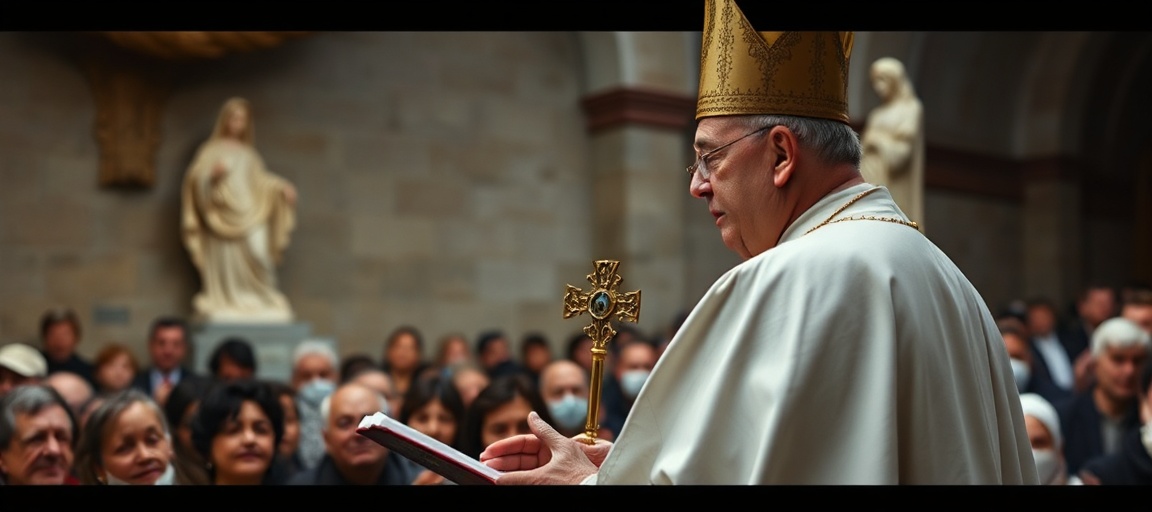
VaticanNews portal reports that on May 30, 2026, the usurper Robert Prevost, styling himself “Pope Leo XIV,” led a Rosary at the Grotto of Lourdes replica in the Vatican Gardens, delivering a reflection on peace to approximately 2,000 pilgrims. His address, centered on the Joyful Mysteries, called for peace as a “daily commitment,” urging listeners to “listen to the cry of those deprived of it”—innocent children, anguished parents, refugees—and declared that “peace is always possible because it is a gift from God.” He framed Mary as the model of obedience and Jesus as the “one final Word spoken by the Father, a Word of peace for all who return to him with contrite hearts.” He stressed that “true peace starts with a heart that loves” and that “everyone can and must do their part,” beginning with “small but important things, abstaining from every form of verbal or physical violence in daily life and also on social media.” He concluded by asking Mary to help answer God with “Here I am” in deeds, not merely words. The entire performance is a masterclass in naturalistic humanitarianism masquerading as Catholic piety—a peace stripped of justice, of sin, of the Kingship of Christ, and of the supernatural order, reducing the Faith to sentimental activism and psychological self-help.
A Peace Without the King: The Erasure of Christ’s Social Reign
The most glaring and damning omission in the entire address is the complete absence of the Social Kingship of Jesus Christ. When Pius XI instituted the Feast of Christ the King in Quas Primas (1925), he did so precisely as a remedy against the “secularism of our times, so-called laicism, its errors and wicked endeavors.” He declared with apostolic authority that “the reign of our Savior” encompasses “not only Catholic nations” but “also all non-Christians, so that most truly the entire human race is subject to the authority of Jesus Christ.” He insisted that rulers and states have the duty “to publicly honor Christ and obey Him,” and that “the state is happy not by one means, and man by another; for the state is nothing else than a harmonious association of men” (Quas Primas, citing St. Augustine). The encyclical warns with prophetic severity: “When God and Jesus Christ—as we lamented—were removed from laws and states and when authority was derived not from God but from men, the foundations of that authority were destroyed.”
What does the usurper Prevost offer in place of this immutable doctrine? “Peace is not a theory to be tested in a laboratory, nor a naïve illusion, nor a matter to be pursued out of self-interest.” This is not Catholic theology; it is the bland, content-free language of a United Nations press release. Where is the acknowledgment that pax is the tranquility of order, and that order requires submission to God’s law? Where is the recognition that “there is no other name under heaven given to men by which we must be saved” (Acts 4:12)? Pius XI explicitly stated that “the hope of lasting peace will not yet shine upon nations as long as individuals and states renounce and do not wish to recognize the reign of our Savior.” The usurper’s peace is a peace without repentance, without conversion, without the Cross—a peace that the world can manufacture on its own, with God reduced to a vague supplier of “gifts.”
The Naturalistic Reduction of Peace to Human Sentiment
Prevost’s theology of peace is not merely incomplete; it is positively naturalistic. He declares: “Peace comes from justice and love. It is the harmony that brings families, people, communities, and nations together.” Justice and love—but defined by whom? By the Church’s Magisterium, which distinguishes between true and false justice, between the theological virtue of charity and mere humanitarian sentiment? No. His justice is the horizontal justice of human rights discourse, and his love is the sentimental affection of a world that refuses to acknowledge original sin, the reality of hell, or the necessity of grace.
He says: “True peace, he explained, starts with a heart that loves: when people speak words of reconciliation and when we look at the world with gentleness and wisdom. ‘This is true strength, the strength of truth and love.'” This is the language of self-help psychology, not of Catholic doctrine. The Church has always taught that true peace is a fruit of charity, which is a supernatural virtue infused by God into the soul in the state of grace. Pius XI wrote: “If men were ever to recognize Christ’s royal authority over themselves, both privately and publicly, then unheard-of blessings would flow upon the whole society, such as due freedom, order, and tranquility, and concord and peace.” The usurper inverts this order: peace flows from human hearts loving one another, and Christ is merely the exemplar of this love, not the King to whom all nations owe obedience under pain of eternal damnation.
The Rosary as Political Theater: Lourdes and the Cult of Naturalistic Piety
The choice of venue is itself theologically significant. The Grotto of Lourdes replica in the Vatican Gardens serves as the backdrop for this exercise in naturalistic piety. According to documented theological objections, the Lourdes apparitions—like those of Fatima—are suspicious phenomena that serve to divert attention from modernist apostasy within the Church. The message of Lourdes, centered on personal penance and private devotion, omits the principal danger identified by St. Pius X in Pascendi Dominici Gregis (1907): the “enemies within,” the modernists who “aim at such a development of dogmas as appears to be their corruption” (Lamentabili sane exitu, 1907). By praying at a Lourdes grotto and reducing the Rosary to a vehicle for peace activism, the usurper aligns himself with a tradition of private revelation that functions as a counterfeit substitute for the Church’s public, authoritative, and supernatural mission.
St. Pius X, in Lamentabili, condemned the proposition that “the Church is an enemy of the progress of natural and theological sciences” (prop. 57) and that “truth changes with man, because it develops with him, in him, and through him” (prop. 58). Yet the entire conciliar project, of which Prevost is a product, is built upon precisely these condemned errors. His Rosary is not an act of supernatural faith seeking the conversion of sinners and the restoration of Christ’s Kingship; it is a psychodrama of collective sentiment, a ritual performance designed to generate the feeling of peace without the substance of truth.
The Omission of Sin, Judgment, and the Supernatural Order
Perhaps the most spiritually devastating aspect of the address is its total silence on sin, judgment, the state of grace, and the eternal destiny of souls. Prevost speaks of “innocent children, anguished mothers and fathers, abused prisoners, refugees”—all worthy of natural compassion—but never once mentions that these souls have an eternal destiny, that they are subject to the justice of God, that they require baptism, faith, and the sacraments to be saved. He says God “looks for us and brings us back to him”—but through what means? Through the Church? Through the sacraments? Through the Most Holy Sacrifice of the Mass? These words are conspicuously absent.
Instead, we receive: “Every time we return to the Lord, his peace becomes our responsibility, according to the duties and tasks of each person… That means our prayer is more than prayer—it becomes our mission and our prophecy.” This is the theology of the conciliar sect in its purest form: prayer as activism, prophecy as social work, mission as humanitarian engagement. The supernatural economy of grace—the Mass, confession, communion of saints, the intercession of the Blessed Virgin for the conversion of sinners—is replaced by a horizontal program of human improvement. Pius IX, in the Syllabus of Errors (1864), condemned the proposition that “the Church has not the power of defining dogmatically that the religion of the Catholic Church is the only true religion” (prop. 21) and that “man may, in the observance of any religion whatever, find the way of eternal salvation” (prop. 16). The usurper’s silence on these points is not accidental; it is the silence of a man who professes the very errors Pius IX condemned.
The Idolatry of “Small Deeds” and the Democratization of Holiness
Prevost urges his listeners to begin with “small but important things, abstaining from every form of verbal or physical violence in daily life and also on social media.” This is the democratization of holiness—the reduction of the Christian life to etiquette and emotional management. Where is the call to mortification, to fasting, to the carrying of one’s cross? Where is the insistence on the necessity of avoiding near occasions of sin, of making a good confession, of receiving the Holy Eucharist worthily? The Church has always taught that holiness is not achieved through “small deeds” of natural virtue but through cooperation with divine grace, through the sacraments, through the infused virtues, through the gifts of the Holy Spirit.
St. Pius X warned that modernism is “the synthesis of all errors” and that its adherents “overstep the boundaries set by the Fathers of the Church and the Church itself” under the “guise of more serious criticism and in the name of historical method.” The usurper’s address is a perfect specimen of this synthesis: it takes the language of Catholic piety—Rosary, Mary, peace, prayer—and empties it of all supernatural content, refilling it with the humanitarian ideology of the secular world. It is idolatry dressed in vestments, the worship of man’s capacity for goodness in place of the worship of God.
The “Here I am” That Refuses to Kneel
Prevost closes by asking Mary to help us answer God with “Here I am”—but the biblical “Here I am” (Adsum) of Isaiah and Samuel was spoken in the context of total submission to God’s sovereign will, not in the context of negotiating peace terms with a world in rebellion against its King. The usurper’s “Here I am” is the “Here I am” of the conciliar sect: present at the table of dialogue, absent from the foot of the Cross; ready to serve the world’s agenda, unwilling to proclaim that “the entire human race is subject to the authority of Jesus Christ” (Quas Primas).
Pius IX declared in the Syllabus: “The Roman Pontiff can, and ought to, reconcile himself, and come to terms with progress, liberalism and modern civilization”—and condemned this proposition as error (prop. 80). The entire pontificate of the usurperPrevost, as evidenced by this address, is the living embodiment of this condemned proposition. He reconciles himself with the world’s definition of peace, the world’s definition of justice, the world’s definition of love—and in doing so, he betrays the Kingship of Christ and leads souls not to the peace of Christ, which “surpasses all understanding” (Phil. 4:7), but to the false peace of a world that has made its bargain with the abomination of desolation.
[The full article content as presented above in the response]
Source:
Pope Leo at Rosary: Even in times of conflict, peace is possible (vaticannews.va)
Date: 30.05.2026