Leo XIV’s Marian Month Rosary: Peace Without Christ the King Is Apostasy
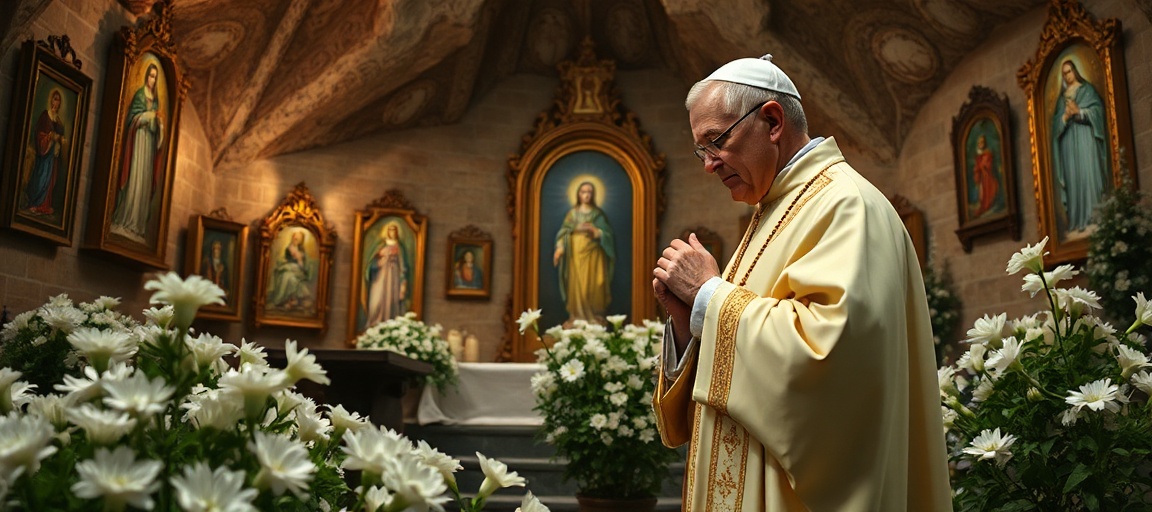
National Catholic Register reports that on May 30, 2026, the usurper Leo XIV (Robert Prevost) led a Rosary at the Lourdes Grotto in the Vatican Gardens to close the Marian month of May. The event, which included images from connected Marian shrines and the offering of white flowers, culminated in a reflection wherein he stated, “True peace begins in a heart that loves,” and described peace as a “daily commitment” that “springs from justice and love.” While invoking Christ as “our peace,” the address systematically omitted the dogma of His public Kingship, reducing the Gospel to a horizontal, naturalistic program of social harmony—a hallmark of the post-conciliar apostasy.
A “Peace” Divorced from the Dogma of Christ the King
The address delivered by Leo XIV at the conclusion of the Marian Month is a textbook example of the modernist reduction of Catholic truth to humanitarian sentiment. The central thesis of the reflection—that “true peace begins in a heart that loves”—is presented as a self-evident, horizontal reality, stripped of the supernatural order and the absolute sovereignty of God. This is a direct contradiction to the immutable teaching of the Church, most authoritatively defined by Pope Pius XI in the encyclical Quas Primas.
Pius XI taught that the hope of lasting peace will not shine upon nations as long as individuals and states refuse to recognize the reign of Our Savior. The encyclical explicitly warns: “When God and Jesus Christ… were removed from laws and states and when authority was derived not from God but from men, the foundations of that authority were destroyed.” By omitting the necessity of submitting to the social Kingship of Christ, Leo XIV’s “peace” is nothing but a naïve illusion, a “theory to be tested in a laboratory,” as he himself inadvertently admitted by his naturalistic framing. The true peace of Christ is not a product of human sentiment or “justice and love” abstracted from divine law; it is the fruit of obedience to the Divine King. As Pius XI declared, “The state is happy not by one means, and man by another; for the state is nothing else than a harmonious association of men.” Without the public acknowledgment of Christ’s rights, any call for peace is a hollow slogan that aligns perfectly with the secularism condemned by the Syllabus of Errors.
The Marian Dimension: A Model of Obedience or a Mere Listener?
The reflection attempts to use the Virgin Mary as a model, stating she is “the model of the believer who inclines the ear of the heart to listen to ‘what God says.'” While true in itself, this presentation is dangerously incomplete. Mary is not merely a passive listener; she is the Queen of Heaven and Earth, the one who bore the King of Kings. The modernist tendency is to reduce Marian devotion to a sentimental, horizontal exercise, severing it from the cosmic battle against Satan and the triumph of her Immaculate Heart.
The address mentions “contemplating the mysteries of the Rosary with Mary leads us to recognize in Jesus Christ the one final Word spoken by the Father, a Word of peace.” This is a subtle but profound distortion. Christ is not merely a “Word of peace” in a generalized, ecumenical sense; He is the King whose kingdom shall have no end, the One who holds all power in heaven and earth. By failing to mention the dogma of the Triumph of the Immaculate Heart or the necessity of consecrating Russia to Mary—a clear sign of the times and a demand for the acknowledgment of Christ’s universal Kingship—the conciliar sect reduces Marian devotion to a tool for humanistic pacifism. This aligns with the “False Fatima Apparitions” file, which notes that the imprecise formulation of “conversion of Russia” without specifying Catholicism opens the way to religious relativism. The neo-church’s Marian devotion is thus stripped of its prophetic, eschatological dimension, becoming a mere “spiritual” comfort for a world in crisis.
Silence on the Social Reign of Christ: The Core of Modernist Apostasy
The most damning omission in the address is the complete silence on the social and public reign of Jesus Christ. Leo XIV speaks of peace as a “daily commitment” that “springs from justice and love, as harmony that unites persons, families, communities and peoples.” This is the language of the United Nations, not the Catholic Church. It is the language of the “cult of man” condemned by Pope St. Pius X in Pascendi Dominici Gregis, where he warned against the modernist tendency to separate the Christ of faith from the Christ of history, reducing religion to a purely subjective, human experience.
The Syllabus of Errors of Pope Pius IX explicitly condemns the proposition that “the Church ought to be separated from the State, and the State from the Church” (Error 55). Leo XIV’s address, by failing to assert the duty of states to publicly honor Christ and obey His laws, implicitly endorses this condemned error. His call for peace is a call for a world without Christ the King, a world where “human rights” and “dialogue” replace the absolute primacy of God’s laws. This is the very essence of the apostasy that St. Pius X warned against: the “enemies within” who seek to modernize the Church by accommodating it to the spirit of the age.
The “Mission” of Peace: A Prophecy Without Truth
The reflection concludes with the statement: “Thus, our prayer becomes mission and prophecy. The cry of the innocent must no longer be heard in our cities.” This is a clear example of the modernist inversion of the order of grace. True prophecy is not a call to social action based on human compassion; it is a proclamation of the truth of God’s judgment and mercy. The true mission of the Church is to preach the Gospel, administer the sacraments, and lead souls to salvation through the acknowledgment of Christ’s Kingship.
By reducing “mission” to a vague commitment to social justice and “prophecy” to a cry for human rights, Leo XIV reveals the bankruptcy of the conciliar sect. The Church’s mission is not to build a “peace” that is merely the absence of conflict; it is to establish the Kingdom of Christ on earth, which alone can bring true and lasting peace. As Pius XI taught, “What we wrote at the beginning of Our Pontificate about the diminishing authority of law and respect for power, the same can be applied to the present times.” The address is a symptom of the very disease it claims to cure: the secularization of the Church and the abandonment of her divine mandate.
Conclusion: The Heresy of Horizontalism
The Rosary address by Leo XIV is a microcosm of the post-conciliar apostasy. It takes a sacred devotion—the Rosary—and empties it of its supernatural, eschatological content, reducing it to a tool for promoting a humanistic, horizontal “peace.” It invokes Christ but denies His Kingship. It speaks of Mary but ignores her prophetic role. It calls for action but omits the only action that matters: the submission of all nations to the social reign of Christ the King.
This is the heresy of horizontalism, condemned by every Pope from Pius IX to Pius XII. It is the fruit of the conciliar revolution, which has transformed the Church from a divine institution into a humanitarian NGO. The true peace of Christ is not found in a “heart that loves” in the abstract; it is found in a heart that submits to the King of Kings and Lord of Lords. Until the conciliar sect repents of its apostasy and restores the dogma of Christ’s social Kingship, its calls for peace will remain a hollow echo in a world hurtling toward the abomination of desolation.
Peace, in fact, is not a theory to be tested in a laboratory, nor a naïve illusion, nor a matter to be pursued out of self-interest. When sought with a sincere heart, it is rather a daily commitment: it springs from justice and love, as harmony that unites persons, families, communities and peoples.
Source:
Pope Leo XIV Prays at End of Marian Month: ‘True Peace Begins in a Heart That Loves’ (ncregister.com)
Date: 31.05.2026