Marian Devotion Reduced to Emotional Self-Help and Feminist Empowerment
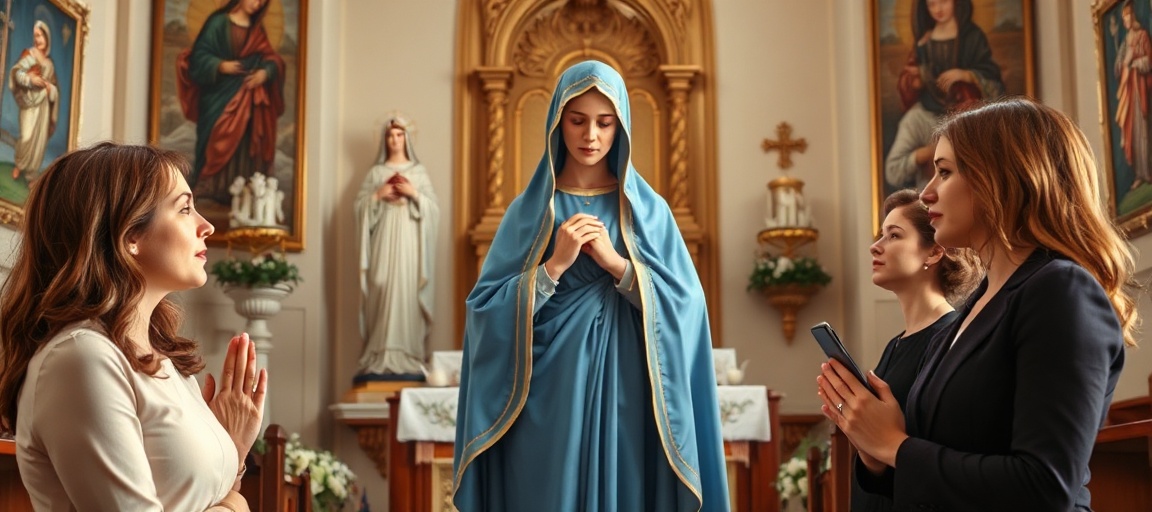
The National Catholic Register portal reports on May 31, 2026, with an article titled “Mary, Model of Feminine Strength, Inspires Catholic Women,” in which three women — Annie Shaw, Kate Fields, and Molly Head — offer personal reflections on the Blessed Virgin Mary through the lens of their own life experiences, presented as models of Marian devotion for Catholic women. The article, authored by Grace Kimzey, a graduate of Franciscan University of Steubenville, frames Marian piety entirely within the categories of feminine empowerment, emotional resilience, and personal vocation, reducing the Mother of God to a psychological companion for navigating pregnancy, grief, and family trials. What is presented as devotion to Mary is, upon even cursory examination, a textbook case of the modernist dissolution of supernatural faith into naturalistic sentimentalism — precisely the kind of corruption that the pre-conciliar Magisterium labored tirelessly to condemn.
The Erasure of Mary’s Divine Maternity and Co-Redemptive Role
The most glaring and damning omission in this entire article is any substantive reference to the Theotokos — the dogmatic title meaning “Mother of God” — as anything more than a decorative name for a university household at Franciscan University of Steubenville. Kate Fields mentions the household named “Theotokos” in passing, but the article never once explains what this title means in Catholic theology, why it was defined at the Council of Ephesus in 431 AD, or why its denial constitutes heresy. Pope Pius XI, in Quas Primas (1925), grounded the universal reign of Christ the King precisely on the dogma of the consubstantiality of the Son with the Father — the very dogma defended at the Council of Nicaea and confirmed at Ephesus. The article’s silence on this foundational truth is not accidental; it is symptomatic of a post-conciliar catechesis that has systematically emptied Marian doctrine of its dogmatic content.
Mary is not presented as the Mediatrix of all graces, the Co-Redemptrix, or the Advocate of the Church. She is not presented as the woman of Genesis 3:15 who crushed the head of the serpent, nor as the woman clothed with the sun in Revelation 12. She is presented instead as a woman with “dirty hands and an apron that’s covered in life.” This is not Catholic devotion. This is the reduction of the Queen of Heaven to a domestic companion — a theological degradation that would have been unthinkable before the conciliar revolution.
Pope Pius IX, in Ineffabilis Deus (1854), defined the Immaculate Conception as a dogma of faith, declaring that Mary was “preserved free from all stain of original sin” by “a singular grace and privilege granted by Almighty God, in view of the merits of Jesus Christ, the Savior of the human race.” The article’s description of Mary as merely “sinless and spotless” in the opening paragraph is a pale shadow of this dogmatic reality, stripped of its supernatural context and presented as a moral compliment rather than a divinely conferred prerogative.
“Feminine Genius” and the Substitution of Gender Ideology for Catholic Doctrine
The article’s framing of Mary as a model of “feminine strength” and its invocation of “true femininity” places it squarely within the post-conciliar project of reinterpreting Catholic teaching through the lens of secular gender categories. Annie Shaw asks Mary directly: “What does true femininity look like?” — as though the Blessed Virgin were a life coach rather than the Mother of God. This is not prayer; it is the democratization of the supernatural order, treating the Queen of Heaven as a peer in a dialogue of equals.
The pre-conciliar Church taught that Mary’s greatness lies precisely in her total surrender to the divine will — her fiat: “Be it done unto me according to thy word” (Luke 1:38). This surrender was not an exercise in feminine self-actualization but an act of perfect obedience to God, meriting her the title Ancilla Domini — Handmaid of the Lord. Pope Leo XIII, in Octobri Mense (1891), emphasized that Mary’s power before God derives entirely from her humility and her union with Christ’s redemptive work, not from any autonomous “feminine strength.”
The article’s three subjects all frame their relationship with Mary in terms of personal emotional needs: Shaw’s complicated pregnancy, Fields’ grief over her mother’s death, Head’s trials as a military spouse. While suffering and the search for comfort are legitimate aspects of the spiritual life, the article presents Mary exclusively as a source of emotional support, never once mentioning the necessity of sanctifying grace, the sacraments, the reality of sin, or the final judgment. This is the cult of man condemned by St. Pius X in Pascendi Dominici Gregis (1907) — the reduction of religion to human experience and feeling.
The Hiddenness Heresy: Mary as Invisible Enabler Rather Than Intercessor
Annie Shaw’s reflection on Mary’s “hiddenness” is particularly revealing of the article’s theological bankruptcy. Shaw states: “Mary teaches in her hiddenness it is better to be hidden in the Lord than seen by the world; better to be known by the Lord in littleness than be known by the world in greatness.” While humility is indeed a virtue, this framing effectively erases Mary’s public, ecclesial, and cosmic role in the economy of salvation. Mary is not “hidden” — she is the woman who stood at the foot of the Cross in full public view (John 19:25), who was present at Pentecost (Acts 1:14), and who, according to Catholic eschatological tradition, will appear in glory at the end of time. The “hiddenness” theology is a modernist trope that serves to privatize faith and remove it from the public, institutional, and dogmatic sphere.
Moreover, Shaw’s claim that “both Mary and the Holy Spirit, though hidden, reveal Jesus” dangerously conflates the distinct persons and roles within the economy of salvation. The Holy Spirit proceeds from the Father and the Son and is the Sanctifier of the Church. Mary is the Mother of God and the Mediatrix. To reduce both to the category of “hiddenness” is to blur the clear theological distinctions that the Church has maintained for two millennia.
The Absence of the Supernatural: No Sacraments, No Sin, No Judgment
Perhaps the most spiritually dangerous aspect of this article is what it does not say. There is no mention of the Holy Mass as the Unbloody Sacrifice of Calvary, no mention of Confession, no mention of the necessity of sanctifying grace for salvation, no mention of the reality of mortal sin, no mention of the Four Last Things — death, judgment, heaven, and hell. The article operates entirely within a naturalistic framework in which Mary functions as a psychological comfort and a model of feminine resilience, rather than as the Mother of the Church who intercedes for sinners before the throne of her Divine Son.
Pope Pius IX, in the Syllabus of Errors (1864), condemned the proposition that “the Church is not a true and perfect society, entirely free — nor is she endowed with proper and perpetual rights of her own” (Proposition 19) and that “the Church has not the power of defining dogmatically that the religion of the Catholic Church is the only true religion” (Proposition 21). The article’s silence on the Church’s unique salvific mission — and by extension, Mary’s role within that mission — is a practical endorsement of the indifferentism condemned by Pius IX.
The three women quoted in the article are all products of the post-conciliar catechetical system: Shaw from Encounter Ministries, Fields from Franciscan University of Steubenville, Head from the general milieu of conciliar Catholic motherhood. None of them demonstrate any awareness of the pre-conciliar Marian devotions — the First Saturdays, the total consecration to Mary as taught by St. Louis de Montfort, the integral theology of the Marian Age as articulated by popes from Leo XIII to Pius XII. Their “Marian devotion” is a product of the conciliar sect’s systematic dismantling of authentic Catholic piety and its replacement with a therapeutic, feminized, and sentimentalized simulacrum.
The Franciscan University Connection: A Nursery of Post-Conciliar Sentimentalism
Grace Kimzey, the article’s author, is identified as a graduate of Franciscan University of Steubenville — an institution that, while it stages the Traditional Latin Mass and maintains an outward appearance of orthodoxy, has been a prolific producer of precisely the kind of emotional, experiential, and subjectively “Marian” piety on display in this article. The university’s emphasis on “household” spirituality, charismatic prayer, and personal encounter with the Holy Spirit has created a generation of Catholics who are fluent in the language of devotion but utterly ignorant of the dogmatic, liturgical, and ascetical tradition of the Church.
Kate Fields’ experience at the “Theotokos” household at Franciscan University is presented as a positive influence, but the article never interrogates whether this household’s understanding of Mary is consistent with the pre-conciliar Magisterium or whether it has been filtered through the lens of post-conciliar charismatic renewal — a movement whose theological foundations remain suspect and whose emphasis on personal experience over doctrinal precision has been a vector for modernist infection within the conciliar structures.
Conclusion: The Marian Devotion of the Neo-Church Is No Marian Devotion at All
What the National Catholic Register presents as a celebration of Marian devotion is, in reality, a case study in the post-conciliar destruction of authentic Catholic piety. The Blessed Virgin Mary — Mother of God, Mediatrix of all graces, Co-Redemptrix, Queen of Heaven and earth — has been reduced to a supportive friend with dirty hands and a comforting word for struggling mothers. The supernatural has been replaced by the sentimental. Dogma has been replaced by personal experience. The Church’s public, institutional, and salvific mission has been replaced by private emotional therapy.
St. Pius X, in Lamentabili Sane Exitu (1907), condemned the proposition that “revelation was merely man’s self-awareness of his relationship to God” (Proposition 20) and that “the dogmas which the Church proposes as revealed are not truths of divine origin but are a certain interpretation of religious facts, which the human mind has worked out with great effort” (Proposition 22). The article’s treatment of Mary — as a human woman whose “strength” can be mined for personal inspiration rather than as the divinely appointed Mother of God whose intercession is necessary for salvation — is a practical application of these very condemned propositions.
The women quoted in this article deserve better than the anemic, naturalistic, and spiritually bankrupt “Marian devotion” offered to them by the conciliar sect. They deserve the fullness of Catholic truth: Mary as she has been taught by the unchanging Magisterium of the true Church — not as a feminist icon or a grief counselor, but as the Queen of Heaven, the Terror of Demons, and the sure refuge of sinners who cry out for the grace of final perseverance.
Source:
Mary, Model of Feminine Strength, Inspires Catholic Women (ncregister.com)
Date: 31.05.2026