Neo-Church Celebrates 60 Years of the Neocatechumenal Way: A Masterpiece of Modernist Subversion
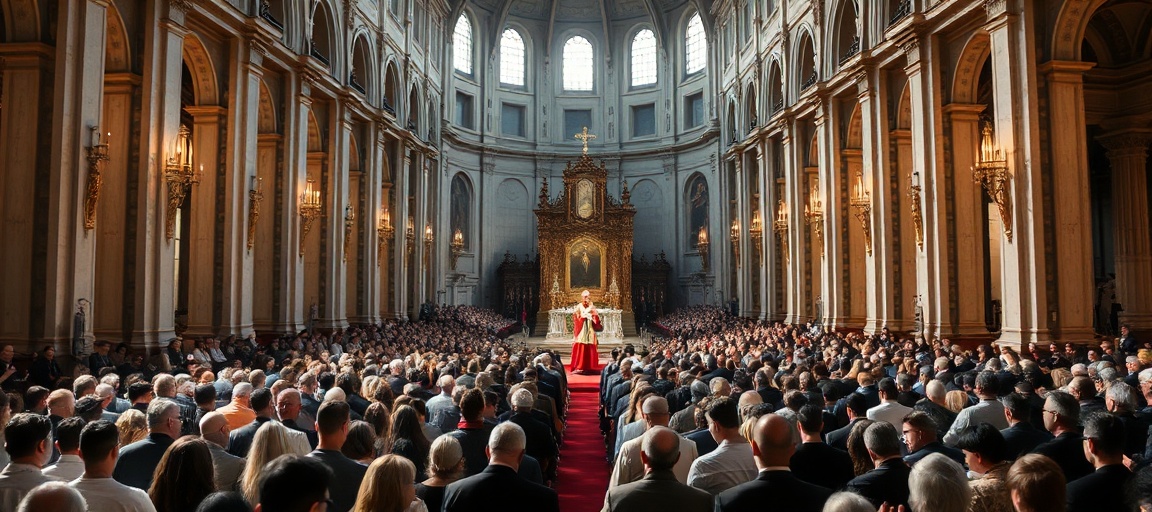
VaticanNews portal reports on the 60th anniversary celebration of the Neocatechumenal Way in Madrid’s Almudena Cathedral, where thousands gathered to commemorate the movement’s growth from the shantytowns of Palomeras Altas to a presence in 138 countries. The article quotes approvingly from a message sent by the antipope Leo XIV (signed by Cardinal Secretary of State Pietro Parolin), praising the movement’s “missionary commitment” and calling it “a fundamental task of the whole Church.” Kiko Argüello, co-founder of the Way, declared that the movement is “a fruit of the Second Vatican Council” and emphasized that “in the Way, we do nothing without the Pope and the bishops,” noting that it has spread “thanks to the support of all the Popes” beginning with Paul VI. Cardinal Cobo Cano of Madrid expressed gratitude for “sixty years of evangelisation” and announced the opening of the beatification cause for co-founder Carmen Hernández. Cardinal Kevin Farrell praised the movement for producing “innumerable conversions, the birth of Christian families, vocations to the priesthood and religious life.” The article presents the Neocatechumenal Way as a glowing success story of post-conciliar “evangelization.” What it conceals is that this movement is one of the most destructive instruments of the conciliar revolution, designed to replace the Catholic parish with heterodox communities, to undermine the authority of bishops, and to advance the modernist agenda under the guise of missionary zeal.
The Neocatechumenal Way: A Fruit of the Council, a Poison for the Church
The article’s central thesis, repeated by virtually every figure quoted, is that the Neocatechumenal Way is a “fruit of the Second Vatican Council” and a “gift of the Holy Spirit.” This claim alone should be sufficient to arouse the deepest suspicion in any faithful Catholic, for the Second Vatican Council was the very instrument through which Modernism—condemned by Saint Pius X as “the synthesis of all heresies”—captured the institutional structures of the Church. To declare that a movement is a “fruit” of that Council is to declare, in plain language, that it is a fruit of heresy. The Holy Spirit, who is the Spirit of Truth (John 16:13), does not produce fruits that contradict the perennial Magisterium of the Church. As the decree Lamentabili sane exitu of Saint Pius X condemns: “The Church is an enemy of the progress of natural and theological sciences” (Proposition 57) and “Truth changes with man, because it develops with him, in him, and through him” (Proposition 58)—precisely the evolutionist mentality that animates the conciliar revolution and its offspring, the Neocatechumenal Way.
Kiko Argüello’s statement that the movement began when he “left behind his career as a painter” and went to live among the poor “inspired by the example of Saint Charles de Foucauld” is a carefully crafted narrative of sanctity designed to obscure the movement’s true nature. The Catholic Church has always taught that authentic missionary work flows from the sacramental life of the Church, from the Most Holy Sacrifice of the Mass, and from obedience to the hierarchy established by Christ—not from the private inspirations of lay individuals who gather communities outside the parish structure. Pius XI, in Quas Primas, taught that “the Church, established by Christ as a perfect society, demands for itself by a right belonging to it, which it cannot renounce, full freedom and independence from secular authority.” The Neocatechumenal Way does not seek freedom for the Church; it seeks freedom from the Church’s established structures, creating parallel communities that owe their allegiance not to the local bishop but to the movement’s own international team.
The Heresy of “Christian Initiation” Without the Sacraments
The article repeatedly employs the language of “Christian initiation,” a term that in modernist usage has been deliberately emptied of its Catholic content. In authentic Catholic theology, Christian initiation consists of the sacraments of Baptism, Confirmation, and Holy Eucharist, administered within the context of the Catholic Church under the authority of her legitimate pastors. The Neocatechumenal Way has redefined “Christian initiation” as a prolonged process of communal formation that can last years, effectively creating a parallel catechumenate that treats the sacraments—already received—as mere waystations on a journey defined by the movement’s own methods. This is a direct contradiction of the Council of Trent, which taught that the sacraments confer grace ex opere operato—by the very fact of their valid administration—and not through the subjective dispositions fostered by a particular movement.
Kiko Argüello’s claim that the Way seeks to “form Christian communities like the Holy Family of Nazareth, living in humility, simplicity and praise” is a masterwork of modernist rhetoric. The Holy Family of Nazareth lived in obedience to the Mosaic Law, attended the synagogue, and fulfilled every requirement of the religion established by God. The Neocatechumenal Way, by contrast, creates communities that operate with near-total autonomy from diocesan structures, celebrating a truncated “liturgy” that is not the Most Holy Sacrifice of the Mass but a simulacrum designed to foster communal bonding rather than the adoration of God. The movement’s “three pillars of Word, Liturgy and Community” replace the Catholic triad of Sacraments, Magisterium, and Tradition with a horizontal, anthropocentric framework that places the community at the center rather than God.
The Antipope’s Endorsement: A Seal of Apostasy
The message from the antipope Leo XIV, which the article presents as the highest possible endorsement, deserves particular scrutiny. “It is important to remember,” the message states, “that the evangelising mission is a fundamental task of the whole Church. With joy and humility, seeking the unity of all her members and docile to the action of the Holy Spirit, the Church is called to bring the gift of salvation to everyone.” This language is a textbook example of the modernist heresy of religious indifferentism, condemned by Pope Pius IX in the Syllabus of Errors: “Man may, in the observance of any religion whatever, find the way of eternal salvation, and arrive at eternal salvation” (Proposition 16) and “Protestantism is nothing more than another form of the same true Christian religion, in which form it is given to please God equally as in the Catholic Church” (Proposition 18). The phrase “the gift of salvation” is deliberately vague—it does not specify that salvation comes exclusively through the Catholic Church, as defined by the Fourth Lateran Council: Extra Ecclesiam nulla salus (“Outside the Church there is no salvation”).
The antipope’s call for “a renewed missionary commitment for the sake of God’s beloved children” echoes the false ecumenism that has been the hallmark of the conciliar sect since Vatican II’s Dignitatis Humanae, which Pius IX had condemned in advance: “The Roman Pontiff can, and ought to, reconcile himself, and come to terms with progress, liberalism and modern civilization” (Proposition 80). Authentic Catholic missionary work seeks the conversion of non-Catholics to the one true Faith, not the fostering of a vague “unity” that treats all religions as equally valid paths to God. As Pius XI declared in Quas Primas: “His reign, namely, extends not only to Catholic nations or to those who, by receiving baptism according to law, belong to the Church, even though their erroneous opinions have led them astray or discord has separated them from love, but His reign encompasses also all non-Christians, so that most truly the entire human race is subject to the authority of Jesus Christ.” The Neocatechumenal Way’s “mission” is not the Catholic mission of converting souls to Christ through His one true Church; it is the modernist mission of building communities of mutual affirmation that serve the conciliar agenda.
The Beatification Cause of Carmen Hernández: Canonizing Modernism
Cardinal Cobo Cano’s announcement that the diocesan phase of the beatification cause for Carmen Hernández is about to close is perhaps the most revealing element of the entire article. The post-conciliar structures have been engaged for decades in a systematic campaign to create a new pantheon of “saints” who embody the values of the new church—ecumenism, religious liberty, dialogue with the world, and the democratization of the Church. Just as the antipope Francis “canonized” John Henry Newman—a convert from Anglicanism whose theological writings on the development of doctrine were a direct precursor to Modernism, and who was buried at his own request in the same grave as his “friend” a priest—so too the beatification of Carmen Hernández is designed to sanctify the Neocatechumenal Way and, through it, the entire conciliar revolution.
The article notes that “there have been many signs of holiness among you,” as Cardinal Cobo Cano told the assembled faithful. But the Catholic Church has always taught that true holiness consists in the theological virtues of Faith, Hope, and Charity, united with the moral virtues and the gifts of the Holy Spirit, all lived in union with the Church and her sacraments. The “holiness” of the Neocatechumenal Way is a counterfeit—a naturalistic imitation that produces emotional experiences, communal bonds, and a sense of purpose, but not the supernatural transformation of the soul that comes from grace received through the true sacraments of the Catholic Church. As Saint Pius X warned in Pascendi Dominici Gregis, the Modernists “propose a reform of the Catholic religion” that would transform it into “a certain dogmaless Christianity, that is, into a broad and liberal Protestantism” (Proposition 65 of Lamentabili). The beatification of Carmen Hernández would be the canonization of precisely this heresy.
The Linguistic Camouflage of Apostasy
A careful analysis of the language employed throughout the article reveals the extent to which the conciliar sect has developed a specialized vocabulary designed to obscure the true nature of its innovations. The word “communion” appears repeatedly—”ecclesial communion,” “communion with the Lord,” “the Church is communion”—but it is emptied of its Catholic meaning. In Catholic theology, communion (communio) refers to the unity of the faithful with Christ and with one another through the profession of the same faith, the participation in the same sacraments, and the submission to the same authority (the Pope and the bishops in union with him). In modernist usage, “communion” becomes a vague sense of togetherness that can include Protestants, Orthodox, and even non-Christians—precisely the false ecumenism condemned by Pius XI in Mortalium Animos.
Similarly, the word “mission” is used throughout the article without any specification of what the mission actually entails. Authentic Catholic mission is the missio ad gentes—the preaching of the Gospel to non-baptized peoples with the explicit goal of their conversion to the Catholic Church and their reception of the sacraments. The Neocatechumenal Way’s “mission” is something far more insidious: it is the transformation of Catholic parishes into communities shaped by the movement’s own methods, effectively replacing the Catholic liturgy with a modernist simulacrum and the Catholic catechism with a subjective, experience-based formation. Cardinal Farrell’s enumeration of the movement’s “fruits”—”the return of countless people to faith and to the Church, innumerable conversions, the birth of Christian families, vocations to the priesthood and religious life”—is presented without any critical examination of what kind of “faith,” what kind of “Church,” what kind of “conversions,” and what kind of “vocations” these actually are. Given that the entire conciliar structure has been producing precisely the kind of “clergy” and “religious” who advance the modernist agenda, these “fruits” are not fruits of the Holy Spirit but fruits of the revolution.
The Omission That Condemns: Silence on the Most Holy Sacrifice
Perhaps the most damning feature of the entire article is what it does not say. There is not a single mention of the Most Holy Sacrifice of the Mass, not a single reference to the Real Presence of Christ in the Eucharist, not a single word about the propitiatory nature of the Sacrifice of Calvary renewed on our altars. This silence is not accidental; it is the defining characteristic of the conciliar religion. The Neocatechumenal Way has been repeatedly criticized for its liturgical abuses—the celebration of “Masses” in community gatherings that bear little resemblance to the Traditional Latin Mass, the reduction of the Eucharist to a communal meal, the substitution of the Church’s liturgy with the movement’s own rituals. The article’s complete silence on these matters is an admission that the movement’s “liturgy” is not the Catholic liturgy but a modernist counterfeit.
Pius XI, in Quas Primas, taught that “Christ possesses the so-called executive power, for all must obey His commands, and this under the threat of announced punishments, which the obstinate cannot escape.” The Neocatechumenal Way, by creating its own liturgical practices and its own communal structures, has effectively placed itself above the authority of the Church’s liturgical law—an authority that belongs to the Holy See and to the bishops in communion with it. Kiko Argüello’s claim that “in the Way, we do nothing without the Pope and the bishops” is belied by decades of evidence that the movement has consistently operated as a law unto itself, spreading its methods across dioceses with minimal oversight and resisting all attempts at reform.
Conclusion: The Abomination of Desolation in the Temple of God
The celebration of the Neocatechumenal Way’s 60th anniversary, endorsed by the antipope, the “cardinals,” and the “bishops” of the conciliar sect, is not a cause for joy but a cause for mourning. It is the celebration of a movement that has been one of the most effective instruments in the destruction of Catholic parish life, the replacement of the Most Holy Sacrifice with a modernist simulacrum, and the advancement of the apostate agenda of Vatican II. The article in VaticanNews presents this movement as a success story; from the perspective of integral Catholic faith, it is a catastrophe.
The true Church of Christ endures—not in the structures of the conciliar sect, not in the “communities” of the Neocatechumenal Way, but in the faithful who profess the integral Catholic faith, who seek out the true Mass of all ages, and who refuse to bow before the idols of Modernism. As Saint Robert Bellarmine taught in De Romano Pontifice, a manifest heretic ceases to be Pope and head of the Church by that very fact (ipso facto), for “a manifest heretic cannot be Pope… a manifest heretic is not a Christian… therefore, a manifest heretic cannot be Pope.” The antipope Leo XIV, by endorsing the Neocatechumenal Way, has merely confirmed what every faithful Catholic already knows: that the structures occupying the Vatican are not the Catholic Church but the abomination of desolation standing in the holy place (Matthew 24:15). The response of the faithful is not to celebrate with them but to reject them utterly and to cling to the unchanging Tradition of the Catholic Church, which alone is the Ark of Salvation.
Source:
Pope says "Mission" is the Church's task as Neocatechumenal Way marks 60 years (vaticannews.va)
Date: 31.05.2026