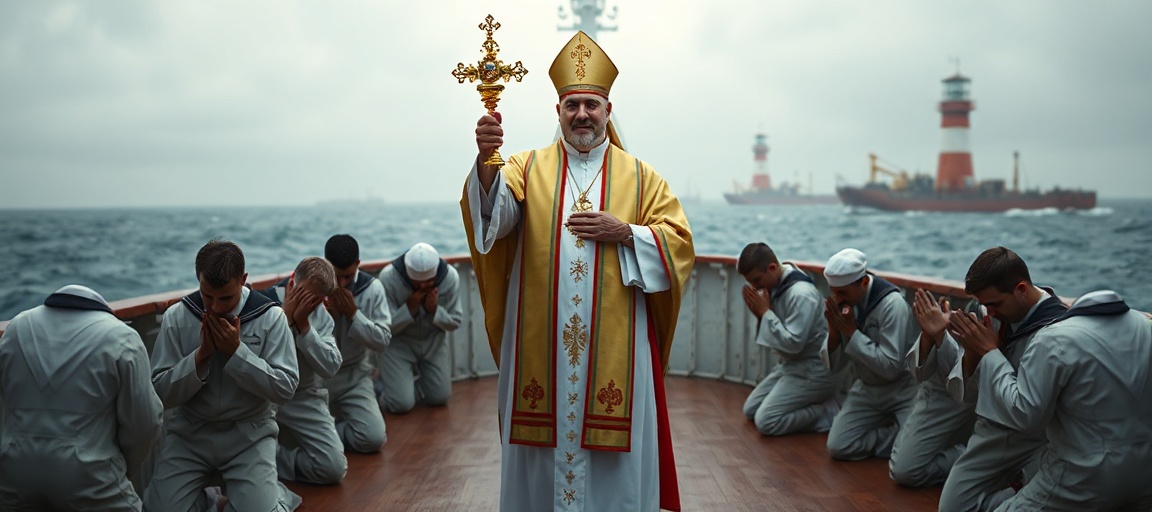
Stella Maris and the Dilution of Sacred Ministry into Mere Humanitarian Accompaniment
EWTN News reports that Seattle Auxiliary Bishop Frank Schuster, speaking ahead of the National Day of Prayer and Remembrance for Mariners, described the work of Stella Maris (formerly the Apostleship of the Sea) as a “ministry of accompaniment” focused on delivering toiletries to sailors, listening to traumatized seafarers, and making referrals for mental health — celebrating Mass aboard ships is mentioned almost as an afterthought. The article presents this humanitarian outreach as the essence of the Church’s mission to those at sea. What is conspicuously absent from this entire portrait is any mention of the salvation of souls, the necessity of the sacraments for eternal life, the reality of sin and the need for conversion, or the supernatural purpose of the Church’s existence — revealing a ministry that has effectively reduced the Catholic faith to a nautical social-work agency.
The Primacy of the Supernatural: What the Church Actually Exists to Do
The Catholic Church was not founded by Our Lord Jesus Christ to distribute toothbrushes and bars of soap. It was not established to provide “a good ear” for those suffering workplace anxiety. The Church exists for one supreme, supernatural purpose: to lead souls to eternal salvation through the preaching of the Gospel, the administration of the sacraments, and the governance of the faithful under the authority of Christ the King. As Pope Pius XI declared in Quas Primas (1925), “the Church of God, by constantly providing spiritual nourishment to people, gives birth to and raises up ever new ranks of holy men and women, and Christ does not cease to call to happiness in the heavenly Kingdom those who were faithful and obedient subjects to Him in the earthly Kingdom.” The “sweet and saving reign of Our King” is the raison d’être of every Catholic apostolate.
When Bishop Schuster states that his “favorite part” of the ministry is “just getting on board the ships and being able to do ministry,” and then describes this as “being able to celebrate Mass, sit down to eat with them and talk about life, it feels like I’m a pastor again,” he unwittingly reveals the inversion that has taken hold. The celebration of the Most Holy Sacrifice of the Mass — the unbloody renewal of Calvary, the most awesome act of worship the world has ever known — is lumped together with sharing a meal and casual conversation as though they were equivalent pastoral activities. The Mass is not one item on a menu of ministerial services; it is the center and summit of all Catholic life, the very reason the Church has a mission at sea or anywhere else.
“Ministry of Accompaniment” — A Modernist Slogan Replaces the Mission of Conversion
The phrase “ministry of accompaniment” has become one of the signature expressions of post-conciliar discourse, and its appearance here is entirely symptomatic. What does “accompaniment” mean in Catholic theology? The Church accompanies souls toward God — toward repentance, confession, sanctifying grace, and eternal life. The accompaniment that Bishop Schuster describes, however, is purely naturalistic: listening to sailors discuss trauma, providing referrals for depression, delivering hygiene products. Nowhere in the article is there any indication that these seafarers are sinners in need of conversion, that they are mortal souls who will face the Particular Judgment, that they require absolution from their sins through the sacrament of Penance to avoid eternal damnation.
This is the hallmark of the conciliar revolution: the reduction of the Church’s mission from the salvation of souls to the alleviation of temporal suffering. Pope Leo XIII, in his encyclical Immortale Dei (1885), taught that “the Almighty, therefore, has given the charge of the human race to two powers, the ecclesiastical and the civil, the one being set over divine, and the other over human, each the highest in its kind, and each fixed within limits which are defined and determined by its own nature and special object.” The Church’s competence is the supernatural order. When a bishop devotes his ministry to soap, razors, and mental-health referrals, he has effectively abdicated his sacred office and replaced it with the work of a secular NGO.
The Sacraments as Afterthought
Bishop Schuster notes that “the main role of port chaplains with Stella Maris is to celebrate Mass and the sacraments aboard ships” — and then immediately pivots to describing the distribution of gifts and counseling services. The grammar itself is revealing: the sacraments are mentioned as a kind of preamble, a box to be checked, before the “real” work of humanitarian outreach begins. One searches the article in vain for any mention of Baptism for the unconverted, Confirmation for the unconfirmed, Penance for the dying, or the Anointing of the Sick for those in danger of death at sea — situations that would be among the most urgent conceivable pastoral emergencies.
The Council of Trent taught that the sacraments of the New Law “contain the grace they signify and confer that grace” (Session VII, Canon 6). They are not symbolic gestures; they are the divinely instituted means by which souls receive sanctifying grace. A port chaplain who fails to prioritize the sacraments — especially Penance and the Holy Eucharist — is a chaplain who fails in his primary duty. To treat the celebration of Mass as merely one aspect of a broader humanitarian portfolio is to deny what the Church has always taught: that the Eucharist is “the source and summit of the Christian life” (Lumen Gentium 11 — though even this conciliar document, compromised as it is, recognized the principle, however much the conciliar sect has failed to live by it).
The Abandoned Ships: A Missed Opportunity for Supernatural Clarity
Bishop Schuster mentions the crew of the Dali cargo ship, stranded in Baltimore after the Key Bridge disaster, and notes that a port chaplain “regularly checks in on several members of the crew.” One might ask: what does he check in for? The article suggests only material and psychological concern. But if these men are in a foreign city, under legal investigation, separated from their families, facing an uncertain future, they are precisely the kind of souls who should be reminded of the fragility of human life, the certainty of death, and the necessity of being in the state of grace. The situation cries out for fervent preaching of the Gospel, urgent calls to confession, and the offering of the Holy Sacrifice for their intentions. Instead, we are given the impression of a chaplain who “checks in” — language indistinguishable from a social worker’s case notes.
Stella Maris and the Post-Conciliar Captivity of Maritime Ministry
The article notes that Stella Maris was renamed in 2020, “a nod to St. John Paul II’s 1997 motu proprio.” Let us be clear about what this means. John Paul II — that is, the usurper Karol Wojtyła — was one of the chief architects of the conciliar apostasy, the man who embraced false ecumenism at Assisi, who promoted the religion of humanity, who “canonized” dubious figures and presided over the near-destruction of Catholic doctrine and discipline. To invoke his name as the inspiration for a Catholic ministry is to anchor that ministry firmly in the post-conciliar revolution.
The original Apostleship of the Sea, approved by Pope Pius XI in 1922, was born in an era when the Church understood that her mission to seafarers was first and foremost a mission of evangelization and sanctification. Pius XI, the same pontiff who established the Feast of Christ the King against the rising tide of secularism, would have understood that bringing the Mass and the sacraments to sailors was not one item among many but the essential, indispensable core of the apostolate — everything else being ordered toward that supernatural end. The renaming of the ministry in 2020, under the authority of the conciliar sect, is not merely a cosmetic change; it is a reorientation of the ministry’s identity toward the horizontal, humanitarian, “accompanying” model that characterizes the neo-church’s abandonment of its supernatural mission.
The Silence on Sin, Judgment, and Eternity
Perhaps the most damning feature of the entire article is what it does not say. There is no mention of sin. There is no mention of the need for conversion. There is no mention of the Last Things — death, judgment, Heaven, Hell. There is no mention of the reality that every one of these seafarers is an immortal soul who will stand before God and give an account of his life. There is no mention that the greatest act of charity one can perform for another human being is to help him save his soul.
Pope St. Pius X, in his Pascendi Dominici Gregis (1907), identified the essence of Modernism as the denial of the supernatural and its reduction to naturalistic terms. The Modernist, he wrote, “acknowledges that faith is a sentiment of the soul” rather than a supernatural assent to revealed truth. When a Catholic bishop describes his ministry entirely in terms of psychological support, material aid, and “feeling good” about pastoral conversation, he is exhibiting precisely the naturalistic reduction that Pius X condemned. The seafarers of the world do not need another sympathetic listener; they need a priest who will tell them the truth about their souls, offer them the sacraments of salvation, and lead them to Christ the King, before whom every knee shall bow.
Conclusion: Restore the Sacred
The Catholic Church’s ministry to seafarers — like every Catholic ministry — must be ordered toward the supernatural end for which the Church exists: the glory of God and the salvation of souls. The distribution of hygiene products and the provision of counseling referrals are not wrong in themselves, but when they become the substance of a bishop’s description of his ministry, something has gone terribly wrong. The Mass is not a warm-up act for social work. The sacraments are not one service among many. The priest is not a counselor with a collar.
Until the structures occupying the Vatican return to the unchanging teaching and mission of the true Catholic Church — until bishops understand that their office is to teach, govern, and sanctify, not to manage humanitarian programs — ministries like Stella Maris will continue to drift further into the naturalist abyss. The seafarers deserve better. Their immortal souls demand better. Deus Vult.
Source:
Bishop highlights Church’s ministry to seafarers facing danger and isolation (ewtnnews.com)
Date: 31.05.2026