The Newark “Catholic Boom”: A Masterclass in Modernist Catechetical Bankruptcy
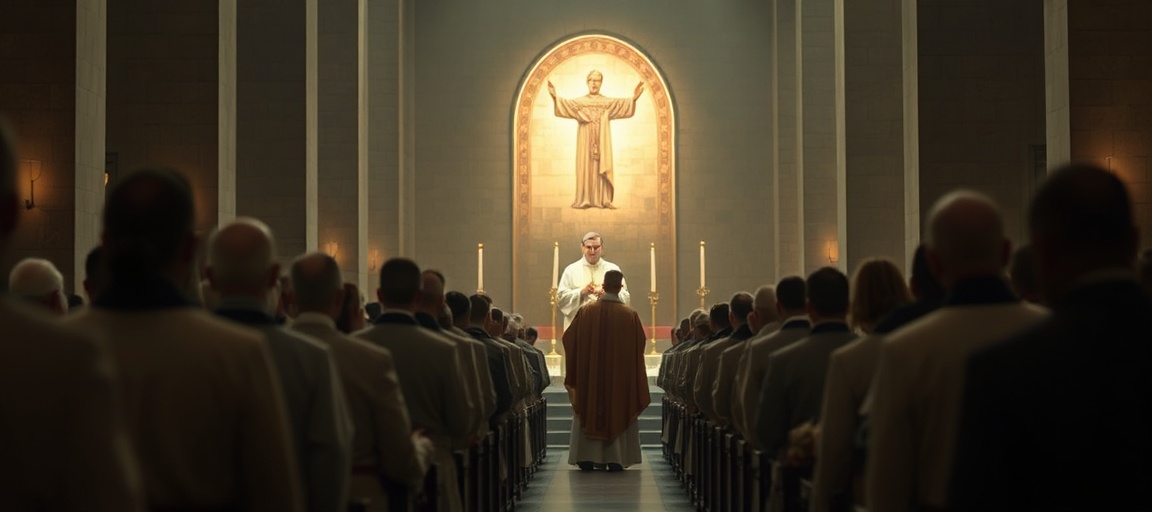
National Catholic Register portal reports that the Archdiocese of Newark, New Jersey, is experiencing a significant surge in new Catholics, with 1,701 catechumens receiving Sacraments of Initiation this Easter season—a 72% increase since 2023. The article attributes this growth to young professionals and immigrants seeking meaning, community, and spiritual grounding in a modern world perceived as empty. It highlights intensive formation programs, diverse demographics, and personal testimonies of conversion, portraying the phenomenon as a vibrant renewal of faith. Yet beneath this veneer of ecclesiastical triumphalism lies a profound theological and spiritual bankruptcy characteristic of the post-conciliar abomination of desolation.
The Illusion of Growth in an Apostate Structure
The article presents statistics as if they were signs of divine blessing: packed churches, rising numbers, enthusiastic testimonials. But quantity is not quality, and numerical growth within the structures of the neo-church proves nothing about the state of true Catholic faith. The Archdiocese of Newark, like all post-conciliar jurisdictions, operates under the authority of usurpers—beginning with John XXIII and culminating in the current antipope, Leo XIV (Robert Prevost)—whose legitimacy is null and void according to immutable Catholic doctrine. As St. Robert Bellarmine teaches, a manifest heretic ceases to be Pope ipso facto, losing all jurisdiction and authority over the Church. The 1917 Code of Canon Law (Canon 188.4) confirms that public defection from the Catholic faith results in automatic loss of office without any declaration. Pope Paul IV’s Cum ex Apostolatus Officio further declares null and void any promotion or elevation of one who has defected from the faith.
Thus, the “Archdiocese of Newark” is not a true diocese of the Catholic Church but a paramasonic structure occupying the shell of what was once a vibrant Catholic jurisdiction. Its “bishops,” “priests,” and “sacraments” are suspect at best, and likely invalid or sacrilegious at worst. The so-called “Sacraments of Initiation” administered therein are not guarantees of grace but potential occasions of sacrilege, especially given the widespread adoption of modernist rites and the doctrinal corruption that permeates every level of the conciliar sect.
Catechesis Without Dogma: The Modernist Formation Factory
The article touts the rigorous yearlong formation program at St. Ann Parish in Hoboken, where catechumens meet twice weekly for doctrinal instruction, Scripture study, and spiritual reflection. Yet nowhere does it mention the content of this formation. What “Catholic doctrine” are they taught? Is it the unchanging dogmas defined by the Council of Trent, the Syllabus of Errors, and Quas Primas? Or is it the watered-down, ecumenically palatable, socially conscious “faith” of Vatican II and its aftermath?
Consider the testimony of John Scully, 29, who says he was drawn away from “sports gambling and porn addiction” and sought “values aligned with family.” While personal morality is commendable, this is naturalism, not supernatural faith. True conversion involves recognition of sin as an offense against God, repentance motivated by the love of God and fear of eternal punishment, and submission to the authority of the One True Church. The article reduces Christianity to self-improvement and emotional fulfillment—a hallmark of Modernism condemned by St. Pius X in Pascendi Dominici Gregis and Lamentabili Sane Exitu.
Cheryl James, director of the RCIA at St. Ann, claims her students “have opened their minds and hearts to see and feel the proof that God exists.” But faith is not based on feelings or empirical proofs; it is a supernatural virtue, a gift of God, assenting to divine truth on the authority of God Who reveals. The Catechism of the Council of Trent explicitly warns against reducing faith to human reasoning or emotional experience. This modernist catechesis produces not Catholics but sentimental theists—precisely the “dogmaless Christianity” condemned in Lamentabili, Proposition 65.
The Ecumenical Abyss: “Converts” from False Religions
The article proudly notes that many new Catholics come from Muslim, Hindu, Buddhist, Jewish, and Protestant backgrounds. It frames this as a triumph of evangelization. In reality, it is a symptom of the false ecumenism condemned by Pope Pius XI in Mortalium Animos and by the entire pre-conciliar Magisterium. The Catholic Church has always taught that she is the only true religion, outside of which there is no salvation (Pope Eugene IV, Cantate Domino). Dialogue with non-Catholics must aim at their conversion to the fullness of truth, not mutual enrichment or interfaith harmony.
Yet the article describes converts like Alexandra Lee, who was moved by the deaths of Korean youths and sought “fairness” and “hope there was a God for those kids.” Her “conversion” was triggered not by the preaching of the Gospel but by emotional trauma and aesthetic experience—kneeling congregations, pottery wheels, imagined Marian apparitions. This is not the work of the Holy Spirit but of psychological manipulation and naturalistic mysticism. The “Blessed Mother calling to her” is indistinguishable from the subjective visions of false mystics like Faustyna Kowalska, whose writings were condemned and placed on the Index of Forbidden Books.
Similarly, Maria Russo, raised in an evangelical church, “fell in love with the holiness” of St. Ann because of its “quiet” atmosphere. Sanzhar Lemay, a former Muslim, was drawn by a “sense of peace.” These are not conversions to Catholic dogma but preferences for liturgical aesthetics and emotional comfort. The article never mentions the Real Presence of Christ in the Eucharist, the necessity of baptism for salvation, the infallibility of the Pope, or the obligation to accept all defined doctrines. Silence on these points is deafening and damning.
The Reign of Christ the King: The Great Omission
Perhaps the most glaring omission in the entire article is any reference to the social reign of Christ the King. Pope Pius XI, in Quas Primas, declared that the peace and happiness of society depend on the public recognition of Christ’s royal authority over individuals, families, and states. He lamented that “when God and Jesus Christ were removed from laws and states… the foundations of authority were destroyed.” The article, however, presents Catholicism as a private spiritual resource for personal fulfillment, completely divorced from its public and social mission.
There is no mention of the duty of rulers to profess the Catholic faith, no condemnation of secularism or laicism, no call for the restoration of the Church’s temporal independence, no warning against the Masonic and Communist forces that seek to destroy Christendom. Instead, we are offered feel-good stories about young professionals finding community and meaning. This is the religion of man, not the religion of God. It is the “cult of man” condemned by the pre-conciliar Magisterium and embodied in the conciliar document Gaudium et Spes.
The Sacramental Charade: Confirmation Without Faith
The article describes moving scenes of confirmation, with candidates kneeling, sponsors standing by, and “priests” imposing hands. But what is the efficacy of these rites? The sacraments confer grace ex opere operato, but only when received with proper disposition and within the true Church. If the minister is a heretic or schismatic, his actions are null. If the recipient lacks true faith—believing, for example, that all religions are equally valid or that the Church has erred in her past definitions—then the sacrament is sacrilegious.
The testimonies reveal a faith devoid of supernatural content. Allegra McMahon speaks of “gains in wisdom and maturity” leading her to “know God is active in the world.” Brenda Gotelli discovered God through a 12-step program’s “higher power” concept. These are not Catholic conversions but generic theistic awakenings. The article never mentions the necessity of believing in the Trinity, the Incarnation, the Redemption, the Resurrection, the Last Judgment, or the existence of Hell. It never warns against the dangers of receiving Communion in a state of mortal sin or the obligation to confess all grave sins before approaching the altar.
Conclusion: The Triumph of Naturalism Over Supernatural Faith
The so-called “Catholic boom” in Newark is not a revival of Catholicism but a triumph of naturalism, emotionalism, and modernist catechesis. It is the fruit of the conciliar revolution, which replaced the supernatural religion of Christ with a humanistic religion of man. The structures of the neo-church are not beacons of truth but instruments of deception, leading souls not to eternal life but to spiritual ruin.
True Catholics must reject this false narrative and cling to the unchanging faith of the ages. As Pope Pius IX declared in the Syllabus of Errors, “The Roman Pontiff can, and ought to, reconcile himself, and come terms with progress, liberalism and modern civilization” (Proposition 80) is condemned. The Church cannot adapt to the world; the world must convert to Christ. Until the usurpers in the Vatican are cast out and the true hierarchy restored, there can be no authentic renewal—only the accelerating apostasy foretold by the prophets and popes.
Let us pray for the conversion of those deceived by this modernist spectacle, and let us remain faithful to the integral Catholic faith, outside of which there is no salvation.
Source:
In Newark, a New Generation Is Finding the Catholic Faith (ncregister.com)
Date: 31.05.2026