The Trinity Reduced to a Mantra of Universal Communion Without Christ the King
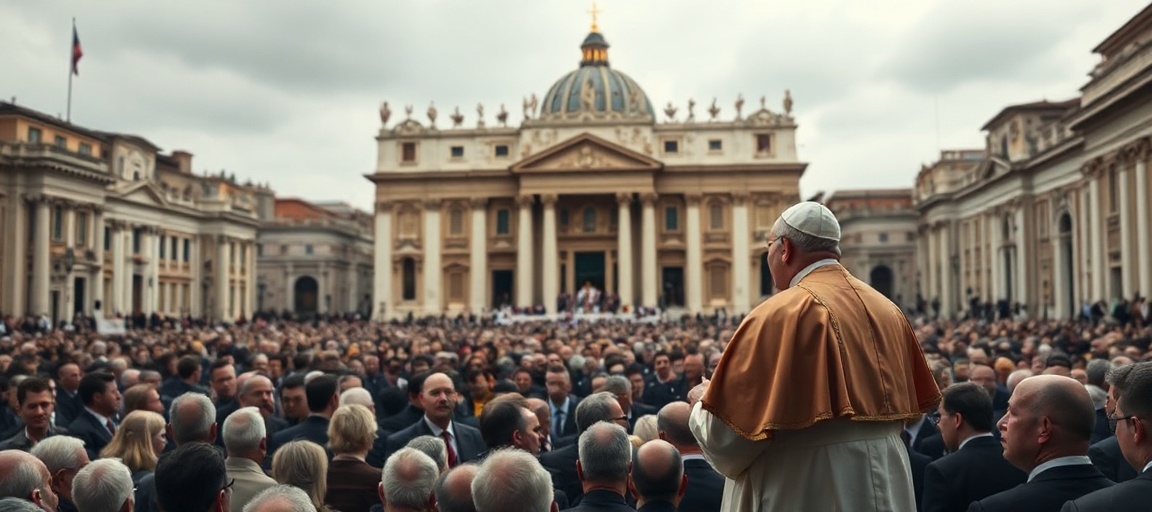
National Catholic Register portal reports that on May 31, 2026, the usurper Robert Prevost, styling himself “Pope Leo XIV,” addressed pilgrims in St. Peter’s Square on the solemnity of the Most Holy Trinity, reducing the ineffable mystery of God to a vague humanitarian principle of “communion” and “encounter,” while praying for peace in the language of the United Nations rather than invoking the Social Kingship of Christ. The cited article presents a litany of naturalistic platitudes devoid of any mention of conversion, repentance, the necessity of the Catholic Church for salvation, or the reign of Christ over nations — a silence that reveals the depth of the modernist apostasy at the heart of the conciliar sect.
The Mystery of the Trinity Dissolved into Sentimental Humanism
The central claim attributed to Leo XIV is breathtaking in its theological vacuity: “The Trinity helps us to love everyone and everything: we discover that every creature is made for communion, relationship and encounter.” This sentence, stripped of all doctrinal precision, could have been uttered at any Masonic lodge, United Nations assembly, or Buddhist retreat. The Most Holy Trinity — one God in three consubstantial Persons, as defined by the Council of Nicaea and defended by Pius XI in *Quas Primas* — is here reduced to a sentimental slogan about “relationship” and “encounter.” There is no mention of the divine essence, no mention of the hypostatic union by which Christ the Man possesses dominion over all creatures, no mention of the indwelling of the Holy Spirit through sanctifying grace in the souls of the baptized. The Trinity becomes a mascot for the religion of man.
Pius XI, in *Quas Primas*, taught with unmistakable clarity that the kingship of Christ is founded on the hypostatic union and extends over all men and all nations: “His reign, namely, extends not only to Catholic nations or to those who, by receiving baptism according to law, belong to the Church, even though their erroneous opinions have led them astray or discord has separated them from love, but His reign encompasses also all non-Christians, so that most truly the entire human race is subject to the authority of Jesus Christ.” Where is this Christ in Leo XIV’s discourse? Where is the Christ who demands obedience, who commands repentance, who will judge the living and the dead? He has been replaced by a god of “communion” — a god who asks nothing, demands nothing, and condemns nothing. This is the god of the *Syllabus of Errors* condemned proposition 80: the god who has “reconciled himself with progress, liberalism, and modern civilization.”
Nicodemus Without the Demand for Baptism
The treatment of the encounter between Christ and Nicodemus is equally revealing. Leo XIV presents Jesus as one who “welcomed him and took his search for answers seriously” — language more appropriate to a therapist’s office than to the proclamation of the Gospel. What does Our Lord actually say to Nicodemus? “Amen, amen, I say to thee, unless a man be born again of water and the Holy Spirit, he cannot enter into the kingdom of God” (John 3:5). The necessity of baptism — the absolute, non-negotiable requirement for salvation — is nowhere to be found in Leo XIV’s reflection. Instead, Nicodemus is presented as someone who simply “received the Spirit of communion” and whose heart was “opened to new truths.”
This is the very essence of modernist indifferentism, condemned by Pius IX in the *Syllabus*: “Man may, in the observance of any religion whatever, find the way of eternal salvation” (proposition 16), and “Good hope at least is to be entertained of the eternal salvation of all those are not at all in the true Church of Christ” (proposition 17). By omitting baptism entirely and replacing it with vague “communion,” Leo XIV implicitly teaches that the specific means of salvation instituted by Christ are unnecessary — that the “Spirit” can be received without the sacraments, without the Church, without conversion to the Catholic faith.
“The Church Becomes a Sacrament of Communion” — But Which Church?
Leo XIV declares: “The Church becomes a sacrament of communion, a place of encounter, love and life where heaven and earth already touch.” This language is drawn directly from the conciliar constitution *Lumen Gentium*, which redefined the Church not as the unique ark of salvation but as a “sacrament” of unity for the entire human race. The true Church, as taught by Pius XI, is “a perfect society” that “demands for itself by a right belonging to it, which it cannot renounce, full freedom and independence from secular authority.” The Church is not a “place of encounter” in the sense of a spiritual marketplace where all comers are welcomed regardless of belief. The Church is the Mystical Body of Christ, outside of which there is no salvation — *extra ecclesiam nulla salus*.
What Leo XIV calls “communion” is in reality the demolition of the Church’s exclusive claim to truth. When he speaks of “contempt for diversity” as destructive, he is implicitly condemning the Church’s perennial teaching that error has no rights, that false religions are not “diverse paths to God” but obstacles to salvation. The *Syllabus* condemns the proposition that “every man is free to embrace and profess that religion which, guided by the light of reason, he shall consider true” (proposition 15). Yet this is precisely the worldview that undergirds Leo XIV’s rhetoric of “diversity” and “encounter.”
Prayers for Peace Without the Prince of Peace
After the Angelus, Leo XIV recalled the Marian prayers for peace offered during May: “May Divine Wisdom enlighten the consciences of those in authority and guide their decisions toward a sincere search for a just and lasting peace.” This is the language of naturalistic diplomacy, not of Catholic theology. Where is the recognition that “the hope of lasting peace will not yet shine upon nations as long as individuals and states renounce and do not wish to recognize the reign of our Savior” (Pius XI, *Quas Primas*)? Where is the acknowledgment that peace is only possible in the Kingdom of Christ, and that Christ must reign in laws, in education, in the administration of justice?
The *Syllabus* condemns the separation of Church and State (proposition 55) and the proposition that “the Catholic religion should no longer be held as the only religion of the State” (proposition 77). Yet Leo XIV prays for “Divine Wisdom” to guide unnamed “those in authority” — without once specifying that these authorities have a binding obligation to recognize Christ the King, to submit their laws to the governance of the Church, and to govern according to Catholic principles. This is the peace of the world, not the peace of Christ: “My peace I give to you, not as the world gives do I give to you” (John 14:27).
The Omission That Condemns: No Mention of Conversion, Repentance, or the Last Things
The most damning feature of Leo XIV’s address is not what it says, but what it omits entirely. There is no mention of:
– The necessity of conversion to the Catholic faith for salvation — the very reason Christ came into the world.
– The reality of sin and the need for repentance — replaced by the language of “encounter” and “openness.”
– The sacraments as the ordinary means of grace — baptism, confession, the Holy Eucharist are entirely absent.
– The final judgment and the eternal consequences of rejecting Christ — the ultimate “division” is not between peoples but between the saved and the damned.
– The Social Kingship of Christ over nations, governments, and every aspect of public life.
– The distinction between the true Church and false religions — all are subsumed under the blanket of “communion.”
This systematic silence is not accidental. It is the hallmark of modernism, which St. Pius X described in *Pascendi Dominici Gregis* as the “synthesis of all heresies.” Modernism does not deny doctrine outright — it relativizes it, reinterprets it, and ultimately replaces it with naturalistic categories. The Trinity becomes a model for “inclusive community.” The Church becomes a “sacrament of communion” rather than the exclusive ark of salvation. Prayer for peace becomes a humanitarian gesture rather than a demand for the submission of nations to Christ the King.
The Fruit of the Conciliar Revolution
Leo XIV’s address is not an aberration — it is the logical and inevitable fruit of the conciliar revolution inaugurated by John XXIII and his successors. The entire trajectory of post-conciliar teaching has been the systematic replacement of supernatural doctrine with naturalistic humanism, the substitution of “dialogue” for proclamation, and the reduction of the Church from the Mystical Body of Christ to a facilitator of global “communion.” The *Syllabus of Errors* warned against precisely this development when it condemned the proposition that the Roman Pontiff “can, and ought to, reconcile himself, and come to terms with progress, liberalism and modern civilization” (proposition 80).
What we witness in the structures occupying the Vatican today is not the Catholic Church. It is the abomination of desolation standing in the holy place (Matthew 24:15) — a paramasonic structure that uses the language of Catholicism to advance the program of the Synagogue of Satan. Pius IX, in the *Syllabus*, warned: “The masonic associations are anathematized… not only in Europe but also in America and wherever they may be in the whole world.” The religion of “communion,” “diversity,” and “encounter” without Christ the King is the religion of the Antichrist, and it is being preached from the very window of the Apostolic Palace.
The faithful who desire salvation must reject this counterfeit and hold fast to the immutable Tradition: that there is one God in three Persons; that Jesus Christ is King of all nations; that the Catholic Church is the only ark of salvation; that outside her there is no peace, no communion, and no life. “He who is not with Me is against Me” (Matthew 12:30). There is no middle ground, no “communion” with error, no “encounter” with the spirit of the world. The choice is Christ or the Antichrist — and the structures occupying the Vatican have made their choice abundantly clear.
Source:
Pope Leo XIV: The Trinity Teaches That Every Creature Is Made for Communion (ncregister.com)
Date: 31.05.2026