Trinity of Deception: Leo XIV’s Angelus and the Modernist Subversion of the Supernatural
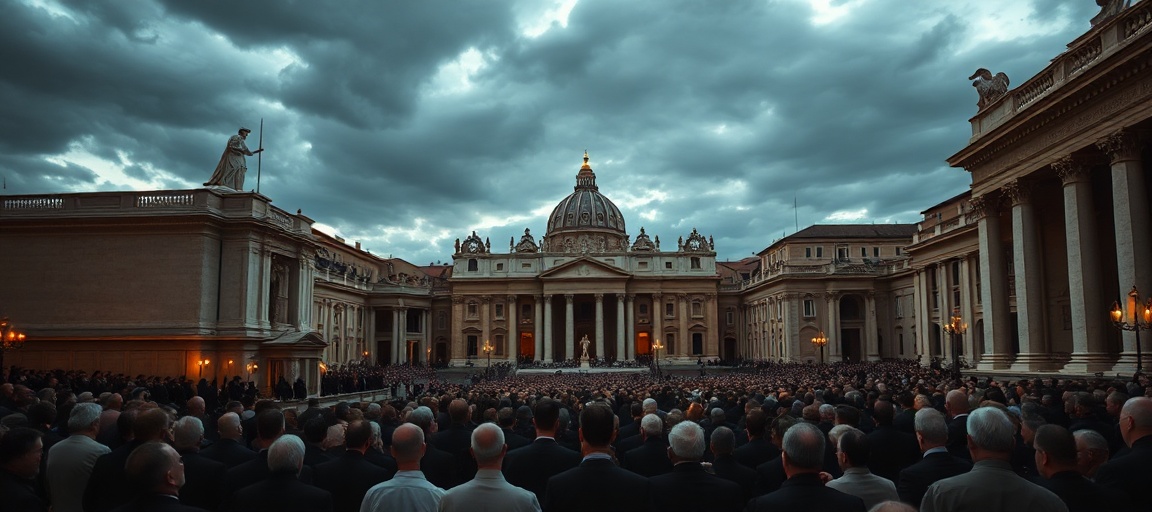
On May 31, 2026, on the Solemnity of the Most Holy Trinity, the usurper Leo XIV addressed the faithful gathered in St. Peter’s Square for the Angelus prayer. Vatican News portal reports that he focused on the dynamic of God’s life given in Jesus, the Holy Spirit placed on hearts, and the Church as a “sacrament of communion.” Leo XIV, drawing on the figure of Nicodemus, emphasized that “we are at home” in the Trinity, that God’s love is the source of peace and communion, and that “polarization” and “diversity” lead to sadness. He urged everyone to say “yes” to God’s will, like Mary. However, beneath the seemingly pious veneer, this address is saturated with modernist errors, naturalistic reductionism, and a complete silence on the supernatural realities of sin, grace, and the true mission of the Church, exposing the theological and spiritual bankruptcy of the conciliar sect.
The Trinity Reduced to a “Home” and “Communion”: Naturalistic Reductionism
Leo XIV’s central assertion, that in the mystery of the Most Holy Trinity “we are at home,” and that this “gives peace to our heart, which is often very restless,” is a profound trivialization of the most sublime mystery of the Catholic faith. The Most Holy Trinity is not a comfortable dwelling place for restless human hearts, but the infinite, incomprehensible, and terrifyingly holy God, “Consubstantial with the Father,” as the Nicene Creed unequivocally professes. Pius XI, in his encyclical *Quas Primas*, emphasized that Christ’s kingdom is “primarily spiritual and relates mainly to spiritual matters,” and that “His reign, namely, extends not only to Catholic nations or to those who, by receiving baptism according to law, belong to the Church, even though their erroneous opinions have led them astray or discord has separated them from love, but His reign encompasses also all non-Christians, so that most truly the entire human race is subject to the authority of Jesus Christ.” The focus here is not on subjective human comfort, but on the objective, absolute, and universal dominion of Christ the King, demanding obedience and submission of intellect and will.
By reducing the Trinity to a source of “peace” and “encounter,” Leo XIV completely bypasses the fundamental Catholic teaching on the necessity of sanctifying grace, the state of grace, and the constant struggle against sin. The Catechism of the Council of Trent teaches that man, by original sin, is “deprived of the supernatural gifts” and “subject to ignorance, suffering, and the dominion of death, and prone to vice.” The “restlessness” of the human heart is not merely a psychological state to be soothed by a vague “communion,” but a consequence of original sin and actual mortal sin, which can only be remedied by true repentance, confession, and the grace of the sacraments. Leo XIV’s language is that of a naturalistic psychologist, not a successor of St. Peter, who would remind the faithful of the “one thing necessary” for eternal salvation.
The “Church” as a “Sacrament of Communion”: A Modernist Ecclesiology
Leo XIV’s statement that the Church “becomes a sacrament of communion, a place of encounter, love and life where heaven and earth already touch” is a direct echo of the modernist ecclesiology condemned by St. Pius X. The Church is not merely a “place of encounter” or a “sacrament of communion” in a horizontal, sociological sense. She is the *Mystical Body of Christ*, a supernatural society instituted by God for the salvation of souls, endowed with infallible teaching authority, the power to sanctify through the sacraments, and the duty to govern. Pius IX, in his *Syllabus of Errors*, condemned the proposition that “The Church is not a true and perfect society, entirely free- nor is she endowed with proper and perpetual rights of her own, conferred upon her by her Divine Founder; but it appertains to the civil power to define what are the rights of the Church, and the limits within which she may exercise those rights” (Proposition 19). Leo XIV’s language, by emphasizing “communion” and “encounter” without defining the Church’s divine constitution, her infallible magisterium, and her exclusive claim to truth, implicitly reduces her to a humanistic gathering, a “place” for subjective experience, rather than the ark of salvation.
This modernist view of the Church is further evidenced by his silence on the necessity of the Catholic Church for salvation. The Fourth Lateran Council dogmatically defined that “There is indeed one universal Church of the outside of which no one at all is saved.” Leo XIV, by speaking of “encounter” and “communion” without specifying that this communion is only possible within the true Church, through her sacraments and under her authority, opens the door to indifferentism and false ecumenism, which Pius IX condemned as the error that “Man may, in the observance of any religion whatever, find the way of eternal salvation, and arrive at eternal salvation” (Proposition 16).
Nicodemus and the “Spirit of Communion”: A Distortion of Conversion
Leo XIV’s reflection on Nicodemus, who “sought him out at night to avoid being seen,” and who “learned that God could transform his life,” is a masterful example of modernist reinterpretation of Scripture. The Gospel account of Nicodemus (John 3:1-21) is a profound teaching on the necessity of Baptism (“Unless one is born again of water and the Holy Spirit, he cannot enter the kingdom of God”) and the divine origin of salvation (“God so loved the world that He gave His only begotten Son, that whoever believes in Him should not perish but have everlasting life”). Leo XIV, however, transforms this into a narrative of personal “transformation” and “interior illumination” devoid of the supernatural realities of grace, faith, and the sacraments.
His assertion that “Whoever does not welcome this Spirit grows old quickly, in sorrow, feeling all alone and without joy in their hearts” is a psychologization of sin and grace. The “Spirit of communion” he speaks of is not the Holy Ghost, the Third Person of the Most Holy Trinity, who bestows sanctifying grace and the theological virtues, but a vague, immanent force of “encounter” and “love.” This is a direct echo of the modernist error condemned by St. Pius X in *Lamentabili Sane Exitu*, which rejected the proposition that “Revelation was merely man’s self-awareness of his relationship to God” (Proposition 20). Leo XIV’s “Spirit” is not the Spirit of Truth who proceeds from the Father and the Son, but a spirit of humanistic “communion” that bypasses the need for true conversion, repentance, and the sacramental life.
Silence on Sin, Judgment, and the True Mission of the Church
Perhaps the most damning aspect of Leo XIV’s address is what it omits. There is no mention of sin, mortal or venial, no call to repentance, no warning of judgment, no mention of Hell, Purgatory, or the necessity of penance. The “restlessness” of the heart is not attributed to sin, but to a lack of “communion.” The “sadness” and “emptiness” are not consequences of separation from God through sin, but of “polarization” and “dislike of diversity.” This is a complete inversion of the Catholic understanding of the human condition and the Church’s mission.
Pius XI, in *Quas Primas*, explicitly stated that “the entire government of public schools in which the youth- of a Christian state is educated, except (to a certain extent) in the case of episcopal seminaries, may and ought to appertain to the civil power, and belong to it so far that no other authority whatsoever shall be recognized as having any right to interfere in the discipline of the schools, the arrangement of the studies, the conferring of degrees, in the choice or approval of the teachers” (Proposition 45 of the *Syllabus* condemned this). Leo XIV, by focusing on “encounter” and “communion” without addressing the moral and doctrinal formation of youth, the necessity of Catholic education, and the dangers of secularism, reveals his complicity with the very “secularism of our times, so-called laicism, its errors and wicked endeavors” that Pius XI identified as the “plague that poisons human society.”
His call to “say ‘yes’ to God’s will, like Mary” is emptied of its supernatural content when divorced from the necessity of faith, hope, charity, and the observance of God’s commandments. Mary’s *fiat* was not a vague assent to “love” and “communion,” but a profound act of faith and submission to the divine plan of redemption, which included the Cross and the sacrifice of her Son. Leo XIV’s “yes” is a modernist “yes” to a god of his own making, a god of “encounter” and “peace,” not the God of Abraham, Isaac, and Jacob, the God who is a consuming fire.
The “Abomination of Desolation” Speaks: A Call to Rejection
Leo XIV’s Angelus address is not a homily from the successor of St. Peter, but a sermon from the mouth of the “abomination of desolation” (Matt. 24:15). It is a testament to the complete triumph of Modernism within the conciliar structures, where the supernatural is replaced by the natural, the divine by the human, and the Church of Christ by a “sacrament of communion” that leads not to eternal life, but to spiritual death. The “peace” he offers is not the peace of Christ, which “surpasses all understanding” (Phil 4:7), but the false peace of a world that has rejected its King.
The faithful must reject this modernist subversion and cling to the immutable truth of the Catholic faith, as taught by the Fathers, the Councils, and the true Popes. The Most Holy Trinity is not a “home” for restless hearts, but the infinite God who demands adoration, worship, and obedience. The Church is not a “place of encounter,” but the ark of salvation, outside of which there is no salvation. And the “Spirit” is not a vague force of “communion,” but the Holy Ghost, who bestows grace and leads to all truth. Let us pray for the true Church, for the restoration of the Holy Mass, and for the coming of the day when Christ the King will truly reign over all nations, and the “abomination of desolation” will be cast out from the holy place.
Source:
Pope at Angelus: We find our home in the Trinity (vaticannews.va)
Date: 31.05.2026