The Idolatry of Athletic Glory: When Catholic Media Celebrates Worldly Triumph Over Spiritual Warfare
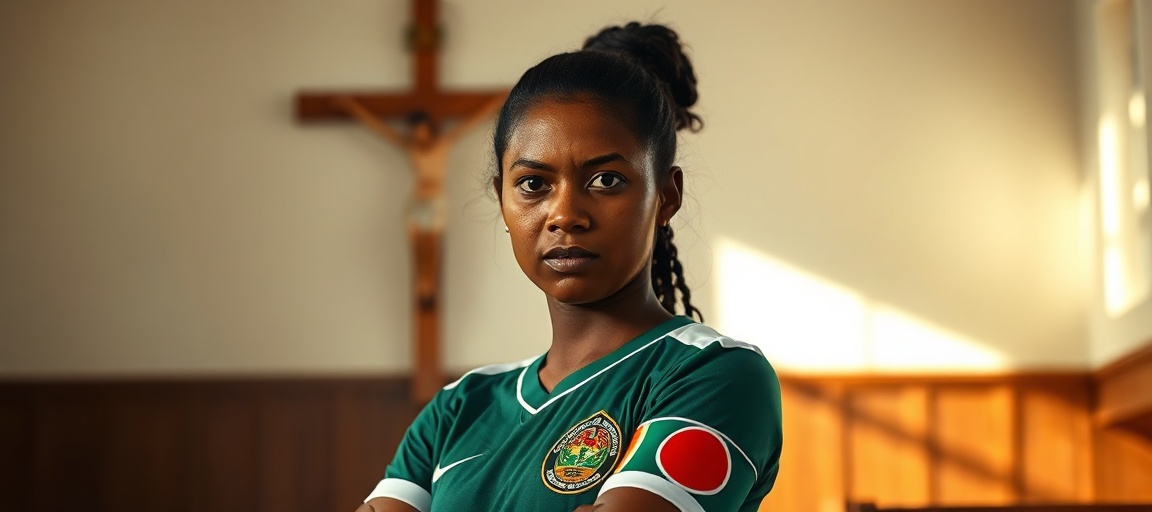
EWTN News portal reports on the celebration of Christian women in South Asian soccer, highlighting Maria Manda, a Catholic from Bangladesh’s Garo Indigenous community, who has been named captain of her country’s women’s national team. The article presents her athletic achievements as a source of “pride” and “inspiration” for the Christian community, while remaining completely silent on the spiritual dangers of elevating worldly sports to the level of Christian witness. This is not journalism—it is the normalization of athletic idolatry dressed in Catholic vocabulary, a symptom of the post-conciliar Church’s capitulation to secular values.
The Reduction of Christian Witness to Athletic Achievement
The article opens with a celebration of Maria Manda’s appointment as captain of Bangladesh’s women’s national soccer team, describing it as a source of “widespread pride” among the country’s Christian community. The language employed is revealing: pride, achievement, leadership, inspiration—all worldly categories utterly foreign to the Gospel’s call to humility, self-denial, and the carrying of one’s cross. “Today, Christian youth and the youth of the country are very happy and proud to see the national team armband in your hand,” declared Father Bikash James Rebeiro, CSC, secretary of the Episcopal Commission for Youth. This statement, presented without critique, exposes the theological bankruptcy of post-conciliar Catholic leadership: the armband of a soccer captain has replaced the Cross of Christ as the symbol of Christian identity.
The article’s framing is not merely inadequate—it is spiritually dangerous. By presenting athletic success as a form of Christian witness, it implicitly teaches the faithful that excellence in worldly competition constitutes a legitimate and praiseworthy expression of Catholic identity. This stands in direct opposition to the teaching of St. Paul: “They that are Christ’s have crucified the flesh with the vices and concupiscences” (Galatians 5:24). The article’s enthusiasm for Manda’s “fighting mentality” and her ability to “carry the ball from defensive lines to the opponent’s box” reveals a complete inversion of the Christian understanding of spiritual warfare, which concerns not the defeat of earthly opponents on a soccer field but the battle against sin, the world, and the devil.
The Silence on the Dangers of Worldly Glory
Nowhere in this article is there any mention of the spiritual dangers inherent in the pursuit of athletic glory, the vanity of human applause, or the fundamental incompatibility between the spirit of competitive sports and the spirit of the Gospel. The Church Fathers consistently warned against the seductive nature of worldly honors and the theater of public spectacle. St. John Chrysostom, in his homilies on the Gospel of Matthew, thundered against those who seek the praise of men rather than the approval of God: “For what does it profit a man to gain the whole world and forfeit his soul?” (Mark 8:36). The article’s celebration of Manda’s “reputation as one of the team’s most decisive players” and her status as “a great inspiration for millions” echoes the very values that Christ condemned when He warned: “Woe to you when all men speak well of you” (Luke 6:26).
The post-conciliar Church’s obsession with visibility, relevance, and positive media coverage has produced a generation of Catholic leaders who instinctively celebrate any instance of Catholic participation in secular activities, regardless of whether such participation advances or undermines the salvation of souls. Father Rebeiro’s statement that Manda has “proven that with concentration and dreams, it is possible to overcome any obstacle” is a perfect example of this secularized Christianity: the language of self-help and positive thinking has replaced the language of grace, sacrifice, and redemption. Where is the mention of prayer, sacramental life, or the intercession of the saints? Where is the recognition that true Christian victory is achieved not through athletic prowess but through the merits of Christ and the cooperation of divine grace?
The Idolization of Athletes as Christian Role Models
The article extends its celebration beyond Manda to other Christian women in South Asian soccer, including Joyann Geraldine Thomas of Pakistan, described as “the first Christian woman to represent her country,” and Grace Dangmei of India, who “has helped India win multiple SAFF titles.” The implicit message is clear: these women are held up as role models for Catholic youth, their athletic achievements presented as exemplary expressions of Christian identity. This represents a profound confusion of values that would have been unrecognizable to the pre-conciliar Church.
The Church’s tradition has always recognized that the true models of Christian life are the saints—those who attained heroic virtue through prayer, mortification, and union with God. The elevation of athletes to the status of Christian role models is a direct consequence of the conciliar revolution’s abandonment of the supernatural order in favor of naturalistic humanism. Pope Pius XI, in his encyclical Quas Primas, established the Feast of Christ the King precisely to combat the secularization of society and the removal of Christ from public life. Yet here we see a Catholic media outlet celebrating not the reign of Christ but the reign of athletic competition, not the victory of the Cross but the victory of the soccer ball.
The Omission of Spiritual Warfare
Perhaps most damning is the article’s complete silence on the reality of spiritual warfare. The language of “fighting” and “battle” is appropriated from the Christian spiritual tradition and applied to athletic competition, while the true battle for souls is ignored. The Church teaches that the Christian life is a militia, a warfare against the powers of darkness: “For our wrestling is not against flesh and blood; but against principalities and powers, against the rulers of the world of this darkness, against the spirits of wickedness in the high places” (Ephesians 6:12). The reduction of this cosmic struggle to a soccer match is not merely trivial—it is blasphemous, for it trivializes the very real battle for eternal salvation that every Christian must wage.
The article’s title—”How Christian Women Are Shaping South Asian Soccer”—reveals the fundamental inversion of priorities that characterizes post-conciliar Catholicism. The question that should be asked is not how Christians are shaping soccer, but how the pursuit of athletic glory shapes—and potentially endangers—the souls of those who engage in it and those who celebrate it. The Church’s mission is the salvation of souls, not the promotion of Catholic participation in secular sports. The pre-conciliar Church understood this distinction; the post-conciliar Church has forgotten it.
The Complicity of Catholic Media
EWTN News, as a Catholic media outlet, bears a particular responsibility for the content it publishes. By presenting this article without any critical commentary or spiritual context, it implicitly endorses the worldview it describes: that athletic achievement is a legitimate and praiseworthy expression of Catholic identity, that worldly success constitutes Christian witness, and that the values of competitive sports are compatible with the Gospel. This is a failure of the Catholic press’s fundamental duty to form consciences in accordance with the teaching of the Church.
The article’s closing lines—Manda’s statement that “We will be careful not to make the same mistakes we made in the first match”—are presented as evidence of her leadership qualities. But what of the mistakes of the Catholic media itself? What of the mistake of presenting worldly achievement as spiritual progress? What of the mistake of remaining silent on the dangers of vanity, pride, and the seductive nature of public acclaim? These are the errors that truly matter, and they go unaddressed.
Conclusion: The Call to Return to Catholic Priorities
The celebration of Christian women in South Asian soccer, as presented in this article, is not a sign of Catholic vitality but a symptom of Catholic decline. It reveals a Church that has lost its supernatural orientation, that has exchanged the language of salvation for the language of secular achievement, and that has forgotten the words of St. John the Baptist: “He must increase, but I must decrease” (John 3:30). The true measure of Christian life is not athletic success but sanctity; not public acclaim but the approval of God; not the defeat of earthly opponents but the victory over sin and death through the Cross of Christ.
The faithful must reject this worldly orientation and return to the authentic priorities of the Catholic faith: the salvation of souls, the glory of God, and the reign of Christ the King over all aspects of human life—including, and especially, the media that claim to serve Him. Until Catholic media outlets recognize that their mission is not to celebrate Catholic participation in secular activities but to form souls in the truths of the faith, they will continue to contribute to the very secularization they claim to oppose.
Source:
How Christian women are shaping South Asian soccer (ewtnnews.com)
Date: 01.06.2026