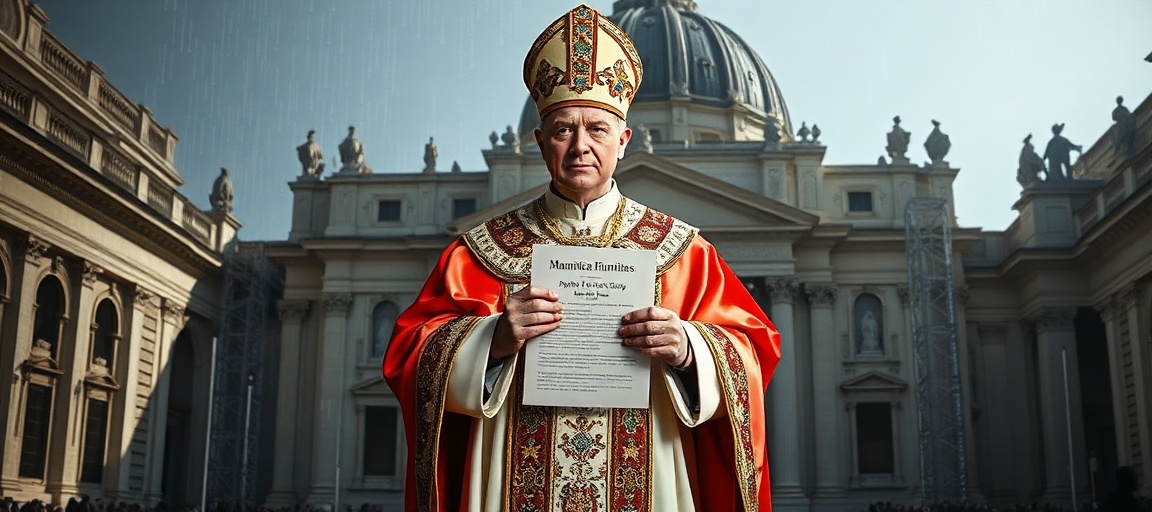
The Usurper on Peter’s Throne Speaks: Magnifica Humanitas and the Digital Abomination
VaticanNews portal reports that the current usurper of the Chair of Peter, Robert Prevost – who styles himself “Pope Leo XIV” – sent a message dated 1 June 2026 to participants in the Third Open Expert Meeting on the revision of the World Medical Association’s Declaration of Taipei. The message, signed on his behalf by Cardinal Pietro Parolin, calls for “stronger safeguards to protect human dignity” in the collection and use of health data, warns against reducing individuals to “exploitable data,” and references his recent encyclical *Magnifica Humanitas*. The conciliar sect’s mouthpiece presents this as a noble defense of human dignity and the common good. Behind the veneer of humanitarian concern, however, lies the same modernist rot that has characterized the post-conciliar abomination: a naturalistic anthropology divorced from supernatural truth, an appeal to “human dignity” stripped of its properly theological content, and the continued legitimization of a heretical structure that has no authority whatsoever to teach on matters of faith or morals.
The Authority That Is No Authority: A Usurper Presumes to Teach
Before examining the content of this message, the fundamental question must be addressed: by what authority does Robert Prevost speak? He occupies the Vatican apparatus not as the legitimate successor of St. Peter but as the latest in a continuous line of usurpers beginning with John XXIII, who convened the Second Vatican Council – that Magna Carta of modernist revolution. The conciliar sect, having systematically dismantled the Catholic faith through the introduction of religious liberty (Dignitatis Humanae), false ecumenism (Unitatis Redintegratio), and the naturalistic reform of the liturgy (Sacrosanctum Concilium), forfeited any claim to authentic magisterial authority. As St. Robert Bellarmine teaches, a manifest heretic ipso facto ceases to be Pope and head (Bellarmine, De Romano Pontifice, II, 30). The post-conciliar occupants of the Vatican are manifest heretics – their own documents condemn them.
That the message is signed by Cardinal Pietro Parolin, Secretary of State of the conciliar apparatus, only underscores the bureaucratic machinery of the paramasonic structure operating in Rome. This is not the voice of the Church; it is the voice of the abomination of desolation standing in the holy place (Mt 24:15), speaking with the cadences of Catholic language while hollowing out its substance.
Anthropology Without Grace: “Human Dignity” as Modernist Mantra
The central claim of the message is that “every person possesses inherent dignity that cannot be reduced to mere information or commercial value” and that each individual is “an irreducible and unique individual of inestimable value.” Superficially, this sounds Catholic. But what does the conciliar sect mean by “human dignity”? In the modernist framework, “human dignity” is a purely naturalistic concept, detached from the supernatural order, from sanctifying grace, from the reality of original sin, and from the necessity of the Catholic Church for salvation.
Pius XI, in Quas Primas (1925), taught that Christ the King reigns over all men – not by courtesy of secular human rights declarations, but by divine right: “His reign encompasses also all non-Christians, so that most truly the entire human race is subject to the authority of Jesus Christ.” The “human dignity” proclaimed by the conciliar sect is not the dignity of the baptized soul in the state of grace, purchased “not with corruptible gold or silver… but with the precious blood of Christ” (1 Pet 1:18-19) – it is the dignity of autonomous man, the man of the French Revolution, the man condemned in proposition 80 of the Syllabus of Errors: “The Roman Pontiff can, and ought to, reconcile himself, and come to terms with progress, liberalism and modern civilization.”
The message speaks of persons “created in the image and likeness of God” – but this formula, torn from its sacramental and ecclesiological context, becomes a blank check for indifferentism. All men are “equal in dignity,” therefore all religions are equally valid paths, therefore the Church’s missionary mandate is reduced to “dialogue,” therefore the Most Holy Sacrifice of the Mass is unnecessary for salvation. This is the inexorable logic of modernist anthropology, and it is the logic that pervades every utterance of the conciliar apparatus.
Magnifica Humanitas: An Encyclical from the Abyss
The message explicitly references the usurper’s recent encyclical Magnifica Humanitas. The very title reveals the modernist project: not Magnificat – the hymn of the Blessed Virgin acknowledging God’s mercy and the scattering of the proud – but Magnifica Humanitas, the glorification of humanity itself. This is the cultus hominis, the cult of man, which lies at the heart of the conciliar revolution. Vatican II’s Gaudium et Spes, the pastoral constitution on the Church in the modern world, inaugurated this anthropocentric turn, placing man – not God – at the center of the Church’s concern.
Pius IX, in the Syllabus of Errors, condemned the proposition that “the progress of sciences requires a reform of the concept of Christian doctrine concerning God, creation, Revelation, the Person of the Incarnate Word, and Redemption” (Proposition 64). Yet this is precisely what the concilar sect has done: it has reformed doctrine to accommodate the “progress” of the human sciences, of technology, of the digital age. The encyclical Magnifica Humanitas is merely the latest iteration of this apostate project – a document that, whatever its surface rhetoric, emanates from a source that has no authority to bind the faithful.
The “New Form of Colonialism”: A Distraction from the Real Enemy
The message warns against “a new form of colonialism” that seeks to transform personal lives into exploitable data. This rhetoric is revealing. The conciliar apparatus, which has presided over the greatest colonization in human history – the colonization of the Catholic faith by modernist errors, the colonization of the liturgy by Protestant and Masonic influences, the colonization of Catholic schools and universities by secular ideologies – now poses as the defender of the oppressed against “digital colonialism.”
Where was this concern for human dignity when the concilar sect embraced religious liberty, thereby opening the floodgates to the proselytism of Protestant sects, the advance of Islam, and the proliferation of occult and New Age movements throughout the formerly Catholic world? Where was this concern when the post-conciliar structures systematically dismantled the Church’s institutions – religious orders, seminaries, Catholic schools – leaving the faithful defenseless against precisely the forms of exploitation the message now decries? The hypocrisy is staggering.
Pius XI warned in Quas Primas that the rejection of Christ’s kingship over society leads to “seeds of discord sown everywhere, flames of envy and hostility… unbridled desires… domestic peace completely shattered… the whole society profoundly shaken and heading towards destruction.” The “new colonialism” of which the usurper speaks is not the cause of our civilizational crisis – it is a symptom. The cause is the rejection of the Social Kingship of Christ, which the concilar sect has systematically undermined since 1958.
Silence on the Supernatural: The Defining Absence
Read the message carefully: where is the mention of sin? Where is the mention of grace? Where is the mention of the sacraments as the ordinary means of salvation? Where is the mention of the Most Holy Sacrifice of the Mass? Where is the mention of the Church as the ark of salvation, outside of which there is no salvation? Where is the mention of the final judgment?
The silence is total, and it is damning. This is the hallmark of every utterance of the concilar sect: the reduction of Catholic truth to naturalistic humanitarianism, the evacuation of the supernatural, the substitution of “human dignity” for “sanctifying grace,” of “the common good” for “the salvation of souls.” As St. Pius X warned in Lamentabili Sane Exitu (1907), the modernists propose that “dogmas, sacraments, and hierarchy, both in concept and in reality, are merely modes of explanation and stages in the evolution of Christian consciousness” (Proposition 54). The message from the Vatican apparatus is a perfect illustration of this principle: all the language of Catholic social teaching is retained, but the supernatural content has been entirely evacuated.
The Declaration of Taipei: Ethics Without God
The Declaration of Taipei, which the message seeks to influence, provides “ethical guidance on health databases, biobanks, and related medical research.” Ethics derived from what foundation? Not from the natural law as understood by the Catholic tradition – which is itself a participation in the eternal law of God – but from the autonomous reason of the Enlightenment, from “human rights” discourse, from the bureaucratic consensus of international organizations.
Pius IX condemned the proposition that “moral laws do not stand in need of the divine sanction, and it is not at all necessary that human laws should be made conformable to the laws of nature and receive their power of binding from God” (Proposition 56, Syllabus of Errors). Yet this is precisely the foundation of the entire modern “bioethics” enterprise: ethics without God, morality without revelation, law without the Lawgiver. The conciliar sect’s participation in this enterprise is not a defense of Catholic truth – it is a capitulation to the very errors that the pre-conciliar Magisterium condemned.
The Pontifical Academy for Life: An Instrument of Apostasy
The message was addressed to Archbishop Renzo Pegoraro, President of the Pontifical Academy for Life. This institution, like every post-conciliar Vatican body, has been thoroughly penetrated by modernist thought. Its “defense of life” is selective and compromised – it speaks of “human dignity” in the abstract while remaining silent on the intrinsic evils that the concilar sect has legitimized: the contraceptive mentality that underlies the culture of death, the false ecumenism that treats heretical and schismatic sects as “separated brethren,” the liturgical revolution that has emptied the churches of the faithful and driven millions into apostasy.
Conclusion: The Voice of the Stranger
Our Lord Jesus Christ said: “He who enters not by the door into the fold of the sheep, but climbs up another way, is a thief and a robber” (Jn 10:1). Robert Prevost enters not by the door of legitimate papal election but by the way of conciliar revolution, modernist subversion, and the systematic destruction of the Catholic faith. His words, however eloquent, however humanitarian in tone, are the words of a stranger. The sheep do not follow him.
The true defense of human dignity is not found in the bureaucratic declarations of international organizations or in the messages of conciliar usurpers. It is found in the immutable Catholic faith: in the Most Holy Sacrifice of the Mass, in the sacraments, in the Social Kingship of Christ the King, in the Church’s infallible teaching on faith and morals. As Pius XI proclaimed: “The Kingdom of our Redeemer encompasses all men” – not as exploitable data, not as abstract “persons of inherent dignity,” but as souls redeemed by the Precious Blood of Christ, called to eternal salvation through the one true Church.
Let the faithful reject the siren song of the conciliar apparatus and return to the unchanging Tradition of the Catholic Church – the faith once delivered to the saints (Jude 1:3), which no usurper, no matter how many messages he sends, can alter or destroy.
Source:
Pope calls for stronger health data protections in digital age (vaticannews.va)
Date: 02.06.2026