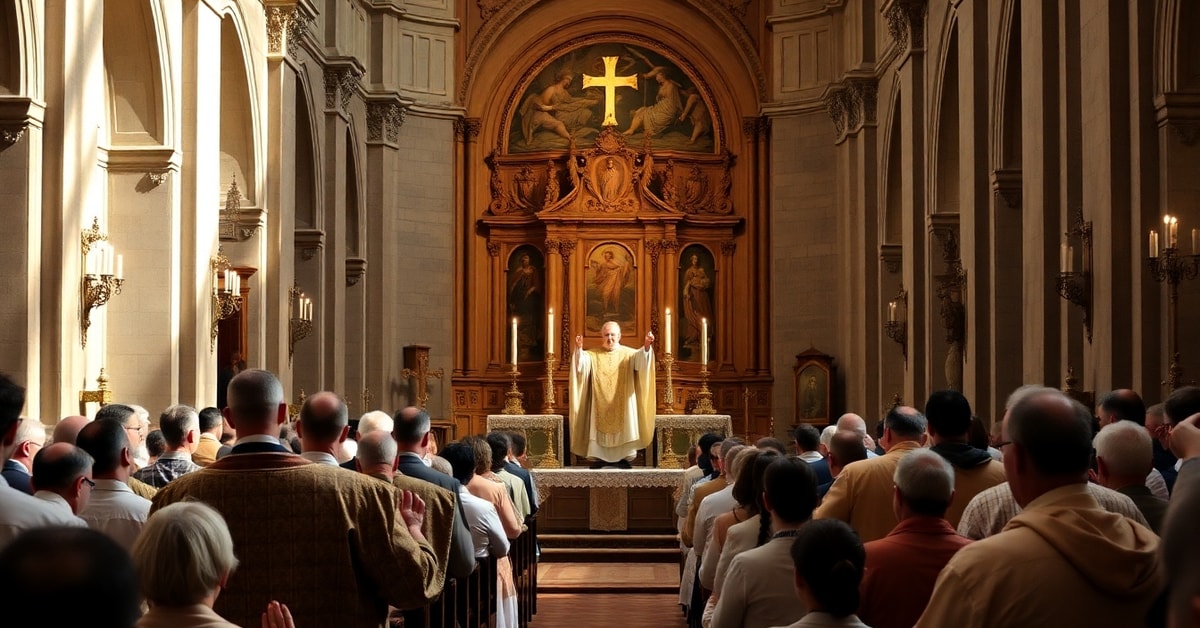
The Liturgy as Self-Help: Leo XIV Reduces the Holy Sacrifice to a Therapeutic Pause
Vatican Media portal reports (June 3, 2026) that during his Wednesday General Audience, the usurper Robert Prevost, styling himself “Pope Leo XIV,” continued his catechesis series on the Documents of the Second Vatican Council, this time reflecting on the 1963 Constitution on the Sacred Liturgy, *Sacrosanctum Concilium*. He emphasized the importance of rite, signs, and symbols, describing the liturgy as a means to “pause” from “hectic lives” and “connect with our inner spiritual life,” drawing us closer to Christ. He spoke of “active participation,” avoiding being “silent spectators,” and highlighted the role of symbols like holy water and gestures such as kneeling. He concluded by calling for a “living and devout liturgy” to “reawaken an openness to an encounter with God.” This address is yet another manifestation of the post-conciliar reduction of the Most Holy Sacrifice of the Mass to a human-centered ritual of self-discovery and communal therapy, utterly devoid of the Catholic theology of propitiatory sacrifice and the transcendent majesty of God.
The Liturgy as Self-Help: Leo XIV Reduces the Holy Sacrifice to a Therapeutic Pause
The address delivered by the individual occupying the Vatican under the name “Leo XIV” on June 3, 2026, as reported by Vatican Media, is a textbook example of the post-conciliar distortion of Catholic liturgy. Framed as a catechesis on *Sacrosanctum Concilium*, it systematically reduces the sacred liturgy – and by extension, the Most Holy Sacrifice of the Mass – from a divinely instituted act of worship, propitiation, and adoration offered to God, to a human-centered ritual designed for personal fulfillment, communal bonding, and spiritual “regeneration.” This is not a development of doctrine; it is a corruption of it, a direct fruit of the Modernist revolution condemned by St. Pius X.
The Erasure of Sacrifice: From Propitiation to “Pause”
The most glaring omission in Leo XIV’s discourse is any mention of the Mass as a propitiatory sacrifice. The Catholic Church has always taught, definitively and infallibly, that the Mass is the unbloody renewal of the Sacrifice of Calvary, offered to God for the sins of the living and the dead. The Council of Trent, in Session XXII, Chapter 2, anathematizes anyone who says that the Mass is “only a sacrifice of praise and thanksgiving” or that it is “a mere commemoration of the sacrifice consummated on the cross” and not propitiatory. Yet, Leo XIV’s language is entirely devoid of this essential truth. Instead, he speaks of the liturgy as a “pause that regenerates the heart,” a means to “connect with our inner spiritual life,” and a way to “savour the presence of God.”
This is not Catholic theology; it is the language of secular self-help and therapeutic spirituality. The liturgy, in this view, becomes a tool for personal well-being, a “healing” ritual for the “busy” and “frenzetic” modern man. The focus shifts entirely from God’s majesty and our duty to offer Him worthy worship, to our own subjective experience and emotional state. As Pope Pius XI encyclical Quas Primas (1925) reminds us, Christ’s kingdom is not of this world, and His royal authority demands obedience, not self-exploration. The liturgy is not a “pause” from our activities; it is the supreme act of religion, the highest point of our existence, where we participate in the eternal sacrifice of the God-Man.
“Active Participation” as the Demise of Adoration
Leo XIV’s emphasis on “active participation” and avoiding being “silent spectators” is a hallmark of the post-conciliar revolution. While the faithful have always been called to participate in the liturgy, this participation was primarily internal and spiritual, united with the priest who acts in persona Christi. The Council of Trent, in Session XXII, Chapter 8, condemned those who said that the Mass should be celebrated only in the vernacular, as it obscured the sacred and mysterious nature of the rite. The traditional Roman Rite, with its silence, its ad orientem posture, and its emphasis on the priest’s unique role as mediator, fostered a profound sense of the sacred and the transcendent.
The post-conciliar concept of “active participation,” however, has been distorted to mean external activity: singing, reading, responding, and even dancing. This has led to the democratization of the liturgy, where the priest becomes a “presider” and the assembly becomes the focus. The result is a loss of reverence, a diminution of the sense of the sacred, and a shift from adoration to self-expression. Leo XIV’s call to participate “with our full selves – body, mind and heart” sounds pious, but in the context of the reformed liturgy, it often means little more than being busy and engaged in human activities, rather than being absorbed in the contemplation of divine mysteries.
Symbols Without Substance: The Reduction of Sacraments to Signs
Leo XIV’s discussion of “signs” and “symbols” further reveals the superficiality of his approach. He correctly notes that signs and symbols are important, but he reduces them to mere pointers to “an entire system of meanings and values” or actions that “engender a sense of belonging.” This is a far cry from the Catholic understanding of sacraments as efficacious signs of grace, instituted by Christ to confer the grace they signify.
The sacraments are not merely symbolic reminders; they are channels of divine grace, operating ex opere operato (by the very fact of the action’s being performed). Holy water, for example, is not just a symbol of baptismal grace; it is a sacramental that, when used with devotion, remits venial sins and strengthens the soul against temptation. The post-conciliar emphasis on the “symbolic” nature of the liturgy has led to a devaluation of the sacramental system, reducing it to a collection of meaningful gestures rather than a divinely ordained means of salvation. This is consistent with the Modernist error condemned in Lamentabili sane exitu (1907), which rejected the objective efficacy of sacraments and reduced them to mere expressions of religious sentiment (propositions 39-51).
The Silence on Sin, Judgment, and the Supernatural
Perhaps the most damning aspect of Leo XIV’s address is what it omits. There is no mention of sin, of the need for repentance, of the reality of judgment, of the existence of Hell, or of the necessity of sanctifying grace. The liturgy, in his presentation, is a positive, uplifting experience, a “regeneration” of the heart, but there is no sense of the gravity of offending God, of the need for atonement, or of the eternal consequences of sin.
This silence is not accidental; it is a direct consequence of the post-conciliar rejection of the supernatural order. The Modernists, as described by St. Pius X in Pascendi Dominici gregis (1907), denied the objective reality of revelation, reduced faith to a subjective religious experience, and rejected the idea of a transcendent God who judges and saves. The post-conciliar liturgy, with its emphasis on community, celebration, and self-expression, reflects this naturalistic worldview. It is a liturgy for a godless age, where the only “god” is the human community itself.
The Fruit of the Conciliar Revolution
Leo XIV’s catechesis is not an isolated incident; it is the logical outcome of the Second Vatican Council’s liturgical reforms. *Sacrosanctum Concilium*, while containing some sound principles, was hijacked by Modernists who used it to justify a radical break with tradition. The introduction of the vernacular, the simplification of rites, the removal of prayers for the propitiation of sins, and the emphasis on “active participation” have all contributed to the creation of a liturgy that is more human than divine, more focused on the assembly than on God.
The result has been a catastrophic decline in faith, vocations, and sacramental practice. The “living and devout liturgy” that Leo XIV calls for is precisely the cause of the spiritual ruin of the faithful. It is a liturgy that feeds the ego rather than mortifying it, that entertains rather than sanctifies, that distracts from the essential rather than leading to it. As the Defense of Sedevacantism argues, a manifest heretic loses his office automatically, and the post-conciliar “popes,” by promoting a liturgy that contradicts Catholic doctrine, have demonstrated their manifest heresy.
Conclusion: Return to the Immutable Tradition
The address of Leo XIV is a stark reminder of the depth of the crisis in the structures occupying the Vatican. It is a call not to “reawaken an openness to an encounter with God,” but to return to the immutable Tradition of the Catholic Church, to the Traditional Latin Mass, to the sacraments as they were always understood and practiced. The liturgy is not a tool for self-improvement; it is the worship of the Most Holy Trinity, the renewal of the Sacrifice of Calvary, the means by which we are sanctified and saved. Anything less is not Catholic; it is the abomination of desolation foretold by Our Lord (Matthew 24:15).
As Pope Pius IX declared in the Syllabus of Errors (1864), “The Roman Pontiff can, and ought to, reconcile himself, and come to terms with progress, liberalism and modern civilization” is a condemned error (proposition 80). The post-conciliar liturgy is the fruit of this condemned reconciliation. It is time to reject it utterly and return to the faith of our fathers, to the Mass of all ages, to the Church that endures in the faithful who profess the integral Catholic faith and are led by bishops with valid sacraments and validly ordained priests. Only then will we find the true “encounter with God” that Leo XIV so emptily promises.
Source:
Pope at Audience: The liturgy leads us back to what is essential (vaticannews.va)
Date: 03.06.2026