Ecumenical “Christians for Capitalism” Project: A Synthesis of Modernist Apostasy and Economic Idolatry
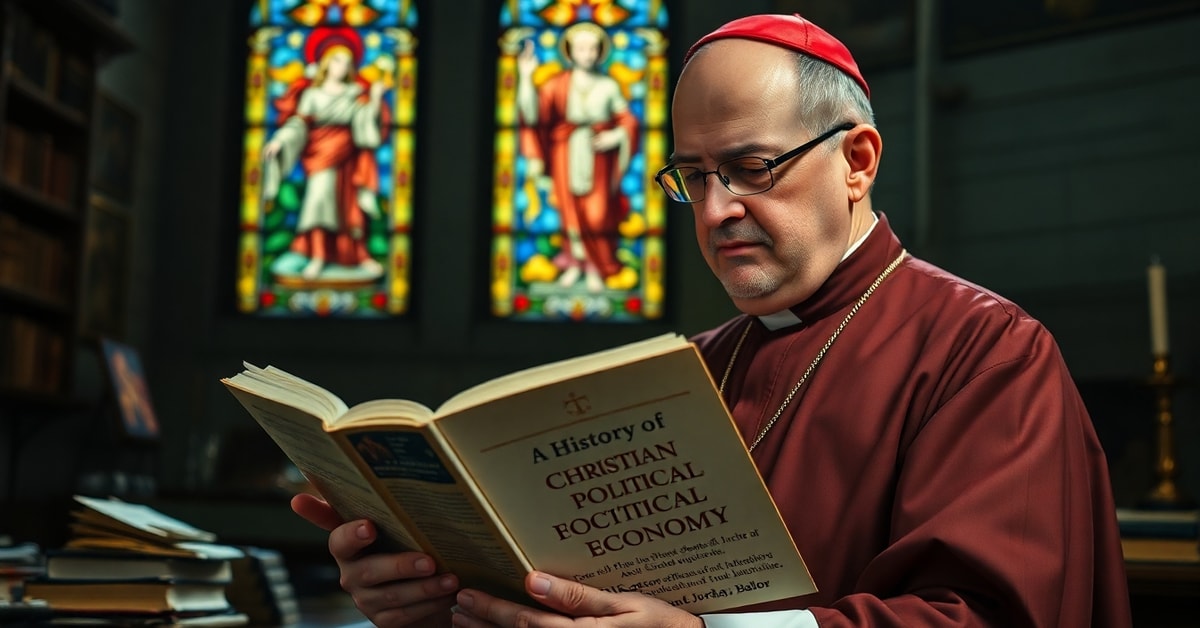
The EWTN News portal reports that the Washington, D.C.-based Institute on Religion and Democracy (IRD) launched its “Christians for Capitalism” project on June 2, 2026, seeking to unite Christians of various traditions in support of free-market capitalism. IRD President Mark Tooley stated the initiative aims to fill a perceived vacuum of “pro-free market Christians” in Washington, D.C., noting the organization is “not tied to any particular Christian tradition” and includes both Protestants and Catholics. The launch event featured a presentation by Erik Matson and Jordan J. Ballor on their book “A History of Christian Political Economy,” which surveys economic thought from biblical times through contemporary scholars, categorizing Christian thinkers into “limited good” and “mutual benefits” perspectives. The project plans to hold events, publish articles, and offer a semester-long fellowship for young people aligned with their vision. This initiative represents yet another manifestation of the post-conciliar obsession with reducing the Church’s supernatural mission to economic and political categories, a direct consequence of the modernist apostasy that has consumed the structures occupying the Vatican since 1958.
The Primacy of the Spiritual Order and the Subordination of Economics
The very premise of the “Christians for Capitalism” project inverts the divinely established hierarchy of human ends. The Church founded by Our Lord Jesus Christ exists for one supreme purpose: the salvation of souls and the eternal glory of God. As Pope Pius XI declared in his encyclical Quas Primas (1925), “the hope of lasting peace will not yet shine upon nations as long as individuals and states renounce and do not wish to recognize the reign of our Savior.” The IRD’s project, by contrast, implicitly elevates economic arrangements — specifically free-market capitalism — to a position of primary concern for Christians, thereby subordinating the supernatural order to the material.
This is not a novel error. Pope Pius IX, in the Syllabus of Errors (1864), condemned under Error 58 the proposition that “all the rectitude and excellence of morality ought to be placed in the accumulation and increase of riches by every possible means, and the gratification of pleasure.” The IRD’s project does not explicitly endorse such crass materialism, but its entire framework operates within a worldview where economic systems — rather than the state of grace, the sacraments, and the moral law — constitute the primary lens through which Christians are to engage with the world. When Matson speaks of “wealth generative” transactions and Ballor laments that theological perspectives are “not in the mainstream of what is taught in economics,” they reveal a mentality that has already accepted the secularist premise that economics, not theology, is the master science of human affairs.
Ecumenism as the Foundation of a Political-Economic Project
The ecumenical character of the IRD project is not incidental — it is constitutive. Tooley explicitly stated that the organization is “not tied to any particular Christian tradition” and includes “both Protestants and Catholics.” This is the false ecumenism condemned repeatedly by the pre-conciliar Magisterium, which treats doctrinal unity as an obstacle to practical collaboration rather than as a supernatural gift to be preserved and defended.
Pope Pius XI, in Mortalium Animos (1928), taught that “the union of Christians can only be promoted by promoting the return to the one true Church of Christ of those who are separated from it, for in the past they have unhappily left it.” The IRD’s approach is the precise opposite: it builds a coalition of “Christians” precisely by setting aside the question of which body constitutes the one true Church and which “Christians” are in heresy and schism. The inclusion of Protestants and Orthodox as equal partners in a “Christian” project implicitly denies the Catholic doctrine, defined at the Council of Florence (1439) and reaffirmed at the First Vatican Council (1870), that “the Holy Roman Church firmly believes, professes, and preaches that none of those existing outside the Catholic Church, not only pagans, but also Jews and heretics and schismatics, can have a part in life eternal.”
The IRD’s founding history is itself revealing. Father Richard John Neuhaus, described as an early board member, was a Lutheran who converted to Catholicism in 1990 and was ordained to the priesthood — but within the post-conciliar structures whose sacramental validity is gravely suspect. Michael Novak, the Catholic philosopher among the founders, was a prominent advocate of the kind of “theology of capitalism” that sought to baptize free-market ideology with a veneer of Catholic language. These are not men who defended the integral Catholic faith; they are men who sought to reconcile the Church with the spirit of the modern world, which is precisely the modernism defined by Saint Pius X as “the synthesis of all heresies” (Pascendi Dominici Gregis, 1907).
The False Neutrality of “Christian Political Economy”
Matson and Ballor’s book, “A History of Christian Political Economy,” claims to survey Christian economic thought from the Bible through contemporary scholars, categorizing thinkers into “limited good” and “mutual benefits” perspectives. Matson identified St. John Chrysostom as falling into the “limited good perspective” and St. Thomas Aquinas as aligned with the “mutual benefits perspective.” This categorization itself is suspect, as it imposes modern economic frameworks onto theologians who would have found the very premise — that economic theory can be separated from moral theology and treated as a neutral science — to be fundamentally misguided.
Saint Thomas Aquinas did not develop a “mutual benefits perspective” in the sense of modern free-market theory. His treatment of economic questions in the Summa Theologiae (II-II, qq. 77-78) is embedded within the virtue of justice and the natural law. His discussion of usury (II-II, q. 78) is unequivocal: “to take usury for money lent is unjust in itself, because this is to sell what does not exist.” The School of Salamanca, which Matson praises for developing the quantity theory of money, operated within a Scholastic framework that subordinated all economic activity to the moral law and the common good as defined by the Church, not by market forces.
Matson’s claim that Pope Leo XIII’s Rerum Novarum (1891) is “more in line with [the] mutual benefits understanding of economics” is a selective and misleading reading. Leo XIII’s encyclical is not a treatise in favor of free-market capitalism; it is a defense of the rights of workers, the legitimacy of private property within the framework of natural law and divine law, and the duty of the state to intervene on behalf of the common good. Leo XIII explicitly rejected both socialism and unbridled liberalism: “The foremost duty, therefore, of the rulers of the State should be to make sure that the laws and institutions, the general character and administration of the common good, shall be such as of themselves to realize public well-being and private property” (Rerum Novarum, §32). The IRD’s appropriation of Leo XIII to support a “pro-free market” agenda is a distortion of his teaching, extracting elements that serve a pre-determined ideological conclusion while ignoring the encyclical’s insistence on the moral limits of economic activity.
The Omission of the Supernatural: Silence as Apostasy
The most damning feature of the IRD project is what it does not say. Nowhere in the reported account is there any mention of the Most Holy Sacrifice of the Mass, the sacraments, the state of grace, mortal sin, the Four Last Things, the necessity of the Catholic faith for salvation, or the social reign of Christ the King. The “Christianity” presented by the IRD is a Christianity stripped of its supernatural content, reduced to a set of moral and economic principles that can be shared across denominational lines.
This silence is not accidental; it is the defining characteristic of modernism. Saint Pius X, in Pascendi Dominici Gregis, identified the modernist as one who “desires to remain within the Church” while “striving to change the Church’s doctrine” by stripping it of its supernatural character and reducing it to a naturalistic framework. The IRD’s “Christians for Capitalism” project is precisely such a naturalistic framework: it takes the name “Christian” and fills it with content drawn from modern economic theory, while remaining entirely silent about the truths that actually define the Catholic faith.
Pope Pius XI, in Quas Primas, taught that Christ’s reign “encompasses all men” and that “men united in societies are no less subject to the authority of Christ than individuals.” The IRD project implicitly denies this by treating economic systems as autonomous domains governed by their own laws, requiring only a vague “Christian” endorsement rather than the submission of all things to Christ the King. The project’s very title — “Christians for Capitalism” — reveals its inversion of proper order: it is not “Capitalism submitted to Christ” but “Christians in service of Capitalism.”
The Fellowship: Forming a New Generation of Naturalistic Christians
The IRD’s plan to host a “semester-long fellowship for young people who align with their vision” is particularly alarming. The formation of young people in a “Christian” framework that is silent about the supernatural truths of the faith and enthusiastic about free-market economics is a form of catechesis in naturalism. These young people will be taught to see the world through the lens of economic productivity and market freedom, rather than through the lens of the Gospel, the sacraments, and the moral law.
The reading materials for the fellowship are expected to feature the writings of Michael Novak prominently. Novak was a prolific author who sought to develop a “theology of capitalism,” arguing that democratic capitalism was the economic system most compatible with Catholic social teaching. This is a fundamental error. The Church does not endorse any particular economic system as such; it teaches principles — the universal destination of goods, the right to private property, the dignity of labor, the obligation of charity, the subordination of economic activity to the common good — that must be applied prudentially in varying circumstances. To baptize “capitalism” with the name of Christianity is to commit the error condemned by Pius IX in the Syllabis of Errors, Error 40: “The teaching of the Catholic Church is hostile to the well-being and interests of society.” The Church does not teach that free-market capitalism is the enemy of society, but neither does it teach that it is the friend of the faith. The Church teaches that Christ the King is the friend of the faith, and that all economic arrangements must be judged by their conformity to His law.
The Deeper Apostasy: The Post-Conciliar Context
The IRD’s “Christians for Capitalism” project cannot be understood apart from the broader apostasy of the post-conciliar period. The Second Vatican Council (1962-1965), convened by the usurper John XXIII and continued by his successors, introduced a series of novelties — false ecumenism, religious liberty, the democratization of the Church, the hermeneutics of continuity — that fundamentally altered the Church’s self-understanding and her relationship with the modern world.
The IRD was founded in 1981, during the pontificate of the antipope John Paul II, a period when the conciliar revolution was being consolidated throughout the structures of the Church. The IRD’s ecumenical approach, its naturalistic understanding of Christianity, and its enthusiasm for free-market economics are all fruits of the conciliar spirit. The post-conciliar “Church” has consistently sought to engage with the world on the world’s terms, rather than calling the world to conversion and submission to Christ the King. The IRD’s project is simply a more explicit and focused expression of this same tendency.
As the sedevacantist analysis recognizes, the men who have occupied the Vatican since the death of Pope Pius XII in 1958 have been manifest heretics who, by that very fact, lost their jurisdiction and authority. Saint Robert Bellarmine taught that “a Pope who is a manifest heretic, by that very fact ceases to be Pope and head, just as he ceases to be a Christian and member of the body of the Church” (De Romano Pontifice, II, 30). The post-conciliar usurpers, by teaching and promoting heresies condemned by the pre-conciliar Magisterium, have demonstrated that they are not true successors of Saint Peter. The structures they control — including organizations like the IRD that operate within the broad orbit of post-conciliar “Catholicism” — are not part of the true Church but are instruments of the conciliar apostasy.
Conclusion: The True Christian Response
The “Christians for Capitalism” project of the Institute on Religion and Democracy is not a Christian project at all. It is a naturalistic, ecumenical, and modernist project that uses the name “Christian” to lend spiritual respectability to a particular economic ideology. It is silent about the truths that matter most — the necessity of the Catholic faith, the sacraments, the state of grace, the social reign of Christ the King — and enthusiastic about truths that matter least — the efficiency of free markets and the productivity of wealth-generative transactions.
The true Christian response to the crises of the modern world is not to baptize capitalism, socialism, or any other economic system, but to call all men and all nations to submit to the reign of Christ the King. As Pope Pius XI taught in Quas Primas, “if men were ever to recognize Christ’s royal authority over themselves, both privately and publicly, then unheard-of blessings would flow upon the whole society, such as due freedom, order, and tranquility, and concord and peace.” The IRD, like the post-conciliar structures it mirrors, has chosen the wisdom of the world over the folly of the Cross. Let those who profess the integral Catholic faith reject this false choice and cling to the immutable Tradition of the Church, which alone leads to eternal life.
Source:
Institute on Religion and Democracy launches ecumenical ‘Christians for Capitalism’ project (ewtnnews.com)
Date: 03.06.2026