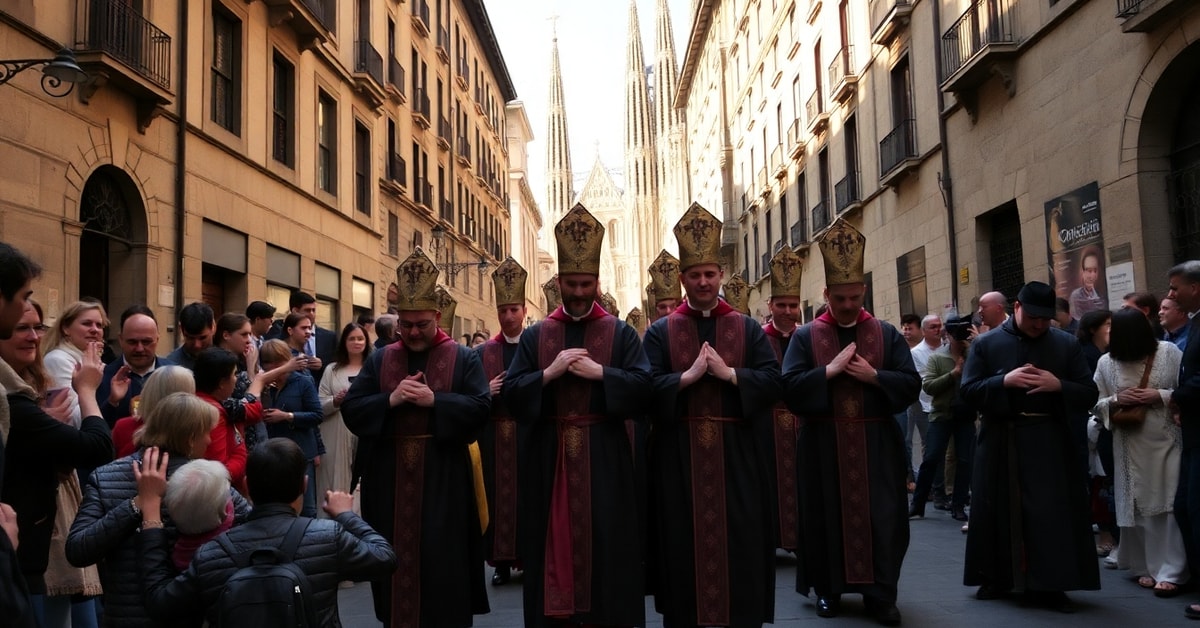
Papal Spectacle in Barcelona: The Triumph of Aestheticism Over the Sacred
VaticanNews portal reports on the arrival of the usurper Robert Prevost, known as “Pope Leo XIV,” in Barcelona for the second leg of his apostolic journey to Spain. The article describes the city’s preparations—street cleaning, security arrangements, and the display of welcoming banners with the Catalan word “PAU” (peace)—as well as the visit’s connection to Barcelona’s designation as the World Capital of Architecture for 2026 and the centenary of Antoni Gaudí’s death. The Basilica of Sagrada Família is prominently featured as the “masterpiece” of Barcelona, and the article notes that Leo XIV will visit a parish run by four Augustinian priests serving migrants. The entire framing reduces the Catholic faith to cultural tourism, architectural admiration, and humanitarian sentimentality—precisely the naturalistic reductionism that the pre-conciliar Magisterium unconditionally condemned.
The Reduction of the Papal Office to Cultural Ambassador
The article’s opening lines reveal, with disarming candor, the utter emptiness of what the post-conciliar apparatus still dubs an “apostolic journey.” Barcelona is “literally buzzing with activity”—but this activity consists of “cleaning streets and fixing walkways,” teams of workers, and a “visible security presence.” One could be describing the preparations for a head of state’s diplomatic tour or a celebrity’s promotional visit. Indeed, that is precisely what this is: the abomination of desolation occupying the Vatican has long since reduced the Vicar of Christ—or rather, the one who falsely claims that title—to a global mascot of humanitarian goodwill.
The banners proclaim “Benvingut!” and the word PAU—peace. “Clearly Pope Leo is seen as a man of peace. Someone who can encourage the world to live in peace.” This is the language of the United Nations, not of the Church of Christ. Pius XI, in Quas Primas, proclaimed that “the hope of lasting peace will not yet shine upon nations as long as individuals and states renounce and do not wish to recognize the reign of our Savior.” Peace is only possible in the kingdom of Christ (Pius XI, encyclical Quas Primas). The post-conciliar sect, having abandoned the social reign of Christ the King, can offer nothing but the barren aspiration of “peace” detached from the One who is Himself the Peace—and who demands, as the condition of peace, the submission of every intellect and will to His divine authority.
Sagrada Família: The Temple of Modernist Idolatry
The article’s most revealing passage is its breathless celebration of the Basilica of the Sagrada Família and its architect, Antoni Gaudí. Barcelona has been designated the “World Capital of Architecture for 2026,” and this year marks “the Year of Gaudí and the centenary of his death.” The Church and the city “are both proud of Gaudí’s legacy.” It was “only fitting that Pope Leo grace the tripartite celebrations.”
Let us be clear about what the Sagrada Família represents. It is a monument not to Catholic theology but to the aestheticism and naturalism that the pre-conciliar Magisterium identified as the very soul of Modernism. Gaudí’s architecture, however visually striking, embodies the principle condemned by St. Pius X in Lamentabili sane exitu: that “truth changes with man, because it develops with him, in him, and through him” (proposition 58), and that “contemporary Catholicism cannot be reconciled with true knowledge without transforming it into a certain dogmaless Christianity, that is, into a broad and liberal Protestantism” (proposition 65). The Sagrada Família is, in stone, the religion of the New Advent: a faith reduced to art, emotion, and the cult of human creativity—precisely the “pantheism” and “naturalism” condemned by Pius IX in the Syllabus of Errors (propositions 1–7).
That the usurper Leo XIV “graces” this celebration is not an accident but a necessity. The conciar sect exists to consecrate the world’s values, not to consecrate the world to Christ. The article’s language—”the story of Barcelona is sometimes said to be the story of the Temple and the city”—is a telling inversion. For the Catholic, the story of every city is the story of the Church and the world: the Civitas Dei standing in perpetual judgment over the Civitas Terrena. For the post-conciliar mentality, the “Temple” is merely an architectural achievement of the city, and the Church exists to celebrate the city’s glory.
The Omission of the Supernatural: The Gravest Accusation
Nowhere in this article is there any mention of the Most Holy Sacrifice of the Mass, of the Real Presence of Our Lord in the Blessed Sacrament, of the necessity of the sacraments for salvation, of the state of grace, of the reality of sin, of the final judgment, of the conversion of souls to the Catholic faith, or of the social reign of Christ the King over Spain and all nations. The entire “apostolic journey” is presented as a cultural-pastoral event centered on architecture, migration, and the vague aspiration of “peace.”
This silence is not incidental; it is the very essence of the post-conciliar apostasy. As the Syllabus of Errors condemns: “The Church is not a true and perfect society, entirely free—nor is she endowed with proper and perpetual rights of her own, conferred upon her by her Divine Founder; but it appertains to the civil power to define what are the rights of the Church” (proposition 19). The article’s framing—in which the Church’s activity is indistinguishable from that of a municipal cultural office—is the lived reality of this condemned proposition.
The “Pastoral Challenge” of Migration: Humanitarianism as Substitute for Evangelization
The article notes that Leo XIV will visit “a parish run by a small Augustinian community of only four pastors in the whole of Barcelona—two priests from Tanzania and two from the Philippines,” who “maintain a very strong pastoral presence and ministry among the migrants.” The word “migrants” appears without any reference to the Catholic duty of evangelization, to the necessity of baptism, or to the Church’s mission to bring souls to Christ. The “ministry” described is purely naturalistic: a humanitarian service indistinguishable from that of any secular NGO.
Pius XI declared in Quas Primas that Christ’s reign “extends not only to Catholic nations or to those who, by receiving baptism according to law, belong to the Church, even though their erroneous opinions have led them astray or discord has separated them from love, but His reign encompasses also all non-Christians, so that most truly the entire human race is subject to the authority of Jesus Christ.” The Church’s duty toward migrants is first and foremost their conversion to the Catholic faith—not the maintenance of their earthly comfort. To reduce “pastoral ministry” to social service is to deny the very purpose of the Church’s existence: extra Ecclesiam nulla salus—outside the Church there is no salvation.
The “Normalcy” of a World Without God
Perhaps the most chilling detail in the article is its observation that “people are also going their usual business in a normal way—they are walking children to school and riding their bikes and sitting at the tables on the streets.” This is presented as a charming backdrop to the papal visit. But from the perspective of integral Catholic faith, it is a devastating indictment. The world goes about its business as if the Church had nothing to offer it—as if the “apostolic journey” were merely a colorful interruption in the ordinary flow of a life lived without reference to God, to grace, to eternity.
Pius IX, in the Syllabus of Errors, condemned the proposition that “in the present day it is no longer expedient that the Catholic religion should be held as the only religion of the State, to the exclusion of all other forms of worship” (proposition 77). The “normalcy” described in the article is the fruit of this condemned error: a world in which the Catholic faith is one cultural activity among many, and in which the Church’s representative is welcomed as a celebrity rather than obeyed as the Vicar of Christ.
Conclusion: The Paramasonic Structure Continues Its Work
The visit of the usurper Leo XIV to Barcelona is not an act of Catholic pastoral governance. It is a public relations exercise by the paramasonic structure occupying the Vatican, designed to present the conciliar sect as a benevolent, culturally engaged, humanitarian institution. The celebration of Gaudí’s architecture, the reduction of pastoral care to migrant services, the invocation of “peace” without Christ, and the total silence about the supernatural mission of the Church—all of this is the inevitable fruit of the Modernist revolution that the pre-conciliar Magisterium identified, condemned, and anathematized.
The faithful who retain the integral Catholic faith must see these events for what they are: not the Church of Christ fulfilling its divine mission, but the abomination of desolation performing its role in the systematic destruction of the Catholic religion and its replacement with a naturalistic, humanitarian, aesthetically pleasing counterfeit. The response is not reform but rejection—a return to the immutable Tradition that the conciliar sect has betrayed, and an unwavering confession that Jesus Christ is King, not only of individuals but of nations, and that no power on earth has the right to separate His Church from His royal authority.
Source:
Pope Leo arrives in Barcelona for second leg of Spain visit (vaticannews.va)
Date: 09.06.2026