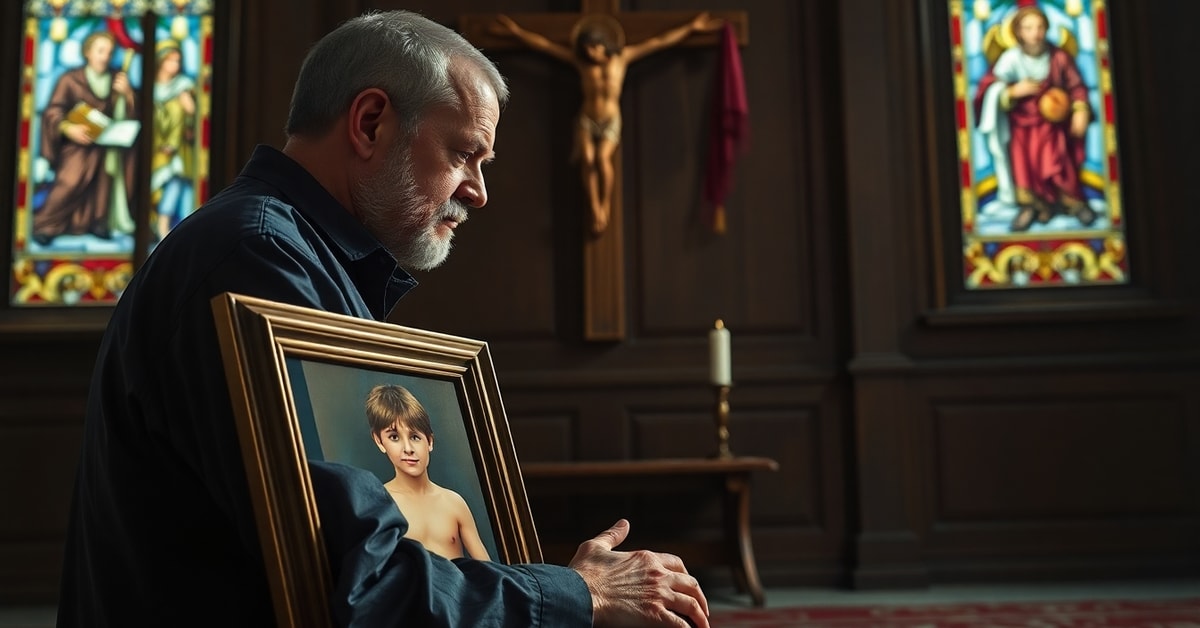
The Culture of Death Masquerading as Compassion: Exposing the Spiritual Bankruptcy of a World That Kills Its Children
National Catholic Register portal reports on the 100th birthday of Jérôme Lejeune, the scientist who discovered the chromosomal basis of Down syndrome, while simultaneously covering the tragic case of an influencer couple who aborted their unborn child after receiving a Down syndrome diagnosis. Writer Fran Maier, father of a 35-year-old son with Down syndrome, offered reflections on both the Lejeune legacy and the couple’s decision, telling EWTN Radio: “They’ve killed their child, but also something in themselves.” The article invokes “Pope Leo’s” AI encyclical Magnifica Humanitas and quotes the antipope as saying “every child is a dream of God.” Yet beneath the veneer of pro-life sentiment lies a profound silence about the most fundamental truths: the eternal destiny of the murdered child, the state of grace of the murderers, and the absolute moral law that admits of no exceptions.
The Murder of an Innocent and the Silence About Eternal Consequences
Let us begin with what is most grave, and what the article, despite its pro-life framing, systematically obscures. A child has been killed. Not “terminated,” not “lost,” not subjected to a “tragic decision” — killed. The influencer couple deliberately destroyed the life of their unborn son or daughter because the child bore the mark of an extra chromosome. This is not a medical procedure. This is not a difficult choice. This is the deliberate murder of an innocent human being, a soul created by God, endowed with an immortal destiny, and made in the image and likeness of the Almighty.
Fran Maier told EWTN Radio: “There’s a sadness about that couple that I thought about all morning,” and noted that “unintentionally probably, they were casting themselves as the victim: ‘We’re so sad, we’re so sorry.'” He continued: “There’s a tendency in an indulgent culture to think that admitting this was a difficult problem, or that this was a bad thing apparently to do, gives you exoneration. It doesn’t do that. The child is dead.” This is true as far as it goes. But Maier’s analysis, while emotionally compelling, remains trapped within the naturalistic framework of human sympathy. He speaks of sadness, of lost experience, of what the couple “prevented themselves from having.” He does not speak — and this omission is deafening — of the eternal consequences.
Where is the mention that this child, if baptized in utero by desire or by the martyrdom of innocent blood, now stands before the throne of God? Where is the acknowledgment that the parents have committed a crime that cries out to heaven for vengeance, a sin that carries the penalty of eternal damnance if not repented? Where is the call — not for sympathy, not for “weird sympathy” as Maier awkwardly offers — but for contrition, confession, and absolute amendment of life? The Catechism of the Council of Trent teaches that the killing of an innocent person is one of the gravest sins against the Fifth Commandment, and that those who procure or cooperate in such an act incur latae sententiae excommunication. Yet the article treats the matter as a psychological and emotional tragedy, not as a spiritual catastrophe of the highest order.
Maier said: “They’ve killed their child, but they’ve also killed something in themselves because they’ve denied not just that child’s life, but all of the life that would come from it.” This is true in the natural order. But the supernatural truth is far more terrible: they have, by this act, potentially severed themselves from the grace of God and placed their own immortal souls in mortal peril. No amount of sadness, no public statement of regret, no casting of themselves as victims can substitute for the sacrament of confession, validly administered by a true priest of the Catholic Church, with true contrition and a firm purpose of amendment. The article is silent on all of this. It treats the murder of a child as a social media controversy, not as an offense against the living God.
The Cult of the Body and the Denial of the Soul
Maier, in discussing transhumanism and referencing the antipope Leo XIV’s encyclical Magnifica Humanitas, stated: “It’s very important to understand that our bodies are part of us. They’re not some sort of separate mechanism that wears out, so we get irritated with it, as if we have this little man in our head that is the ‘real me.’ Our bodies are part of our humanity; we’re not humans without them.” This is a correct philosophical principle — the hylomorphic unity of body and soul, as taught by St. Thomas Aquinas and affirmed by the perennial Magisterium. But the application Maier draws from it is revealingly incomplete.
He applies it to the importance of touch in raising children with Down syndrome: “I mean to massage him so that he feels it. I can say, ‘I love you very much, Dan,’ and I can get him good things and feed him, but if I don’t touch him, I’m not locating him. He needs that. You have to make a point of embracing them and reassuring them with your touch. When we pray with Dan, we put our hands on his head; he knows that.” This is beautiful in its natural dimension. But where is the mention of baptism, of the sacramental character impressed on the soul, of the grace that flows through the sacraments and is the true “locating” of a human person in the Body of Christ? Where is the acknowledgment that the most important thing one can do for a child — any child, with or without Down syndrome — is to ensure their baptism and their incorporation into the Catholic Church, outside of which there is no salvation?
The article’s silence on the supernatural destiny of Dan Maier, of the murdered child of the influencer couple, of any child whatsoever, is not accidental. It is the hallmark of the naturalistic humanism that has infected even those who profess to be pro-life. The Church has always taught that the body exists for the sake of the soul, and the soul exists for the sake of God. To speak endlessly of the body, of touch, of emotional bonding, while remaining silent about baptism, grace, the state of sin, and eternal judgment, is to invert the order of creation. It is to make man the measure of all things, rather than God.
The “Pope” Who Is Not a Pope and the Encyclical That Is Not Binding
The article invokes “Pope Leo” and his encyclical Magnifica Humanitas, quoting the antipope as saying that “every child is a dream of God.” Let us be absolutely clear: Robert Prevost, who currently occupies the Vatican under the name Leo XIV, is not the Pope of the Catholic Church. He is a usurper, an antipope, a member of the conciliar sect that has occupied the See of Peter since the death of Pope Pius XII. His encyclicals carry no binding authority, his teachings carry no guarantee of truth, and his words — however superficially orthodox they may appear — must be evaluated against the immutable standard of Catholic Tradition.
The doctrine that “every child is a dream of God” is, in itself, a true statement. God is the author of all life, and every child is indeed willed by God in His providence. But the context in which this statement is made — within an encyclical by an antipope, published by a conciliar structure that has systematically undermined the faith, promoted ecumenism, religious liberty, and the democratization of the Church — renders it suspect. The devil can quote Scripture for his purposes. An antipope can utter true statements about the dignity of human life while simultaneously promoting a system that denies the necessity of the Catholic Church for salvation, that embraces religious liberty as a natural right, and that reduces the Church to a humanitarian NGO.
The article makes no mention of this. It treats Leo XIV as the legitimate successor of St. Peter, quotes his encyclical as though it carried the weight of apostolic authority, and thereby reinforces the legitimacy of the conciliar usurpation. This is not a minor oversight. It is a fundamental betrayal of the faith, because it acknowledges as the Vicar of Christ a man who holds office in defiance of the divine constitution of the Church. As St. Robert Bellarmine teaches in De Romano Pontifice, a manifest heretic ceases to be Pope and head, just as he ceases to be a Christian and member of the body of the Church. The conciliar sect, from John XXIII onward, has proclaimed heresies — religious liberty, ecumenism, the evolution of dogmas — that place its manifestly heretical leaders outside the Church. To quote them as though they were the Magisterium is to lead the faithful into error.
The Lejeune Legacy: Heroism Without the Fullness of Truth
Jérôme Lejeune is rightly honored as a great scientist and a defender of unborn life. His discovery of the chromosomal basis of Down syndrome was a genuine contribution to human knowledge, and his public opposition to the abortion of children with Down syndrome was courageous. The article quotes Aude Dugast, postulator of his cause: “He did not follow the spirit of the times. His morals were safe… And that’s heroic because he knew he was going to get in a lot of trouble for doing that.” It further notes that even in the face of death threats, Lejeune “always remained incredibly calm and gentle.”
All of this is admirable. But the article presents Lejeune’s heroism in purely naturalistic terms — as a matter of personal courage, moral conviction, and scientific integrity. Where is the mention of his Catholic faith as the foundation of his opposition to abortion? Where is the acknowledgment that his heroism derived not from personal virtue alone, but from sanctifying grace, from his membership in the Catholic Church, from his participation in the sacraments? The Church has always taught that without grace, man cannot persevere in virtue, and that all true heroism is a gift of God, not an achievement of human will.
Moreover, the article’s treatment of Lejeune’s cause for canonization is presented uncritically, as though the conciliar sect’s process of canonization were legitimate. It is not. The conciliar sect has “canonized” manifest heretics and apostates — John Paul II, John Henry Newman, and others — in a process that is canonically null and spiritually void. To present Lejeune’s cause as though it were being advanced by a legitimate authority is to lend credibility to a system that has forfeited all claim to authority.
The Influencer Couple: A Mirror of a Culture of Death
Maier’s reflections on the influencer couple are, in many ways, the most revealing part of the article. He said: “What you learn very quickly is that they have all the same personality traits that the rest of us do. Now, are they closer to heaven? Sure, because they don’t have the capacity to commit certain sins.” This statement, made about people with Down syndrome, contains a kernel of truth — that all human beings share the same fundamental nature — but it is framed in a way that subtly diminishes the gravity of sin and the necessity of grace.
The claim that people with Down syndrome are “closer to heaven” because they “don’t have the capacity to commit certain sins” is theologically imprecise. All human beings, regardless of their intellectual capacity, are born with original sin and are capable of committing personal sin. The degree of culpability may vary according to knowledge and freedom, but the capacity for sin remains. To suggest otherwise is to deny the universality of original sin and the necessity of redemption through Jesus Christ. The Church teaches that all men are sinners and all men stand in need of the grace of baptism and the sacraments. No one is “closer to heaven” by nature; all are saved, if they are saved at all, by the merits of Christ applied through the Church.
Maier also said of his son Dan: “Dan is a very shrewd dude. I mean, he understands really good-looking women and he knows how to play the victim around them because he knows that it works. But he’s also not above lying.” This is presented as a charming anecdote, and it may well be true. But it serves to illustrate a deeper point: the article’s treatment of Down syndrome is entirely naturalistic. It speaks of personality, of emotional needs, of family bonding, of the “blessings” that come from raising a child with special needs. It does not speak of the soul, of grace, of the sacraments, of eternal life. It treats the human person as a biological and psychological entity, not as a creature made for God and destined for eternity.
The Wages of Celebrity and the Vanity of the World
Maier’s reflections on his years in Hollywood and the fleeting nature of celebrity are among the most perceptive passages in the article. He said: “When I was in the film industry, I was very conscious that hot actors sooner or later are not hot anymore. They have their time in the sun, they’re very talented, and they earned it, but it very rarely lasts. When you’re an influencer, sooner or later that influence is going to run out because people are going to get tired of you or you’re going to get old. And then what do you have? Well, you have that memory of almost being pregnant or almost having that child, and you’ll never know the answer to what would have happened if that child had lived and what that might have brought you.”
This is a powerful observation about the transience of worldly glory. But it remains, once again, on the natural level. The Church teaches that the goods of this world are passing, and that only the goods of the soul endure. Our Lord Himself said: “What does it profit a man if he gains the whole world and forfeits his soul?” (Matt. 16:26). The influencer couple has not merely lost a fleeting experience; they have forfeited the possibility of eternal joy with their child in heaven, and have imperiled their own souls. The tragedy is not that they will grow old and lose their followers. The tragedy is that they have committed a mortal sin and, if they do not repent, will suffer eternal separation from God.
Maier also reflected on his 56-year marriage: “Sue and I have been married 56 years and I wouldn’t give away a minute of it. Not a minute of it.” This is a beautiful testimony to the permanence of the marriage bond, and it stands in stark contrast to the disposability mentality that led the influencer couple to destroy their child. But again, the article fails to connect this to the sacramental nature of marriage, to the grace conferred by the sacrament, to the indissolubility of the bond as taught by Christ Himself: “What God has joined together, let no man put asunder” (Matt. 19:6). Marriage is not merely a human commitment; it is a sacrament of the New Law, a channel of grace, and an image of the union of Christ and His Church. To speak of marriage without reference to its supernatural dimension is to reduce it to a natural contract, which is precisely the error the Church has always condemned.
The Omission That Condemns: Silence About the True Church
The most damning feature of this article is not what it says, but what it does not say. It speaks of love, of family, of the dignity of people with Down syndrome, of the heroism of Jérôme Lejeune, of the sadness of a couple who killed their child. But it is utterly silent about the following truths:
First, that outside the Catholic Church there is no salvation (Extra Ecclesiam nulla salus). The murdered child, the influencer couple, Fran Maier, Dan Maier, Jérôme Lejeune — all stand in need of the Catholic Church for their eternal salvation. No amount of natural virtue, no amount of love for the disabled, no amount of pro-life advocacy can substitute for membership in the true Church of Christ.
Second, that the conciliar sect is not the Catholic Church. The structures occupying the Vatican, the “popes” who have reigned since Pius XII, the “bishops” and “priests” who serve in the conciliar system — all are part of a counterfeit church that has abandoned the faith of the Apostles. To quote an antipope, to invoke his encyclicals, to present his words as though they carried apostolic authority, is to lead the faithful into the abomination of desolation.
Third, that the true Mass — the Most Holy Sacrifice of the Mass as offered according to the traditional Roman Rite — is the only valid liturgical act by which the faithful can participate in the propitiatory sacrifice of Calvary. The novus ordo missae, the “Mass” of Paul VI, is a Protestantized rite that obscures the sacrificial nature of the Mass and leads the faithful into error. To speak of “praying with Dan” without reference to the true Mass is to offer a prayer without a sacrifice, a devotion without a foundation.
Fourth, that the sacraments are the ordinary means of grace, and that without baptism, confession, and the Eucharist, no one can be saved. The article speaks of love, of touch, of family bonding — all good things in their natural order — but it does not speak of the one thing necessary: the salvation of the soul through the sacraments of the Catholic Church.
Conclusion: The Dream of God and the Nightmare of Apostasy
The article concludes by invoking the words of the antipope Leo XIV: “every child is a dream of God.” This is true. Every child is indeed a dream of God, a creature willed into existence by the Almighty, endowed with an immortal soul, destined for eternity. But the God who dreams of children is the God of the Catholic Church, the God who revealed Himself through Jesus Christ, the God who established His Church as the ark of salvation. To invoke this God while remaining silent about His Church, while quoting His enemies, while participating in a system that denies His kingship over nations and His authority over souls, is to blaspheme against the Holy Ghost.
The influencer couple killed their child. This is a fact. But the conciliar sect, by its systematic denial of the faith, by its promotion of religious liberty and ecumenism, by its abandonment of the missionary mandate to convert all nations, has killed millions of souls. It has told the world that all religions are equal, that the Catholic Church is not necessary for salvation, that the sacraments are optional, that the Mass is a meal rather than a sacrifice. This is a far greater crime than the abortion of a single child, because it destroys not one soul but countless souls, not in the womb but in the very heart of the Church.
Let us pray for the soul of the murdered child. Let us pray for the repentance of the influencer couple. Let us pray for Fran Maier and his family. But above all, let us reject the conciliar apostasy, return to the true faith, seek out the true sacraments, and place our trust not in the words of antipopes but in the immutable teaching of the Catholic Church, which alone is the pillar and foundation of truth. Extra Ecclesiam nulla salus. There is no salvation outside the Church. And there is no Church outside the truth.
Source:
From Jérôme Lejeune’s Discovery to a Father’s Devotion: How Down Syndrome Teaches a Selfish World to Love (ncregister.com)
Date: 13.06.2026