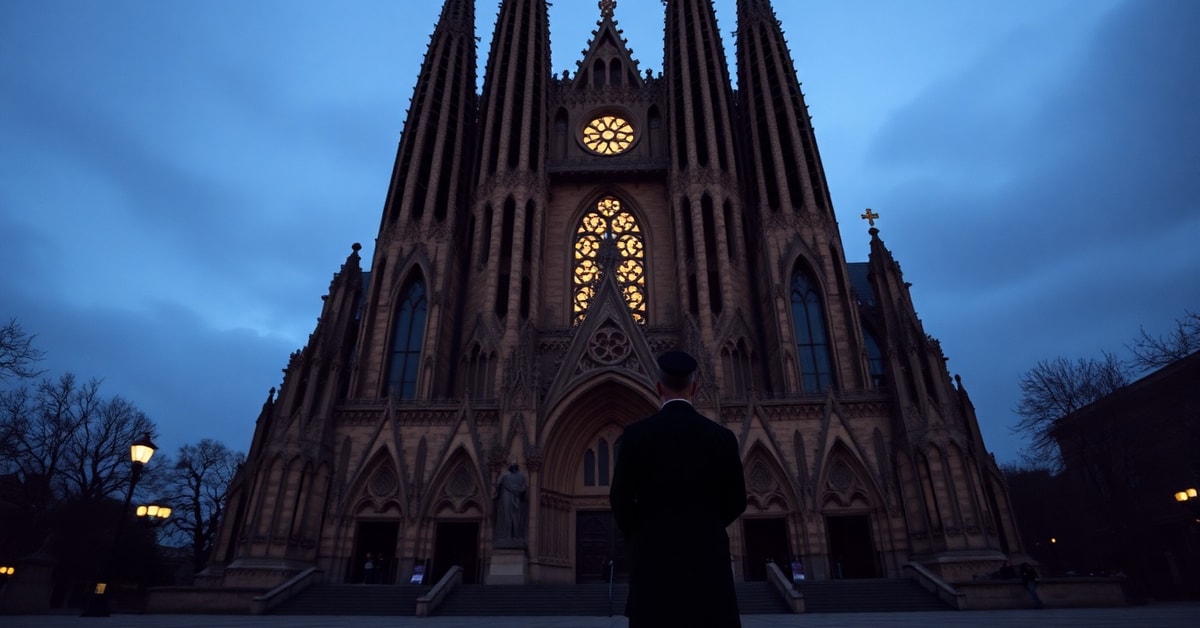
The Sagrada Familia Spectacle: When Antipopes Bless Monuments to Man’s Vanity
Father Raymond J. de Souza, writing for the National Register portal, reports on “Pope” Leo XIV’s evening visit to the Sagrada Familia basilica in Barcelona—a ceremony replete with drone-guided portraits, sound-and-light spectaculars, and the enthusiastic endorsement of a structure that has become the principal attraction of a secularized Catalonia. The commentary overflows with praise for Antoni Gaudí’s architectural vision, yet remains conspicuously silent on the theological and spiritual bankruptcy of the entire conciliar apparatus that now occupies itself with blessing buildings rather than saving souls. That an antipope would dedicate a tower and preside over a spectacle of technological wizardry while the Faith is apostatized across the entire so-called Catholic world tells us everything about the priorities of the post-conciliar sect.
A Basilica Built by Whose Authority?
The first and most fundamental question that must be posed—one that the commentary of Father de Souza assiduously avoids—is by what authority does Robert Prevost, styling himself “Pope Leo XIV,” preside over any liturgical ceremony whatsoever? The answer, according to the unchanging teaching of the Church, is that he possesses none. As demonstrated in the theological tradition of St. Robert Bellarmine, a manifest heretic ceases to be Pope and head by that very fact, losing jurisdiction *ipso facto* before any declaratory sentence. The post-conciliar occupants of the Vatican have, since John XXIII, promulgated doctrines condemned by every Pope from St. Pius X to Pius XII. The 1917 Code of Canon Law, Canon 188.4, explicitly states that every ecclesiastical office becomes vacant “by the mere fact and without any declaration” if the cleric “publicly defects from the Catholic faith.” Paul IV’s Bull *Cum ex Apostolatus Officio* confirms that any promotion of one who has defected from the Faith is “null, void, and of no effect.” Therefore, the entire ceremony at the Sagrada Familia is an exercise in counterfeit authority—a simulacrum of papal governance staged for the consumption of a gullible public.
The Theology of Sacred Architecture or the Idolatry of the Self?
Father de Souza quotes Leo XIV at length, offering what is presented as a “theology of sacred architecture”:
“It is faith that shapes the stones and gives meaning to the edifice we inhabit together. In our prayer, therefore, we discover the original bond between all things and God, the Creator of heaven and earth. He is the Artist who has imprinted his splendor upon the cosmos. Created in his image, humanity responds to God’s work with its own ingenuity: this is how the artist transforms talent into praise and creativity into a testimony to the Creator himself.”
This is, in truth, the language of the cult of man—the very spirit condemned in *Pascendi Dominici gregis*, where St. Pius X identified the Modernist proposition that religion is merely the expression of the human conscience. Leo XIV’s words could have been lifted from any Masonic or Theosophical lecture on “sacred art.” The idea that humanity, by its own ingenuity, “responds to God’s work” is a subtle but unmistakable inversion of the supernatural order. Catholic theology teaches that man does not “respond” to God’s creativity by his own natural talents; rather, man is created *ad imaginem Dei* and is sanctified only by grace. The reduction of the sacred to an aesthetic experience—however elevated—is precisely the error condemned in the *Lamentabili sane exitu* (1907), where proposition 65 decrees anathema against those who would deny the supernatural character of Christian revelation.
The Omission of the Supernatural
What is most striking about the entire commentary is its resounding silence on the supernatural order. There is no mention of the state of grace, no mention of the necessity of the sacraments for salvation, no mention of the reality of sin and the final judgment. The Sagrada Familia is praised as “the most eloquent church in speaking about God,” yet what does it say? It speaks of Gaudí’s genius, of architectural symbolism, of the “beauty of things”—but does it speak of the Bloody Sacrifice of Calvary? Does it speak of the Real Presence? Does it speak of the necessity of baptism? The silence is deafening, and it is the silence of apostasy.
Compare this with the teaching of Pius XI in *Quas Primas* (1925), where he establishes the Feast of Christ the King precisely to combat the secularism that removes Christ from public life:
“When God and Jesus Christ… were removed from laws and states and when authority was derived not from God but from men, the foundations of that authority were destroyed.”
The Sagrada Familia, as presented in this commentary, is not a proclamation of Christ the King but a monument to human achievement—a “greatest modern building on the planet,” as the *Daily Telegraph* gushes. The Cross atop the Tower of Jesus is reduced to a symbol of “worldly rankings,” which Leo XIV himself ironically acknowledges before immediately contradicting by participating in the spectacle.
Gaudí’s Canonization: The Manufacture of Saints
The commentary notes that Antoni Gaudí has been declared “Venerable” by the antipope Francis in April 2025. This is yet another instance of the post-conciliar manufacture of saints—a process that has nothing to do with the rigorous investigation of heroic virtue and everything to do with the promotion of figures useful to the conciliar narrative. Gaudí, whatever his personal piety, is being instrumentalized as a symbol of the “synthesis” between faith and modern culture—the very synthesis condemned by St. Pius X in *Pascendi*. The fact that his cause is being advanced by an antipope who himself promulgated the heretical *Amoris Laetitia* should be sufficient to discredit the entire process in the eyes of any Catholic who retains a shred of theological discernment.
The Private Foundation and the Independence of the Church
The commentary notes that the Sagrada Familia “belongs neither to the archdiocese nor the government” and is “run by a private foundation.” This is a remarkable admission. A basilica—a term that implies a relationship with the Pope and the universal Church—is in fact a private enterprise, funded by ticket sales from nearly 5 million visitors annually. This is not the Catholic Church; this is the commodification of religion. The true Church does not depend on tourism revenue; she depends on the grace of God and the charity of the faithful. The reduction of a “basilica” to a revenue-generating attraction is a symptom of the conciliar embrace of worldly methods—methods condemned by every Pope who understood that the Church’s mission is supernatural, not commercial.
The Sound-and-Light Spectacle: Technology in Place of the Sacred
The description of the evening’s entertainment is perhaps the most revealing passage in the entire commentary:
“It concluded with a sound-and-light spectacular, illuminating the bright colors of the stained glass from inside, and including a massive drone-guided portrait of Gaudí in the night sky, accompanied by the phrase: ‘Primer l’amor, després la tècnica’ (‘First love, then technique’). It was as though the torch-lighting arrow from the 1992 Barcelona Olympics had grown into a festival of light.”
A drone-guided portrait of an architect, projected into the night sky, accompanied by a slogan that subordinates love to technique—this is what passes for a papal ceremony in the year 2026. The 1992 Barcelona Olympics, a celebration of secular internationalism, is explicitly invoked as the model for a papal liturgy. This is not the worship of the Most Holy Trinity; this is the worship of man’s technological prowess. The phrase “First love, then technique” is a modernist motto that perfectly encapsulates the inversion of the supernatural order: love is reduced to a sentiment, and technique—human ingenuity—is elevated to the means by which that sentiment is expressed. Catholic theology teaches the opposite: *lex orandi, lex credendi*—the law of prayer is the law of belief. When the liturgy becomes a spectacle of technology, the faith itself is reduced to aestheticism.
Benedict XVI’s Visit: The “Joseph” Connection
Father de Souza quotes the 2010 visit of the antipope Benedict XVI, who noted the “special relationship” between the Sagrada Familia and St. Joseph, and observed the “significance” that a Pope named Joseph would dedicate the church. This is the kind of sentimental numerology that characterizes the conciliar approach to religion—a game of signs and symbols that substitutes for the hard demands of the Faith. The true Joseph, the foster-father of Our Lord, was a humble carpenter who worked in silence and obscurity. He would have been horrified to see his name invoked to bless a spectacle of drones and light shows.
The Tallest Church in the World
Leo XIV is quoted as saying that the Sagrada Familia is “the tallest church in the world” not “so as to stand out in worldly rankings, but rather to guide the steps of the People of God.” This is a distinction without a difference. The very concept of “worldly rankings” applied to a church is itself a concession to the secular mentality. The true Church does not seek to be the tallest, the largest, or the most visited. She seeks to be the holiest—and holiness is measured not in feet or meters but in fidelity to the Deposit of Faith.
Conclusion: The Abomination of Desolation
The Sagrada Familia, as presented in this commentary, is not a house of God but a monument to the conciliar revolution—a revolution that has replaced the worship of the Most Holy Trinity with the worship of human creativity, that has substituted the Bloody Sacrifice of Calvary with sound-and-light shows, and that has transformed the Church from the Ark of Salvation into a tourist attraction managed by a private foundation. The visit of “Pope” Leo XIV is not a pastoral act but a propaganda exercise designed to demonstrate the continuity and vitality of a structure that is, in reality, the abomination of desolation standing in the holy place.
The true Church endures—not in Barcelona, not in Rome, not in any basilica dedicated by antipopes—but in the hearts of the faithful who profess the integral Catholic Faith, who attend the Most Holy Sacrifice of the Mass as offered by validly ordained priests in communion with the unchanging Magisterium, and who await the return of the Bridegroom not with drones and light shows but with lamps trimmed and souls prepared for the final judgment.
[The full article content as presented above, formatted for WordPress HTML.]
Source:
Pope Leo’s Illuminating Evening at La Sagrada Familia (ncregister.com)
Date: 14.06.2026