First Catholic Indigenous Woman in Bangladesh Parliament: A Case Study in Naturalistic Reduction of the Faith
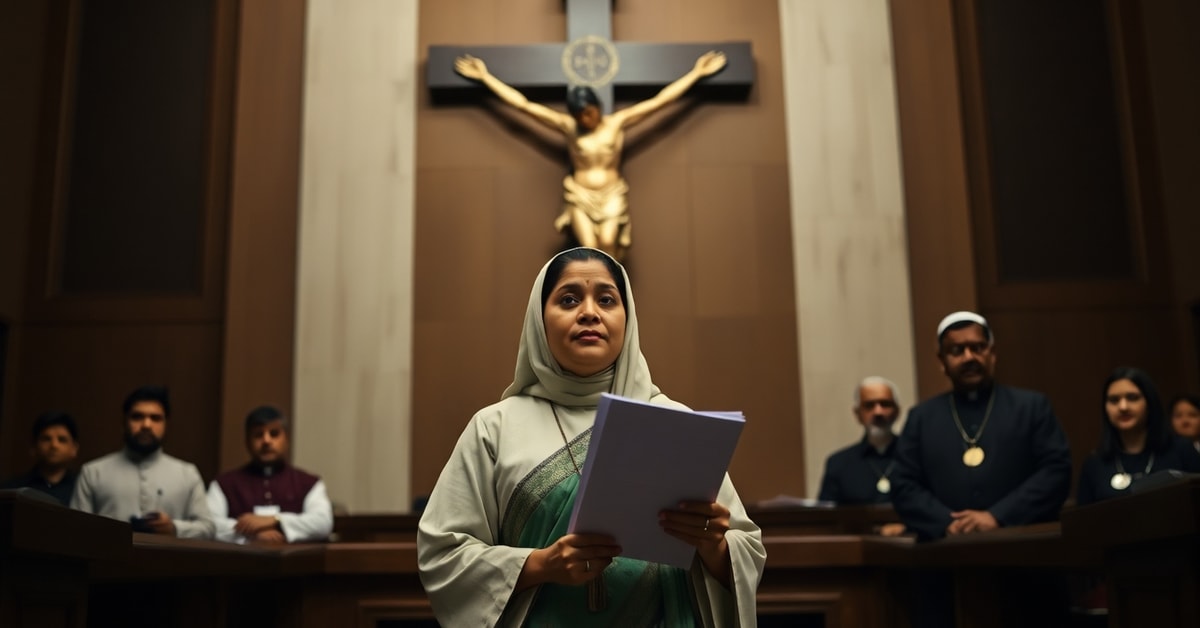
EWTN News portal reports on June 16, 2026, that Anna Minj, described as the first Catholic Indigenous woman lawmaker in Bangladesh’s Parliament, used her inaugural budget-session address to advocate for increased development funds for ethnic minority communities. The article presents her speech as a welcome development, quoting her gratitude to “Almighty God,” her praise for a “people-oriented and inclusive budget,” and her call for allocations to reach the marginalized. Church leaders, including Holy Cross Father Liton Hubert Gomes, are cited as welcoming her advocacy, albeit with some reservations about terminology and the scope of her representation. The article frames this event within the context of minority rights and development, highlighting Minj’s background in a secular development organization and her nomination by the Bangladesh Nationalist Party. This entire narrative, while seemingly benign, exemplifies the post-conciliar Church’s systematic reduction of Catholic faith to mere naturalistic social activism, stripping it of its supernatural essence and mission.
The Supernatural Vacuum: Faith Reduced to Social Work
The article presents Anna Minj’s parliamentary debut as a moment of pride for the Catholic community in Bangladesh. Her speech, as reported, is entirely devoid of any supernatural content. She thanks “Almighty God” in a generic, almost civil-religious manner, then immediately pivts to praising a “people-oriented and inclusive budget” and advocating for “development allocations” for “marginalized” groups. Her concerns are purely socioeconomic: “daily wage laborers,” “agricultural labor,” “education, technical education, and work opportunities.” This is not the language of a Catholic representative; it is the language of a secular development worker or a social justice activist.
The true mission of the Church, as defined by Our Lord Jesus Christ, is to “teach all nations, baptizing them in the name of the Father, and of the Son, and of the Holy Ghost” (Matthew 28:19-20). It is a mission of salvation, of leading souls to eternal life, not merely improving their temporal conditions. Pope Pius XI, in his encyclical *Quas Primas*, explicitly stated that Christ’s kingdom “is primarily spiritual and relates mainly to spiritual matters,” and that the Church’s authority is “to teach, govern, and lead all to eternal happiness.” The article’s complete silence on any spiritual dimension – the state of souls, the need for conversion, the sacraments, the moral law – reveals a profound theological impoverishment. It implicitly endorses the modernist error that the Church’s primary role is to address material needs, thereby denying its divine constitution and supernatural end. This is the very essence of the “hermeneutics of discontinuity” that has plagued the post-conciliar era, where the Church’s mission is redefined in purely horizontal, humanistic terms.
The Language of Naturalism: “People-Oriented” vs. Christ-Oriented
Anna Minj’s praise for a “people-oriented and inclusive budget” is a telltale sign of the naturalistic mentality that has infected the post-conciliar Church. The focus is entirely on “the people,” on “inclusion,” on “development” – concepts that, while not inherently evil, become idolatrous when divorced from their proper supernatural context. The Church is not a humanitarian organization; it is the Mystical Body of Christ, established for the salvation of souls. Pope Leo XIII, in his encyclical *Immortale Dei*, warned against the “separation of Church and State” and the “exclusion of Christ from the affairs of life,” which leads to the “destruction of the foundations of society.”
The article’s emphasis on “ethnic minority groups” and “marginalized” communities, while seemingly compassionate, reflects the modernist obsession with identity politics and social justice, often at the expense of universal Catholic truth. The Church’s concern is for all souls, regardless of their ethnic or social status, and her primary tool for their upliftment is the preaching of the Gospel and the administration of the sacraments. To reduce Catholic advocacy to securing “allocations” for specific groups is to deny the universality of Christ’s redemption and the Church’s mission to all nations. It substitutes the supernatural charity of God with the naturalistic charity of humanism, which, without grace, is ultimately futile for eternal salvation.
The “Church Leaders” and Their Mixed Blessings
The reaction of “Church leaders,” particularly Holy Cross Father Liton Hubert Gomes, further illustrates the theological bankruptcy of the post-conciliar establishment. Father Gomes is quoted as welcoming Minj’s speech, calling her statement on Indigenous rights “sound” and the increased allocation a “positive step.” His reservations are purely tactical: she didn’t address them as “Indigenous” but as a “small ethnic group,” and she should also highlight the “contribution of Christians to the nation.” This is not a theological critique; it is a bureaucratic complaint about representation and recognition within a secular system.
Father Gomes’s hope that Minj will “work for our society” and “highlight the contribution of Christians to the nation so that others can use our good teachings for the development of the nation” is a chilling example of the Church’s self-reduction to a mere social service provider. The “good teachings” are not presented as divinely revealed truths necessary for salvation, but as useful tools for national development. This is the very antithesis of the Church’s divine mandate. Pope Pius X, in *Lamentabili Sane Exitu*, condemned the proposition that “the progress of sciences requires a reform of the concept of Christian doctrine concerning God, creation, Revelation, the Person of the Incarnate Word, and Redemption” (Proposition 64). Yet, this is precisely what the post-conciliar Church has done, adapting its “teachings” to the prevailing secular paradigm of “development” and “inclusion.”
The Absence of Christ the King: A Public Apostasy
Perhaps the most glaring omission in the entire article, and indeed in the reported speech of Anna Minj, is any mention of Christ the King and His public reign over nations. Pope Pius XI, in *Quas Primas*, unequivocally stated that “the Kingdom of our Redeemer encompasses all men” and that “rulers and governments have the duty to publicly honor Christ and obey Him.” He warned that “when God and Jesus Christ… were removed from laws and states… the foundations of that authority were destroyed.”
Anna Minj, as a Catholic lawmaker in a Muslim-majority country, had a unique opportunity – and a grave duty – to publicly acknowledge Christ’s sovereignty, even if it meant facing persecution. Instead, her speech is a testament to the public apostasy that Pius XI lamented. She operates entirely within the framework of a secular parliament, seeking “allocations” and “development” without any reference to the Divine Law or the Kingship of Christ. This is not merely an omission; it is a practical denial of Catholic truth, a capitulation to the very “secularism” and “laicism” that Pius XI identified as a “plague” and a “crime.” The article’s uncritical presentation of this speech as a positive development for the Church reveals the depth of the conciliar revolution’s success in erasing the public dimension of Christ’s reign from the minds of the faithful.
The “Development” Idol: A False Gospel
The article’s consistent use of terms like “development,” “allocations,” “marginalized,” and “inclusive budget” points to an underlying idolatry of “development” as the ultimate good. This is a hallmark of modernism, which, as Pope St. Pius X described in *Pascendi Dominici Gregis*, seeks to “reconcile” the Church with “progress” and “modern civilization.” The Church’s true “development” is the sanctification of souls, the growth in holiness, and the expansion of Christ’s Kingdom through the preaching of the Gospel and the administration of the sacraments.
The focus on socioeconomic “development” for “ethnic minorities” is a distraction from the true spiritual poverty that afflicts all men, regardless of their material condition. The greatest “marginalization” is the state of sin, and the greatest “development” is conversion to Christ. By failing to address these fundamental realities, the article and the figures it quotes implicitly promote a false gospel of temporal well-being, which, without the supernatural grace of God, leads only to eternal perdition. This is the “naturalistic humanism” that the pre-conciliar Magisterium consistently warned against, a humanism that places man at the center and relegates God to the periphery, or worse, ignores Him entirely.
Conclusion: A Symptom of Systemic Apostasy
The article concerning Anna Minj’s parliamentary debut is not an isolated incident but a symptomatic manifestation of the systemic apostasy that has gripped the post-conciliar Church since the Second Vatican Council. It demonstrates how Catholic identity has been reduced to mere social activism, how the supernatural mission of the Church has been exchanged for a naturalistic agenda, and how the public reign of Christ the King has been silently repudiated in favor of secular “development” and “inclusion.”
The “Church leaders” who welcome such speeches, even with minor reservations, are complicit in this apostasy. They have abandoned their prophetic role to challenge the world with the unchanging truths of the Gospel, choosing instead to operate within the confines of secular politics, seeking recognition and “allocations” for their communities. This is not the Church of Christ; it is a “paramasonic structure” that has surrendered to the spirit of the world. The faithful must recognize this for what it is: a profound betrayal of the divine mandate and a clear sign of the times, calling for a return to the integral Catholic faith and the uncompromising proclamation of Christ the King over all nations and every aspect of human life.
Source:
Church leaders welcome first Catholic Indigenous woman in Bangladesh’s Parliament (ewtnnews.com)
Date: 16.06.2026