Cardinal Koovakad’s Azerbaijan Visit Strengthens Interreligious Dialogue — A Path to Apostasy
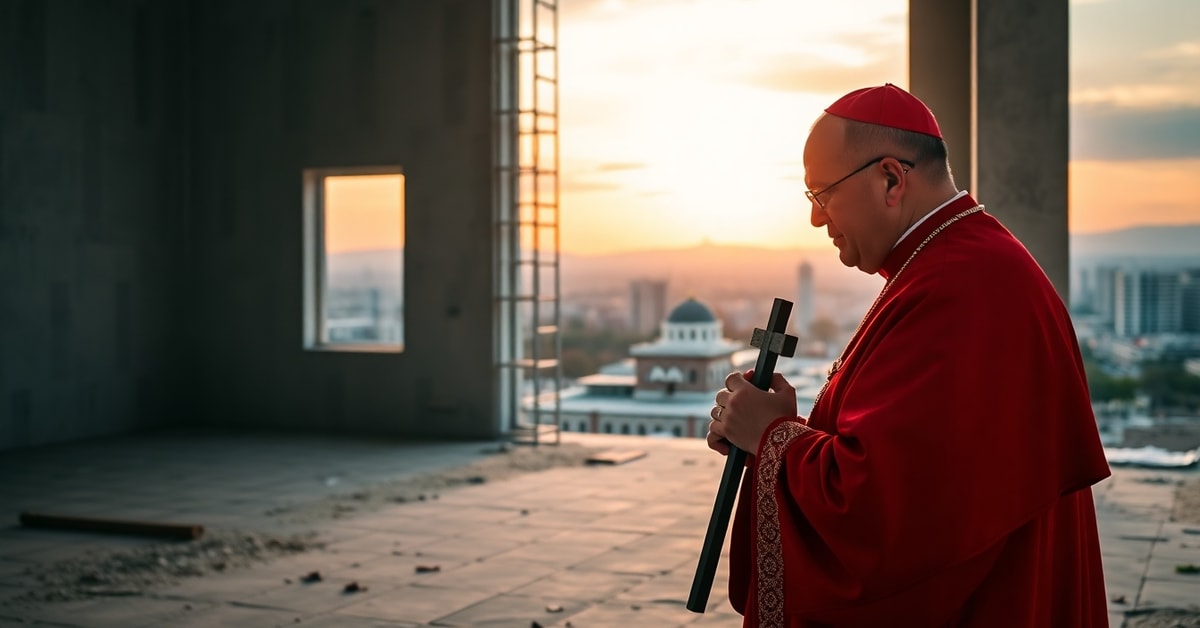
VaticanNews portal reports on the visit of Cardinal George Koovakad, Prefect of the Dicastery for Interreligious Dialogue, to Azerbaijan from 15–19 June 2026. The cardinal met with President Ilham Aliyev and religious leaders in Baku, delivering speeches that emphasized tolerance, multiculturalism, and the “civilization of love” — a concept drawn from the encyclical of the antipope Leo XIV, Magnifica humanitas. Koovakad invoked the teaching of the Second Vatican Council’s Nostra aetate, stating that “Christians and Muslims have thus sought to walk together in the service of peace, recognizing that we worship the one God, Creator of heaven and earth.” The visit, framed as a renewal of friendship between the Holy See and Azerbaijan, included discussions on bilateral agreements, the construction of a new Catholic church, and cooperation with the Heydar Aliyev Foundation. This entire enterprise is not diplomacy but the systematic betrayal of Catholic truth dressed in the language of false ecumenism.
The Idol of “Interreligious Dialogue” Against the Kingship of Christ
The central premise of this visit — that the Catholic Church and Islam “worship the one God” and should “walk together in the service of peace” — is a direct repudiation of the solemn teaching of the Church. Pope Pius XI, in the encyclical Quas Primas (1925), proclaimed with apostolic authority that the reign of Christ the King extends over all men, all nations, and all aspects of life, and that there is no power exempt from His dominion. The Pope stated: “His reign, namely, extends not only to Catholic nations or to those who, by receiving baptism according to law, belong to the Church, even though their erroneous opinions have led them astray or discord has separated them from love, but His reign encompasses also all non-Christians, so that most truly the entire human race is subject to the authority of Jesus Christ.” The duty of nations is not to “dialogue” with false religions as equals, but to recognize Christ’s sovereign authority and submit to His law. The very concept of a “Dicastery for Interreligious Dialogue” is an institutionalization of apostasy, a permanent structure dedicated to the proposition that the Church must learn from and cooperate with those who deny the Divinity of Christ and the necessity of His Church for salvation.
The Syllabus of Errors of Pope Pius IX (1864) condemned the proposition that “every man is free to embrace and profess that religion which, guided by the light of reason, he shall consider true” (Proposition 15), and that “Protestantism is nothing more than another form of the same true Christian religion, in which form it is given to please God equally as in the Catholic Church” (Proposition 18). If Protestantism — which at least retains baptism and a nominal belief in Christ — is condemned as a false form of religion, how much more so Islam, which explicitly denies the Trinity, the Divinity of Christ, and the Redemption through His Cross? The proposition that Christians and Muslims “worship the one God” is not merely an error; it is a blasphemous equivocation that erases the fundamental distinction between the true God — Father, Son, and Holy Ghost — and the god of the Qur’an, who has no Son and whose revelation supersedes and contradicts the Gospel. The Church has never taught that Muslims worship the same God as Catholics; she has taught that they are in grave error and must be converted to the Catholic faith for their salvation.
Nostra Aetate: The Trojan Horse of Modernism
Cardinal Koovakad explicitly invokes the Second Vatican Council’s Nostra aetate as the foundation for his remarks. This document, issued by the conciliar sect in 1965, represents one of the most catastrophic ruptures in the history of the Church’s public teaching. The Council’s declaration that the Church “regards with reverence” the worship of Muslims and that they “adore the one God” is a direct contradiction of the Church’s constant teaching. St. Thomas Aquinas, in the Summa Theologica, demonstrated that the act of faith terminates in the truth, and that to believe what is false about God is not faith but unbelief. Islam’s denial of the Trinity and the Incarnation places it outside any authentic worship of the true God. The conciliar document does not “regard with reverence” — it capitulates.
Pope St. Pius X, in Pascendi Dominici gregis (1907), identified the core error of Modernism as the denial that divine revelation is a objective, immutable deposit of truth, and the assertion that religion is merely a subjective experience of the human mind. The Modernist treats dogmas as “modes of explanation and stages in the evolution of Christian consciousness” — precisely the error condemned in proposition 54 of Lamentabili sane exitu. The entire framework of “interreligious dialogue” as practiced by the conciliar sect is built upon this Modernist foundation: the assumption that all religions are equally valid expressions of the human search for the divine, and that the Church must abandon her claim to exclusive truth in favor of “collaboration” and “mutual understanding.” This is not the Catholic faith; it is the synthesis of all errors that St. Pius X identified as Modernism.
The Syllabus of Errors further condemned the proposition that “the Roman Pontiff can, and ought to, reconcile himself, and come to terms with progress, liberalism and modern civilization” (Proposition 80). The entire project of the conciliar sect — from Nostra aetate to the Abu Dhabi declaration to the present visit of Cardinal Koovakad — is precisely this reconciliation with the spirit of the age, this surrender to the liberal demand that the Church abandon her supernatural claims and become merely one voice among many in the global conversation about peace and tolerance.
The “Civilization of Love” — A Naturalistic Substitution for the Kingdom of Christ
Koovakad invokes the concept of the “civilization of love,” drawn from the encyclical of the antipope Leo XIV, as the guiding principle for interreligious cooperation. This phrase, while sounding pious, is a hallmark of the conciliar sect’s naturalistic reduction of the Church’s mission. The true “civilization of love” is the Kingdom of Christ, which Pius XI described as encompassing all men and all nations, ordered according to God’s commandments and Christian principles. The Pope insisted that “the state must leave the same freedom to the members of Orders and Congregations” and that rulers have the duty “to publicly honor Christ and obey Him” (Quas Primas). The conciliar “civilization of love” replaces the supernatural reign of Christ with a horizontal, humanitarian project in which all religions collaborate on “peace,” “justice,” and “dignity” — stripped of any reference to the necessity of conversion, the reality of sin, the propitiatory sacrifice of the Mass, or the eternal destiny of souls.
The five commitments Koovakad lists — disarming words that sow hostility, building peace in justice, adopting the perspective of victims, renewing dialogue, and strengthening diplomacy — are indistinguishable from the program of any secular humanitarian organization. There is no mention of the Most Holy Sacrifice of the Mass, no mention of the necessity of baptism, no mention of the Real Presence of Christ in the Eucharist, no mention of the Church as the sole ark of salvation, no mention of the obligation of nations to embrace the Catholic faith. This silence is not accidental; it is the defining characteristic of the conciliar sect, which has systematically emptied the Catholic faith of its supernatural content and replaced it with a naturalistic humanism that would be entirely at home in the United Nations or the World Economic Forum.
Meeting with President Aliyev — Diplomacy Without Truth
The meeting between Cardinal Koovakad and President Ilham Aliyev, in which the cardinal conveyed greetings from the antipope Leo XIV and Cardinal Secretary of State Pietro Parolin, is presented as a normal exercise of diplomatic relations. But the Church’s diplomacy has always been ordered toward the propagation of the faith and the defense of the rights of the Church and of Christ the King. Pius XI declared that “what we wrote at the beginning of Our Pontificate about the diminishing authority of law and respect for power, the same can be applied to the present times: ‘When God and Jesus Christ — as we lamented — were removed from laws and states and when authority was derived not from God but from men, the foundations of that authority were destroyed'” (Quas Primas). The discussions with Aliyev focused on tolerance, multiculturalism, cooperation with the Heydar Aliyev Foundation, and the construction of a second church — all entirely naturalistic concerns that could be discussed between any two civil servants.
There is no indication that Koovakad raised the systematic persecution of Christians in Muslim-majority nations, the destruction of Christian heritage, the imposition of sharia-based restrictions on religious freedom, or the duty of the Azerbaijani government to recognize the Catholic Church as the one true Church and to facilitate the conversion of its citizens. The “tolerance and multiculturalism” praised by the cardinal are precisely the liberal shibboleths that Pius IX condemned in the Syllabus of Errors — the proposition that “it is no longer expedient that the Catholic religion should be held as the only religion of the State, to the exclusion of all other forms of worship” (Proposition 77). The Church has always taught that the Catholic religion must be the religion of the state, and that other forms of worship may be tolerated only by reason of the greater good, never as a matter of right or equality.
The Dicastery for Interreligious Dialogue — A Permanent Structure of Apostasy
The very existence of the Dicastery for Interreligious Dialogue is an institutional scandal. Created by the conciliar sect to perpetuate the errors of Nostra aetate, this dicastery has no basis in the Church’s traditional teaching or governance. The Church has always engaged with non-Christians — but for the purpose of their conversion, not for “dialogue” as an end in itself. The missionary mandate of Christ — “Go ye therefore, and teach all nations, baptizing them in the name of the Father, and of the Son, and of the Holy Ghost” (Matt. 28:19) — is not a suggestion to be balanced against “interreligious cooperation” but a divine command that admits no exception.
The bilateral agreement signed in 2011 and the memorandum of understanding on religious cooperation signed in 2025, cited by Koovakad as evidence of “shared conviction,” are not acts of Catholic diplomacy but acts of formal submission to the principle that Islam is a legitimate partner in the pursuit of peace. The Church does not enter into “agreements” with false religions as equals; she preaches the Gospel to them and calls them to conversion. The construction of a second church in Baku, mentioned in the article, is presented as a sign of progress — but if that church celebrates the Novus Ordo Missae, with its ambiguous prayers, its communion with heretics and schismatics, and its implicit denial of the Church’s exclusive claim to truth, then it is not a Catholic church but a monument to apostasy.
The Spirit of Vatican II — A Synthesis of All Errors
The entire visit of Cardinal Koovakad to Azerbaijan is a perfect illustration of what St. Pius X predicted would happen if the Modernists were allowed to prevail. In Pascendi, he described the Modernist agenda as the transformation of Catholicism into a “broad and liberal Protestantism” — a religion without dogmas, without authority, without the supernatural. This is precisely what the conciliar sect has achieved. The “dialogue” practiced by Koovakad is not Catholic; it is the religion of the Antichrist, which acknowledges every “spiritual path” while denying the unique salvific mission of Jesus Christ and His Church.
Pope Pius IX, in the Syllabus of Errors, warned that the Church must defend herself against “the frauds and machinations of these sects” — the Masonic and liberal forces that seek to “submit the Church of God to the most cruel servitude, to undermine the foundations on which it rests, to contaminate its splendid qualities; and, moreover, to strike it with frequent blows, to shake it, to overthrow it, and, if possible, to make it disappear completely from the earth.” The Dicastery for Interreligious Dialogue is not a defense against these forces; it is their instrument within the structures occupying the Vatican.
The faithful who profess the integral Catholic faith must reject this entire enterprise. There can be no “dialogue” with those who deny Christ’s Divinity. There can be no “cooperation” with false religions on the assumption that they worship the same God. There can be no “civilization of love” that is not founded on the Kingship of Christ, the Most Holy Sacrifice of the Mass, and the Church’s exclusive claim to be the one true religion established by Almighty God. The visit of Cardinal Koovakad to Azerbaijan is not a sign of the Church’s vitality; it is a symptom of the terminal disease of Modernism that has consumed the conciliar sect and reduced it to a pale imitation of the one, holy, catholic, and apostolic Church founded by Our Lord Jesus Christ.
Source:
Cardinal Koovakad's Azerbaijan visit strengthens interreligious dialogue (vaticannews.va)
Date: 19.06.2026