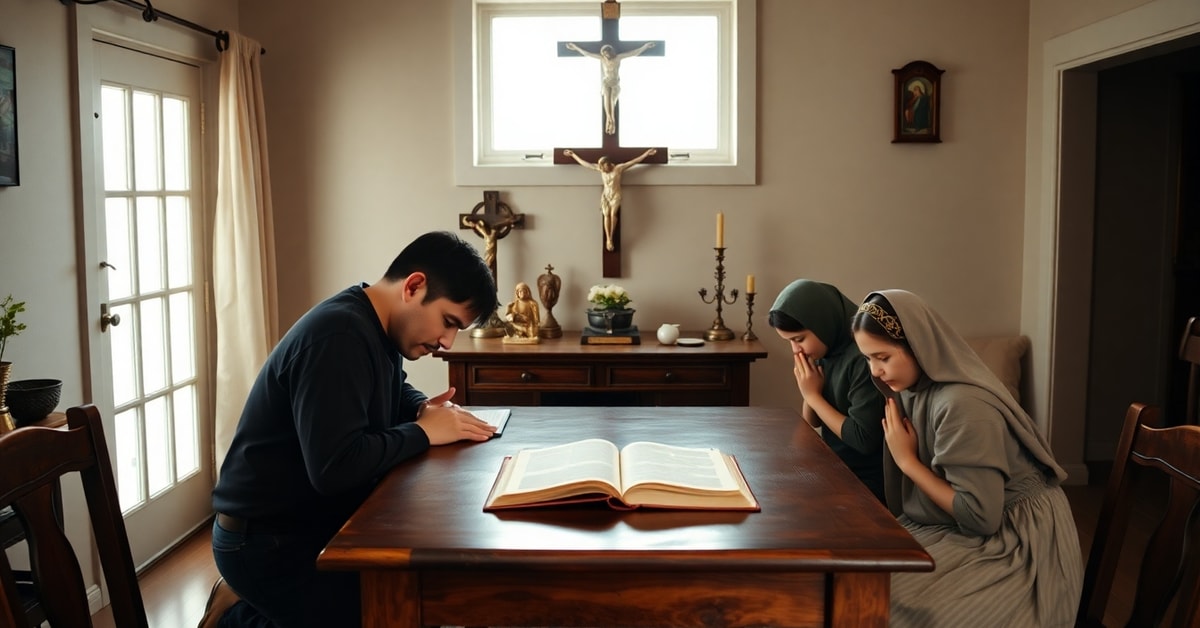
Peru’s Pro-Family Law: A Naturalistic Gesture in a World That Has Rejected Christ the King
EWTN News reports that Peru’s national legislature has passed Law 32671, declaring June as “Life and Family Month.” The bill’s author, Milagros Jáuregui de Aguayo, stated that the family is “the most important pillar of our society,” while Carlos Polo of the Population Research Institute emphasized the family’s role in addressing Peru’s “worrying birth-rate crisis.” While such legislation may appear commendable on the surface, it fundamentally operates within a naturalistic framework that, by omitting the supernatural foundation of the family and the social reign of Christ the King, reduces Catholic social teaching to mere humanitarianism and demographic policy—a far cry from the integral Catholic doctrine articulated by the Church’s authentic Magisterium before the conciliar revolution.
The Family: Natural Institution or Supernatural Reality?
The language employed in both the law and the supporting statements reveals a profoundly impoverished understanding of the family. When Jáuregui de Aguayo calls the family “the most important pillar of our society” and speaks of building “a Peru with greater unity, solidarity, and hope,” she speaks the language of secular sociology, not Catholic theology. The authentic Magisterium teaches something far more radical and far more true.
Pope Leo XIII, in his encyclical *Arcanum Divinae Sapientiae* (1880), defined the family’s origin with precision: “The family, or rather the domestic society, is anterior to every nation and city, and therefore must have rights and duties prior to those of any civil society.” He further declared that **”the family is the cradle of civil society, and it is in great measure within the domestic circle that is prepared the destiny of states.”** But crucially, Leo XIII grounded this not in mere social utility but in divine institution: marriage was raised by Christ to the dignity of a sacrament, and the family derives its stability and sanctity from this supernatural reality.
The Peruvian law speaks of the family as a “natural and fundamental institution of society”—language that, while not explicitly heretical, is deliberately truncated. It omits entirely the sacramental character of marriage, the indissolubility of the conjugal bond as defined by the Council of Trent (Session XXIV, Canon 7: **”If anyone says that the Church errs in having taught and in teaching that, according to the evangelical and apostolic doctrine, the bond of marriage cannot be dissolved by reason of the adultery of one of the spouses… let him be anathema”**), and the family’s orientation toward the procreation and education of children *for the Kingdom of God*, not merely for national development.
The Demographic Panic: Children as Economic Assets
Carlos Polo’s statement exposes the underlying naturalistic calculus with startling clarity. He frames the family law’s significance in terms of Peru’s “worrying birth-rate crisis” and “progressively aging population,” phenomena that “jeopardize the country’s future development.” The family is presented as instrumental to “the continuity, stability, and prosperity of our nation.”
This is the language of the demographic technocrat, not the Catholic theologian. Children are implicitly reduced to economic units—future workers, taxpayers, consumers—whose production must be incentivized to sustain the machinery of the state. Pope Pius XI, in *Casti Connubii* (1930), condemned this very mentality when he wrote that **”those who act in this way are criminal”** who “deliberately frustrate the marriage act,” and he reaffirmed that “the primary end of marriage is the procreation and education of children”—not the maintenance of GDP growth or pension systems.
The authentic Catholic position, as articulated by the pre-conciliar Magisterium, holds that children are souls destined for eternal beatitude, entrusted by God to parents who cooperate with divine grace in forming members of the Church Militant. To speak of “birth-rate crises” without reference to the supernatural ends of marriage—the salvation of souls, the increase of the Church, the glory of God—is to evacuate Catholic doctrine of its very substance and replace it with the barren categories of Malthusian economics dressed in pro-natalist clothing.
The Omission of Christ the King: The Fatal Silence
The most damning deficiency of this Peruvian legislation is what it does not say. Nowhere in the reported statements or in the law’s stated purposes is there any mention of the social reign of Christ the King—the doctrine that Pius XI proclaimed as the indispensable foundation of all just social order.
Pius XI, in *Quas Primas* (1925), declared with unmistakable clarity: **”His reign, namely, extends not only to Catholic nations or to those who, by receiving baptism according to law, belong to the Church, even though their erroneous opinions have led them astray or discord has separated them from love, but His reign encompasses also all non-Christians, so that most truly the entire human race is subject to the authority of Jesus Christ.”** He further warned: **”When God and Jesus Christ—as we lamented—were removed from laws and states and when authority was derived not from God but from men, the foundations of that authority were destroyed.”**
The Peruvian law operates entirely within the framework of secular constitutionalism. It is a law passed by a legislature, published in an official gazette, framed in terms of national policy. It makes no acknowledgment that the state has a positive duty to recognize the Catholic faith as the religion of the nation, to submit its legislation to the judgment of the Church, and to order all things toward the supernatural end of the human person.
Pope Pius IX, in the *Syllabus of Errors* (1864), condemned the proposition that **”In the present day it is no longer expedient that the Catholic religion should be held as the only religion of the State, to the exclusion of all other forms of worship”** (Proposition 77). He likewise condemned the separation of Church and State: **”The Church ought to be separated from the State, and the State from the Church”** (Proposition 55). The Peruvian law, by its silence on these matters, implicitly accepts the very liberalism that the Church has consistently condemned.
The Conciliar Captivity of Catholic Discourse
The framing of this law through organizations such as the Population Research Institute and media outlets like ACI Prensa and EWTN News reveals the extent to which even nominally Catholic discourse has been captured by the conciliar paradigm. The language of “pro-life” and “pro-family” leadership, while superficially aligned with Catholic moral teaching, operates almost entirely within the categories permitted by the post-conciliar settlement: natural law arguments accessible to reason, demographic and economic justifications, appeals to “human dignity” and “common good” stripped of their supernatural content.
This is precisely the error that St. Pius X identified in *Pascendi Dominici Gregis* (1907) as the Modernist method: the reduction of supernatural truths to natural categories, the evacuation of dogma in favor of “vital immanence” and social utility. The Modernist, St. Pius X wrote, **”is accustomed to speak of the evolution of dogmas, meaning that they must adapt to the times”**—and we see this adaptation in the way Catholic social action has been reconceived as lobbying within secular democratic frameworks rather than the proclamation of the integral social kingship of Christ.
The conciliar document *Gaudium et Spes* (1965) inaugurated this trajectory by speaking of the Church’s engagement with “the world” in terms that blurred the distinction between the supernatural and the natural, between the City of God and the City of Man. The Peruvian law is a fruit of this conciliar compost: it speaks of “life” and “family” but in a register that any secular humanist could endorse, because it has been carefully stripped of the offensive particularity of Catholic truth—that marriage is a sacrament, that the family exists for the glory of God and the salvation of souls, and that the state is subject to the law of Christ the King.
What Authentic Catholic Action Demands
The pre-conciliar Magisterium provides an entirely different model of Catholic engagement with the social question. Pope Leo XIII, in *Immortale Dei* (1885), laid down the principles with crystalline clarity:
**”The Almighty, therefore, has given the charge of the human race to two powers, the ecclesiastical and the civil, the one being set over divine, and the other over human, each supreme in its own kind, and each fixed within limits which are defined by its own nature and special object.”** He further declared that **”the state must not absorb the individual or the family”** and that **”it is a sin in the state not to have care for religion… or to treat the various religions (as they call them) alike.”**
Authentic Catholic action on behalf of life and the family would demand, at minimum:
1. **The explicit recognition of the Catholic Church as the true Church of Christ** and the submission of all legislation to the judgment of her Magisterium.
2. **The legal protection of the sacrament of marriage** as defined by the Council of Trent, with the absolute prohibition of divorce and the recognition of the Church’s exclusive jurisdiction over matrimonial causes.
3. **The rejection of all forms of contraception and abortifacient technology** as crimes against God and nature, not merely as matters of personal conscience.
4. **The education of children in the Catholic faith** as the primary end of the family, with the state facilitating rather than impeding this duty.
5. **The public acknowledgment of Christ the King** as the source of all legitimate authority, including that of the Peruvian state.
None of these demands are present in the Peruvian law. What is present is a well-intentioned but fundamentally naturalistic measure that, by its silence on the supernatural, effectively ratifies the very secularism it purports to combat.
Conclusion: The Poverty of Naturalistic Catholicism
The Peruvian “Life and Family Month” law represents the best that conciliar Catholicism can offer: a gesture toward Catholic moral teaching that has been so thoroughly laundered through the categories of secular liberalism that it is indistinguishable from the positions of any religiously affiliated humanitarian organization. It speaks of “life” without the supernatural destiny of the soul; of “family” without the sacrament of marriage; of “society” without the social reign of Christ the King; of “hope” without the theological virtue thereof.
Pope Pius XI warned in *Quas Primas* that **”the seeds of discord sown everywhere, flames of envy and hostility have engulfed nations”** precisely because “Jesus Christ and His most holy law” have been “removed from customs, from private, family, and public life.” The Peruvian law does not remove Christ—but it does not install Him either. It occupies the neutral ground that the conciliar revolution carved out between the City of God and the City of Man, and in doing so, it testifies to the spiritual bankruptcy of a Catholicism that has learned to speak the world’s language while forgetting the language of the Gospel.
Until the nations publicly acknowledge what the Church has always taught—that **”there is no other name under heaven given to men by which we must be saved”** (Acts 4:12), and that this name must be confessed not only in private devotion but in the laws, institutions, and public life of every nation—such legislative gestures, however well-intentioned, will remain what they are: naturalistic palliatives applied to a supernatural disease.
Source:
Peru passes law declaring June Life and Family Month (ewtnnews.com)
Date: 22.06.2026