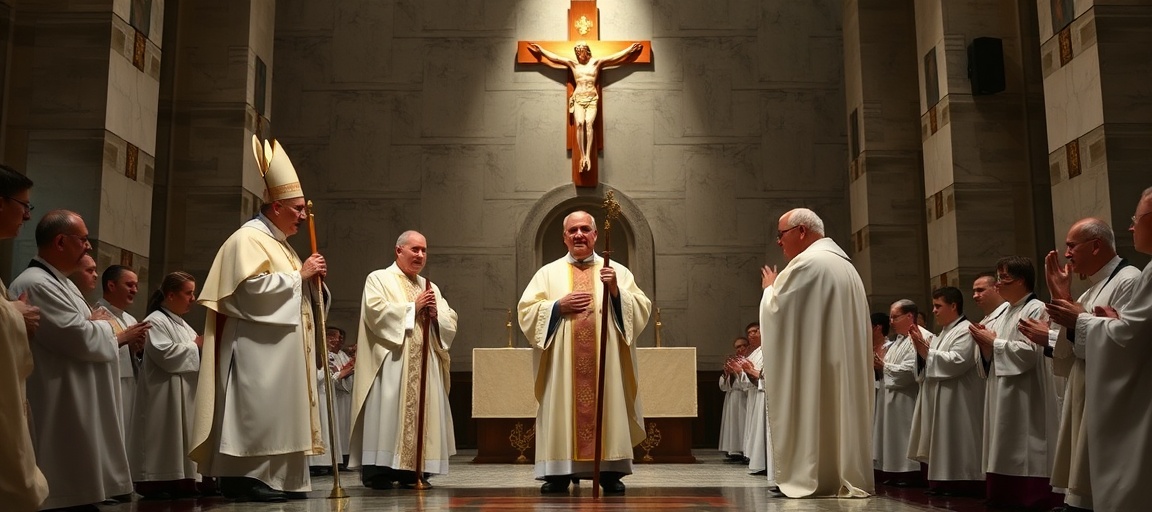
SSPX Illicit Consecrations: Schismatic Theater in the Conciliar Sect
The Pillar podcast—a mouthpiece of the conciliar establishment—devotes its 268th episode to the Society of St. Pius X’s latest episcopal consecrations, performed on July 1 without any mandate from the Holy See. Hosts JD Flynn and Ed Condon frame the event as a canonical irregularity requiring Vatican “response,” thereby implicitly recognizing the legitimacy of the usurpers occupying the Vatican since 1958. This analysis exposes the SSPX not as a bastion of Tradition but as a controlled opposition wholly integrated into the paramasonic structure of the neo-church.
Theatrical Schism: The SSPX as Conciliar Pressure Valve
The July 1 consecrations—carried out by Bp. Bernard Fellay without apostolic mandate—are presented by the conciliar media as a “crisis” between the SSPX and Rome. In reality, they are the latest act in a decades-long charade. Archbishop Marcel Lefebvre, the Society’s founder, explicitly acknowledged the validity of the post-conciliar “popes,” declaring: “We recognize the Pope… we accept the Pope.” This recognition alone places the SSPX outside the Catholic Church, for cum ex apostolatus officio (Pope Paul IV) teaches that a manifest heretic cannot hold the papacy, and Canon 188 §4 of the 1917 Code decrees that public defection from the faith vacates office ipso facto. By treating John XXIII, Paul VI, John Paul II, Benedict XVI, Francis, and now Leo XIV (Robert Prevost) as true pontiffs, the SSPX adheres to the heresy of papal validity despite manifest modernism.
The Pillar’s framing—“the Vatican’s response”—reveals the symbiotic relationship: the conciliar sect needs the SSPX to absorb traditionalist sentiment, while the SSPX needs the conciliar sect for a veneer of legitimacy. As St. Robert Bellarmine teaches in De Romano Pontifice, “a manifest heretic… by that very fact ceases to be Pope and head, just as he ceases to be a Christian and member of the body of the Church.” The SSPX’s refusal to apply this principle to the conciliar usurpers makes them co-responsible for the great apostasy.
Invalid Orders: The Liénart-Fellay Chain of Doubt
The sacramental validity of SSPX ordinations is gravely compromised. Lefebvre was consecrated bishop in 1947 by Achille Liénart, a documented Freemason whose membership in the lodge “L’Avenir du Nord” was exposed by Mgr. Georges Roche in L’Église et la Franc-Maçonnerie (1974). A Freemason incurs ipso facto excommunication (Canon 2335, 1917 Code) and loses all jurisdiction; his consecrations are at minimum doubtful, likely invalid for defect of intention. The 1988 consecrations performed by Lefebvre—without papal mandate—carried this tainted lineage forward. The July 1, 2026 consecrations by Fellay merely extend a dubious episcopal succession that cannot transmit the fullness of the priesthood with moral certainty.
The Pillar’s silence on this foundational defect is telling. It treats the SSPX as a canonical “society” in irregularity rather than what it is: a schismatic sect within the neo-church, simulating Tradition while recognizing the Antichrist’s vicars.
Linguistic Complicity: The Vocabulary of Conciliar Legitimacy
The podcast’s language betrays its modernist presuppositions. Terms like “Vatican,” “Holy See,” and “Pope” are used without qualification, as if the structures occupying Rome since 1958 retain divine institution. The hosts speak of “canonical regularization” as a desirable goal—as though communion with Modernism could ever be regular. Pius XI in Quas Primas (1925) declares: “When God and Jesus Christ… were removed from laws and states… the foundations of that authority were destroyed.” The conciliar sect has removed Christ the King from its constitution (Dignitatis Humanae, Gaudium et Spes); therefore it possesses no authority to regularize anything.
The SSPX’s own rhetoric—“recognize and resist”—is an ontological impossibility. One cannot recognize a manifest heretic as Vicar of Christ and simultaneously resist his magisterium; the very act of recognition submits the intellect to a false authority. St. Francis de Sales warns: “The Church is the pillar of truth; whoever separates from it falls into error.” The SSPX, by remaining canonically tethered to the conciliar hierarchy, shares in its condemnation.
Theological Bankruptcy: Silence on the Papal Vacancy
The gravest omission in The Pillar’s coverage—and in SSPX discourse generally—is total silence on the sede vacante. Not a word on the automatic loss of office for manifest heresy (Bellarmine, De Romano Pontifice 2.30; Wernz-Vidal, Ius Canonicum 2.398). Not a word on Pope Paul IV’s Cum ex Apostolatus Officio (1559), which declares the election of a heretic “null, void, and of no effect” regardless of cardinal consensus. Not a word on the Nestorian precedent: Pope Celestine I taught that Nestorius “had already brought the divine judgment upon himself” from the moment he preached heresy, before any conciliar declaration.
The SSPX’s practical sedevacantism—refusing the New Mass, rejecting conciliar doctrine—is intellectually dishonest without the formal conclusion. As John of St. Thomas argues, citing Bellarmine: “A heretic is not a member, therefore he cannot be the head of the Church… a manifest heretic cannot be Pope.” The SSPX wants the benefits of sedevacantism (traditional liturgy, sound doctrine) without the cross of declaring the See vacant—because that would require them to act as Catholics outside the visible structures of the neo-church, without the comfort of a “canonical” identity.
Symptomatic Level: The SSPX as Fruit of the Conciliar Revolution
The SSPX is not a pre-conciliar survival; it is a post-conciliar creation. Founded in 1970, it exists only because the conciliar revolution created a market for “traditional” Catholicism that the neo-church could manage. Its 1988 consecrations were a staged rupture—Lefebvre chose four priests, not the twelve required for a valid provincial council, and performed the rite on the feast of St. Peter and Paul, mocking the very papacy he claimed to obey. The 2026 consecrations follow the same script: theatrical defiance that changes nothing.
The Pillar’s coverage serves the same management function. By treating the SSPX as a “canonical problem,” it reinforces the illusion that the conciliar hierarchy has jurisdiction to solve it. This is the hermeneutic of continuity applied to schism: the neo-church absorbs its critics by granting them a hearing, then neutralizes them through endless “dialogue.”
The Only Catholic Position: Total Separation from the Abomination
True Catholics—those who hold the integral faith ante 1958—recognize that the See of Peter has been vacant since the death of Pius XII. The line of usurpers (John XXIII → Leo XIV) constitutes the abomination of desolation foretold by Our Lord (Mt 24:15). The SSPX, the FSSP, the Institute of Christ the King, and all “Ecclesia Dei” communities are part of the conciliar sect, differing only in liturgical aesthetics. Their sacraments, where valid, are administered outside the Church and therefore profit nothing unto salvation (extra ecclesiam nulla salus).
The July 1 consecrations are not a “crisis for the Vatican.” They are another brick in the wall of the counter-church. The only response a Catholic can make is the one St. Athanasius gave to the Arian occupiers of his see: “You have the buildings; we have the faith.” The true Church subsists in the remnant of bishops and priests who profess the integral faith without compromise, who reject the false apparitions of Fatima, the pseudo-saints of the conciliar calendar, and the Masonic novelties of the new rites.
“He who is not with Me is against Me; and he who does not gather with Me scatters.” (Mt 12:30) The SSPX scatters. The Pillar obscures. The conciliar sect destroys. Return to Tradition. Reject the usurpers. Hold the faith entire.
Source:
Ep. 268: The SSPX and what comes next (pillarcatholic.com)
Date: 04.07.2026