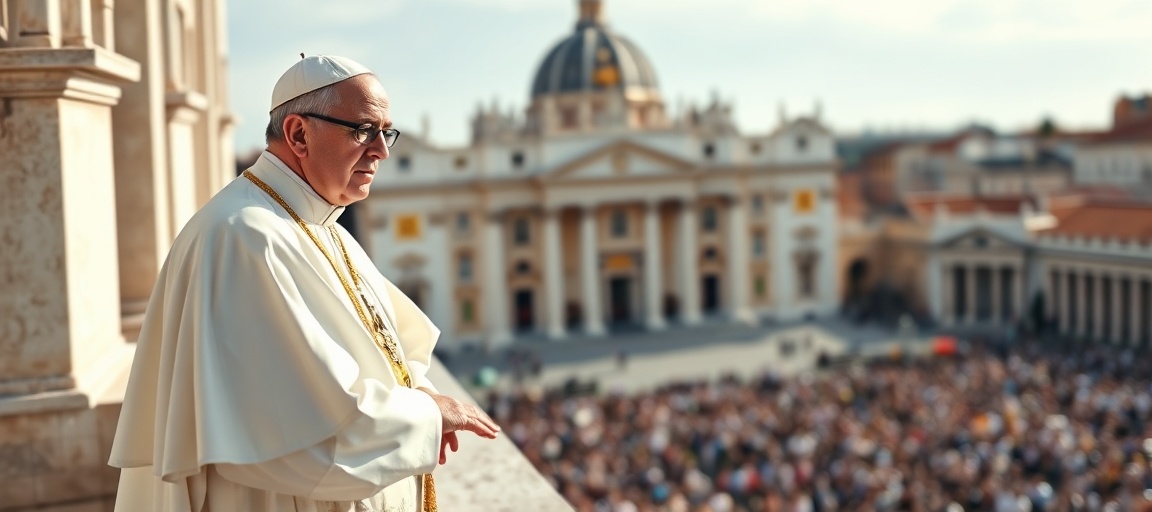
Antipope Leo XIV’s Angelus: Therapeutic Deism Replaces Christ the King
The Vatican News portal reports that the usurper “Pope” Leo XIV (Robert Prevost) delivered an Angelus address on 5 July 2026 in St. Peter’s Square, presenting a Christ stripped of His royal sovereignty and judicial authority, reduced to a therapeutic companion for the “weary” and a vague “hope” amid war. The address cites Matthew 11:25–30 but evacuates the text of its dogmatic density, substituting the social kingship of Christ (Quas Primas) with a humanitarian pablum that ignores the rights of God, the necessity of the Church for salvation, and the reality of eternal judgment. This is not the preaching of the Catholic faith but the liturgy of the cult of man condemned by Pius XI and St. Pius X.
The Usurper’s Pulpit: No Authority, No Mission, No Salvation
The very premise of the article is an offense to the sedes apostolica. Robert Prevost, a manifest heretic who embraces the conciliar errors of religious liberty, false ecumenism, and the “dignity of man” as the supreme principle, occupies the Vatican palaces not as Vicar of Christ but as the antipope of the conciliar sect. As St. Robert Bellarmine teaches in De Romano Pontifice: “A Pope who is a manifest heretic, by that very fact ceases to be Pope and head, just as he ceases to be a Christian and member of the body of the Church”. The “Defense of Sedevacantism” file confirms this doctrine with canonical precision: “By notorious and publicly manifested heresy, the Roman Pontiff… is deprived ipso facto of his personal jurisdiction even before any declaratory sentence by the Church” (Wernz and Vidal, Ius Canonicum). Canon 188.4 of the 1917 Code declares that an office becomes vacant ex ipsa facto when a cleric “publicly defects from the Catholic faith”. Prevost’s entire “pontificate” is a walking ipso facto vacancy. His words carry no more weight than those of any other layman — less, indeed, for he speaks as a usurper of the Chair of Peter, an abomination of desolation standing in the holy place (Matt. 24:15).
Christ the King Abolished: The Quas Primas Betrayed
Pius XI’s encyclical Quas Primas (1925) — instituted precisely to combat the “plague… of secularism, so-called laicism” — proclaims that “His reign encompasses not only Catholic nations… but also all non-Christians, so that most truly the entire human race is subject to the authority of Jesus Christ” (citing Leo XIII, Annum Sacrum). The encyclical teaches that “the state must leave the same freedom to the members of Orders… who contribute most to the expansion and establishment of Christ’s Kingdom” and that “rulers and governments have the duty to publicly honor Christ and obey Him”, reminded of the final judgment where Christ “will very severely avenge these insults”.
What does the antipope offer instead? A Christ who is “liberation in slavery,” “hope amid war,” “forgiveness in sin” — a horizontal, immanent, psychological balm. There is no mention of Christ’s rights over nations, no condemnation of the secular state, no call for the public confession of His kingship in parliaments and laws. The antipope’s Christ is a cosmic therapist, not the Rex regum et Dominus dominantium (Rev. 19:16). This is the theological bankruptcy of the conciliar revolution: the substitution of the social reign of Christ with the reign of man.
The Gospel Evacuated: Humility Without Truth, Cross Without Sacrifice
The address cites Matthew 11:25–30 — “Come to me, all you that are weary and are carrying heavy burdens” — but severs the yoke of Christ from the lex credendi and the lex orandi of the true Church. The antipope says: “our journey of following Christ is not an asceticism that mortifies. Rather, it is a school of freedom”. This is Modernist proposition 59 condemned by St. Pius X in Lamentabili Sane Exitu: “Christ did not proclaim any specific, all-encompassing doctrine suitable for all times and peoples, but rather initiated a certain religious movement, applied or applicable to different times and places.” The Cross is reduced to a symbol of solidarity, not the propitiatory sacrifice of Calvary renewed on the altar. The “yoke” becomes “self-giving out of love… ablaze with love for all” — a sentimental vapor that ignores the necessity of baptism, the integrity of the faith, the rejection of heresy, the observance of all Commandments.
The Syllabus of Errors (1864) condemns the very spirit of this address: “The civil government… has a right to an indirect negative power over religious affairs” (Error 41), “In the case of conflicting laws enacted by the two powers, the civil law prevails” (Error 42), “The Church ought to be separated from the State, and the State from the Church” (Error 55), “The Roman Pontiff can, and ought to, reconcile himself, and come to terms with progress, liberalism and modern civilization” (Error 80). The antipope’s Angelus is the living embodiment of Error 80: a “pope” who has reconciled the papacy with the world, the Cross with comfort, the Kingship with dialogue.
Silence as Heresy: What Is Omitted Condemns the Speaker
The gravest accusation is the total silence on the supernatural order. No mention of:
- The necessity of the Catholic Church for salvation (extra ecclesiam nulla salus, Fourth Lateran Council, Bull Unam Sanctam);
- The reality of hell and the particular judgment;
- The Sacrifice of the Mass as the unbloody renewal of Calvary;
- The Social Kingship of Christ over legislation, education, marriage, economy;
- The condemnation of religious liberty as deliramentum (Gregory XVI, Mirari Vos; Pius IX, Quanta Cura; Leo XIII, Libertas);
- The duty of states to profess the Catholic faith and repress public blasphemy;
- The invalidity of the new “sacraments” and the new “mass” of the conciliar sect.
This silence is not accidental; it is systematic apostasy. As Pius XI wrote in Quas Primas: “When God and Jesus Christ… were removed from laws and states and when authority was derived not from God but from men, the foundations of that authority were destroyed”. The antipope’s message is the theology of the “Church of the New Advent”: a paramasonic structure that serves the synagogue of Satan (Apoc. 2:9) by anesthetizing souls with a counterfeit gospel.
The “Wise and Intelligent” vs. the “Infants”: A Modernist Inversion
The antipope contrasts the “wise and intelligent” who “fail to recognize the presence of Christ” with the “infants” to whom God reveals Himself. But in the conciliar sect, the “wise and intelligent” are the Modernist theologians — the Rahner, Küng, Kasper, Bergoglio types — who dismantle dogma under the guise of “development”, while the “infants” are the simple faithful led into false ecumenism, intercommunion, and religious indifferentism. St. Pius X condemned this inversion in Pascendi Dominici Gregis and Lamentabili Sane Exitu: “The dogmas which the Church proposes as revealed are not truths of divine origin but are a certain interpretation of religious facts, which the human mind has worked out with great effort” (Prop. 22), “Faith, as assent of the mind, is ultimately based on a sum of probabilities” (Prop. 25). The antipope’s “humility” is the humility of the Modernist who submits not to the depositum fidei but to the spirit of the age.
The Structural Apostasy: A Sect, Not a Church
The article originates from Vatican News, the propaganda organ of the neo-church occupying the Vatican. This structure — born of the conciliar revolution (1962–1965) — is not the Catholic Church but a counterfeit, a synagogue of Satan (Apoc. 3:9) that has usurped the visible patrimony while denying the invisible reality. Its “pope” is a layman in white, its “bishops” are functionaries of a false religion, its “sacraments” are empty rituals (the new “mass” a cena, not a sacrificium), its “saints” are fabricated idols (Kolbe, Newman, Wojtyła, Kowalska — all “canonized” by antipopes). The “Defense of Sedevacantism” file demonstrates that Pope Paul IV’s Bull Cum ex Apostolatus Officio declares the elevation of a heretic “null, void, and of no effect” — and the 1917 Code references this Bull 19 times. The line of usurpers from John XXIII to Leo XIV is a continuous crime against the papacy.
Fatima and the Diversion from the True Crisis
The “False Fatima Apparitions” file exposes the Masonic operation “Fatima” as a psychological weapon to divert attention from the modernist apostasy within. The antipope’s Angelus — with its vague “hope amid war” and “cross as comfort” — functions identically: it externalizes evil (war, suffering) while ignoring the internal enemy (heresy, apostasy, the loss of the faith in Rome). St. Pius X warned against the “enemies within” (Pascendi); the Fatima narrative and the conciliar “gospel of comfort” both serve to obscure the true catastrophe: the vacancy of the Holy See and the eclipse of the Church (cf. La Salette, the true prophecy).
Conclusion: No Salvation Outside the True Church
The Angelus of the antipope Leo XIV is a document of damnation for those who take it as Catholic teaching. It offers a Christ without a Crown, a Cross without Blood, a Church without Dogma, a Father without Judgment. Quas Primas declares: “There is no other name under heaven given to men by which we must be saved” (Acts 4:12) — and that name belongs to the King of Kings, not the therapist of the nations. The faithful must flee the conciliar sect, reject its false shepherds, cleave to the Tradition of 1958, and pray for the restoration of the true papacy. Non praevalebunt (Matt. 16:18) — but the gates of hell have occupied the Vatican. The remedy is not in St. Peter’s Square but in the catacombs of Tradition, where the Mass of All Ages is offered and the Social Kingship of Christ is proclaimed without compromise.
Christus vincit, Christus regnat, Christus imperat.
Source:
Pope at Angelus: Amid the scourge of war Christ is hope (vaticannews.va)
Date: 05.07.2026