May 2026

Antichurch

Toes-a-ry: When Marian Devotion Becomes Infantile Superstition

The National Catholic Register reports on a viral social media trend called the “Toes-a-ry” — a practice where mothers pray the Rosary by counting their babies’ toes instead of using actual rosary beads. Laika Ordoñez, the mother who popularized the practice, shared on Instagram: “Forgot my Rosary; so Toesary it is,” adding that her baby’s toes are “a built-in rosary — blessed and everything.” The post garnered over 640,000 views and 65,000 comments, with reactions ranging from amusement to claims that the practice is “definitely from the Holy Spirit.” The article frames this as a “beautiful” and “holy” innovation, suggesting that motherhood itself becomes a “pathway to prayer.” What the Register celebrates as charming innovation is, in reality, a symptom of the post-conciliar Church’s catastrophic descent into sentimentalism, superstition, and the trivialization of sacred devotion — a deviation that would have been unrecognizable to the Catholic mothers of previous centuries who understood that the Rosary is not a casual game but a quasi-sacramental weapon of war against the powers of darkness.

Antichurch

Vatican Symposium Reveals Post-Conciliar Obsession With “Emotional Culture” Over Sacramental Reality

VaticanNews portal reports that the Dicastery for Laity, Family and Life, under Cardinal Kevin Farrell, will host a study day on April 28, 2026, at the Vatican’s Casina Pio IV, titled “The Sacrament of Marriage, Faith and the Munus Docendi.” The event, celebrating the tenth anniversary of the heretical *Amoris laetitia*, focuses on forming “priests” to accompany young people and married couples through “profound cultural changes” and “the changing landscape of emotional culture.” This initiative reveals the post-conciliar obsession with adapting the Church’s mission to secular psychological frameworks rather than forming souls in the unchanging doctrine of the sacramental order.

Spiritual

When “Awareness” Replaces the Cross: The Infertility Article’s Silence on Suffering’s Supernatural Meaning

The National Catholic Register portal reports on an interview with Leigh Fitzpatrick Snead, an EWTN radio host and author, who during National Infertility Awareness Week encourages Catholic couples facing infertility to seek support, avoid isolation, and adhere to Church teaching against IVF, while also discussing adoption as one path to fruitfulness. The article, while superficially orthodox in its rejection of IVF, ultimately reduces the profound mystery of human suffering and God’s will to a therapeutic narrative of emotional management, community support, and personal fulfillment, conspicuously omitting the indispensable supernatural framework that alone gives meaning to the cross of infertility.

The Medicalization of a Spiritual Cross: From Supernatural Vocation to Psychological Burden

The article’s foundational premise, as articulated by Snead, is that infertility is a “particularly private cross” involving “intimate parts of your marriage,” leading to “hard stuff experienced in silence and even shame,” and a feeling that is “almost humiliating.” While acknowledging the pain, the framing is overwhelmingly naturalistic and psychological. The primary solutions offered are “good medical care that aligns with your values,” “parish support groups or a group online,” “frequent confession, spiritual direction, and counseling,” and the advice to “communicate with each other and make time to enjoy your marriage even though you’re struggling.” This approach, while not inherently evil, dangerously sidelines the primary and essential supernatural dimension of suffering, reducing a potential participation in the Passion of Christ to a problem of emotional resilience and social support.

The Church has always taught that suffering, when united to the Cross of Christ, has immense redemptive value. Pope Pius XII, in his address to the World Medical Association (1958), emphasized that “suffering is not an evil to be eliminated at all costs, but a reality to be understood and transcended in the light of faith.” The Catechism of the Council of Trent unequivocally states that afflictions are sent by God to “prove, exercise, and crown” the faithful. By focusing on “relief and comfort” through openness and community, the article implicitly diminishes the higher calling to embrace the cross as a means of sanctification and union with God, transforming a potential pathway into divine intimacy into a challenge of personal well-being.

The Obedience of Faith vs. The “Why” of Prohibition

Snead correctly states that couples should “learn and develop a good understanding of what the Church teaches, especially about the prohibition of IVF,” and stresses the importance of understanding the “why” – “not just the fact that it’s ‘not allowed’.” This is a crucial point, yet the article itself fails to articulate the profound theological and moral reasons behind the Church’s teaching. The prohibition of IVF is not merely a disciplinary rule but flows from the very nature of marriage, the dignity of the human person, and the inseparability of the unitive and procreative dimensions of the conjugal act, as definitively taught in Pope Pius XI’s encyclical *Casti Connubii* (1930) and reaffirmed by Pope Paul VI in *Humanae Vitae* (1968).

The Church teaches that every human life must be conceived through the loving act of intercourse between husband and wife, not manufactured in a laboratory. IVF routinely involves the destruction of embryonic lives, the commodification of human beings, and the separation of procreation from the marital act. By reducing the Church’s teaching to a matter of “values” and “views on marriage, sexuality, procreation, and human dignity,” the article subtly undermines the objective moral law, implying that adherence is a matter of personal alignment rather than an absolute divine command. The call for priests to become “fluent in the language of Catholic infertility” is commendable, but this fluency must extend beyond pastoral sensitivity to a robust proclamation of the objective moral truth, even when it is counter-cultural and demanding.

The All-Embracing Silence on God’s Will and the Primacy of Grace

Perhaps the most glaring omission in the article is any substantive discussion of God’s sovereign will and the primacy of grace in the life of a Christian couple. While Snead mentions praying together and choosing a saint to accompany them, the article lacks a clear affirmation that God is the Lord of life and death, that He alone opens and closes the womb (cf. Genesis 30:22, 1 Samuel 1:5-6), and that His grace is sufficient for every trial (2 Corinthians 12:9). The emphasis remains on human action: seeking medical care, joining support groups, communicating, and considering adoption.

The Church has always taught that children are a gift from God (Psalm 127:3), not a right to be claimed or a problem to be solved. Infertility, like any suffering, is an invitation to deeper trust in Divine Providence and to recognize that human fulfillment is not contingent on biological parenthood but on union with God. Pope Pius XII, in his allocution to the Italian Catholic Union of Midwives (1951), stated that “the transmission of human life is entrusted by nature to a personal and conscious act, and as such is subject to the all-holy, inviolable, and immutable laws of God, which no man may ignore or infringe.” The article’s silence on the acceptance of God’s will, even in the face of profound longing, represents a significant theological void, leaving couples without the ultimate source of peace and strength.

Adoption: A Vocation, Not a “Cure” or an Obligation

Snead’s personal testimony about adoption is presented with admirable nuance: “infertility and adoption are not to be lumped together,” and “the arrival of my sons did not ‘cure’ my infertility, nor did it take away the scars infertility can leave behind.” She correctly states that “not everyone with a diagnosis of infertility will be called to adopt a child” and that “there are so many ways to be fruitful!” This is a vital correction to the common misconception that adoption is the automatic or expected solution for infertile couples.

However, even here, the article could delve deeper into the spiritual nature of adoption as a distinct vocation, a call from God to extend familial love and provide a home for a child in need, rather than primarily a response to personal loss. The Church teaches that adoption is a noble act of charity, reflecting God’s own adoption of us as His children (Romans 8:15, Galatians 4:5). While acknowledging that adoption does not “cure” infertility, the article still frames it within the context of “fruitfulness” and “motherhood,” rather than emphasizing its primary character as an act of selfless love and service, irrespective of the adoptive parents’ fertility status.

The “Growing Conversation” and the Danger of Secular Frameworks

Snead’s aim to “add to the growing conversation and awareness about infertility, especially among Catholics” is presented positively. However, the very concept of “National Infertility Awareness Week” and the statistic “1 in 6 globally” who experience infertility are products of secular, often medicalized, frameworks. While raising awareness can be beneficial, the Church must be cautious not to adopt the world’s metrics and priorities uncritically. The “conversation” must be framed by faith, not by secular notions of reproductive rights or societal pressures.

The article’s reliance on such secular frameworks, even while attempting to provide a Catholic perspective, subtly shifts the focus from God’s eternal plan for each soul to a societal issue requiring collective action and awareness. The true “awareness” the Church should foster is an awareness of God’s presence in suffering, the redemptive value of the cross, and the boundless possibilities for spiritual fruitfulness beyond biological procreation. The “growing conversation” must be one rooted in prayer, sacrifice, and unwavering trust in Divine Providence, not merely in shared experiences and emotional support.

A solemn image depicting Msgr. Marco Formica addressing the United Nations forum on financing for development, with a subtle background of Christ the King's obscured presence.
Antichurch

The Holy See at the UN: When “Human Dignity” Replaces the Kingship of Christ

VaticanNews portal (April 24, 2026) reports that Msgr. Marco Formica, Counsellor of the Holy See’s Permanent Observer Mission to the UN, addressed the ECOSOC Follow-up Forum on Financing for Development, calling for a reformed global financial architecture centered on “human dignity” and the needs of the most vulnerable. While the speech decries the gap between international commitments and reality—particularly regarding debt, aid, and military spending—it operates entirely within the framework of secular, naturalistic humanitarianism, completely omitting the supernatural mission of the Church and the absolute necessity of the Social Kingship of Christ for true justice and peace.

Archbishop Inacio Saure and Mozambican bishops in prayer amidst socio-political crisis in Mozambique
Antichurch

Mozambique Bishops Urge Pastoral Presence Amid Socio-Political Crisis

[VaticanNews] portal reports (April 24, 2026): The Episcopal Conference of Mozambique (CEM), led by Archbishop Inacio Saure, issued a pastoral communique following their Plenary Assembly in Matola, calling for greater pastoral presence amid socio-political challenges, natural calamities, and the conflict in Cabo Delgado. The bishops emphasized dialogue with state actors and practical solutions to poverty and youth disillusionment. This communique, while addressing material needs, completely ignores the supernatural mission of the Church and reduces the faith to social activism, reflecting the post-conciliar apostasy that prioritizes temporal solutions over eternal salvation.

False ordination in St. Peter's Basilica by usurper Leo XIV in 2026, highlighting the neo-church's desacralization of the priesthood.
Antichurch

From Chaos in the Temple to “Priesthood”: The Neo-Church’s Sacramental Farce

EWTN News reports on the upcoming “ordination” of eight men to the “priesthood” by the usurper Leo XIV in St. Peter’s Basilica on April 26, 2026. The article presents sentimental testimonies of the ordinandi, including Christian Sguazzino, who recounts being “kicked out of Mass as a mischievous child” for causing “chaos” during liturgical celebrations. The piece promotes the conciliar sect’s narrative of vocational discernment, featuring stories influenced by the Neocatechumenal Way, World Youth Day experiences, and personal dissatisfaction with secular success. What the article presents as heartwarming vocation stories are, in reality, symptoms of the neo-church’s complete inversion of the sacred — where the profanation of the House of God becomes a stepping stone to “holy orders” in the temple of the Antichrist.

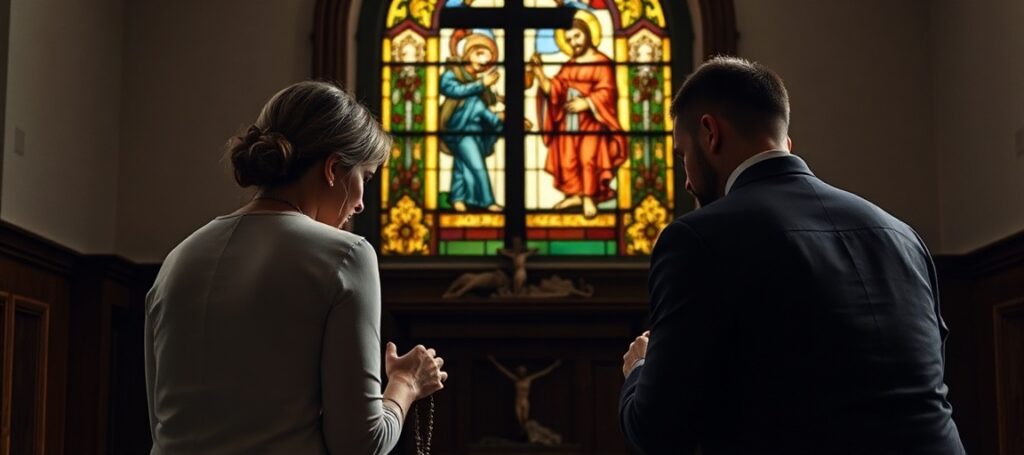
A Catholic couple kneeling in prayer before a crucifix in a traditional chapel, bathed in soft light from a stained-glass window of Christ the King.
Spiritual

The Cross of Infertility: Between Catholic Suffering and the Conciliar Silence on the Reign of Christ the King

EWTN News reports that during National Infertility Awareness Week (April 19–25, 2026), author Leigh Fitzpatrick Snead shared her personal experience of infertility and encouraged Catholic couples to seek support, understand Church teaching against IVF, and consider adoption. The article presents infertility as a “private cross,” emphasizes the prohibition of in vitro fertilization, and suggests resources such as Springs in the Desert and NaProTechnology. While the article correctly rejects IVF, it operates within a framework that reduces the Church’s mission to psychological comfort and naturalistic solutions, omitting any reference to the supernatural order, the necessity of sanctifying grace, the reality of original sin, or the public duty of nations to submit to Christ the King. This silence reveals the modernist impoverishment of post-conciliar pastoral care, which offers sympathy but not salvation, and substitutes human effort for divine mercy.

A traditional Catholic depiction of Pope Leo XIV's 2026 African Safari with Cardinal Ambongo Besungu, highlighting the modernist focus on naturalistic humanism over supernatural mission.
Antichurch

Leo XIV’s African Safari: A Modernist Pope Peddles Naturalistic Humanism While the Faith Burns

Vatican News portal (April 24, 2026) reports on Cardinal Fridolin Ambongo Besungu’s assessment of the apostate Robert Prevost’s — usurping the name “Leo XIV” — apostolic journey to four African countries (Algeria, Cameroon, Angola, Equatorial Guinea) from April 13 to 23, 2026. The Cardinal, President of SECAM, expressed pride and optimism, framing the visit as a “prophetic” message on human dignity, peace, justice, and good governance — yet not a single word is spoken about the supernatural mission of the Church, the salvation of souls, the necessity of baptism, or the conversion of infidels to the Catholic Faith. This silence alone reveals the abyss that separates the conciliar sect from the true Church of Christ.

A solemn scene of Piazza Bartolo Longo in Pompeii during a Novus Ordo 'Mass' led by the usurper Robert Prevost, surrounded by modernist clergymen. The atmosphere reflects the spiritual desolation of the post-conciliar era.
Antichurch

Leo XIV’s Pilgrimage to Pompeii: A Journey Through the Abomination of Desolation

VaticanNews portal reports on the published program for the visit of the usurper Robert Prevost, known as “Pope Leo XIV,” to Naples and Pompeii on May 8, 2026, the first anniversary of his illegitimate election. The program includes a “Mass” in Piazza Bartolo Longo, participation in the noon supplication to the Virgin of Pompeii, and veneration of the relics of San Gennaro in Naples. This meticulously planned itinerary is not a pastoral visit but a choreographed display of the conciliar sect’s false piety, designed to consolidate its grip on the minds of the unsuspecting and further entrench the modernist revolution within the remnants of Christendom.

Fernando Mendoza kneeling with a Rosary near empty pews in a Novus Ordo church as 'Bishop' Gordon raises a ciborium in an NFL locker room, symbolizing the betrayal of true Catholic faith by conciliar structures.
Antichurch

The National Catholic Register Celebrates a Football Player While the Faith Burns

National Catholic Register portal reports on Fernando Mendoza, the Las Vegas Raiders’ No. 1 draft pick, praising his “visible Catholic faith” and welcoming him into the “fastest-growing” Archdiocese of Las Vegas, where “bishop” Gordon celebrates Mass for the NFL team and young adults pray the Rosary on the Strip. The article enthusiastically presents this conciliar apparatus as a vibrant, welcoming community — never once questioning whether any of it constitutes the true Catholic Church.

Scroll to Top
Antichurch.org
Privacy Overview

This website uses cookies so that we can provide you with the best user experience possible. Cookie information is stored in your browser and performs functions such as recognising you when you return to our website and helping our team to understand which sections of the website you find most interesting and useful.