Spiritual

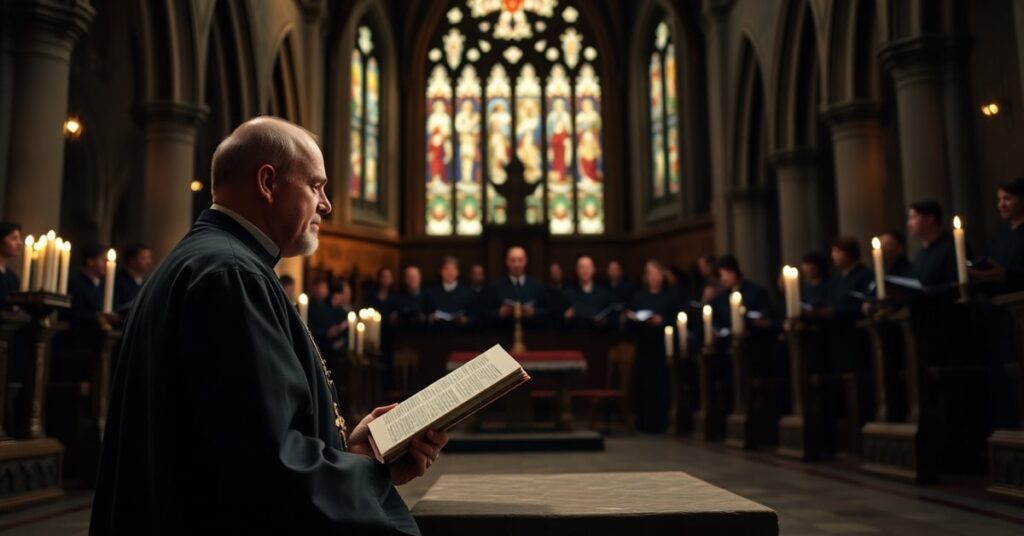
Catholic priest in traditional vestments before an altar, with a faded American flag covering a statue of Christ the King.
Spiritual

Fidelity Month Exposed: Naturalistic Patriotism Masquerading as Virtue

The National Catholic Register reports that elected officials across the United States, including the governors of Arkansas and Utah, have recognized June as “Fidelity Month” — a grassroots movement founded in 2023 by Princeton professor Robert P. George, aimed at renewing commitments to God, family, and country. The movement encourages Americans to “rededicate themselves to basic values” such as patriotism, religion, and community involvement. While the language sounds pious on the surface, this initiative is a textbook example of the naturalistic, horizontal spirituality that has infected even nominally Catholic thought in the post-conciliar era — reducing the supernatural life of grace to a civic program of moralistic therapeutic deism wrapped in the flag.

A Catholic family praying in a traditional chapel with a priest anointing an elderly widow, symbolizing the supernatural focus of true charity.
Spiritual

When Charity Becomes a Program: The Substitution of Supernatural Virtue with Activism

National Catholic Register portal reports on “Both Hands,” a Christian nonprofit that pairs adoption fundraising with service projects for widows, completing 1,652 projects across 46 states and raising more than $25 million since 2008. The article presents this as a model of Christian charity, quoting James 1:27 and featuring testimonials from adoptive families and ministry founders. Yet beneath the veneer of praiseworthy activity lies a fundamentally naturalistic framework that reduces the supernatural life of grace to organized philanthropy, omits the Church’s salvific mission entirely, and reflects the post-conciliar inversion of the spiritual order — where the corporal works of mercy are severed from their theological roots and repackaged as community programming.

Couple praying at Marian shrine in traditional Catholic setting
Spiritual

Marian Shrines and the Theology of Suffering: What the Article Dares Not Say

The *National Catholic Register* article from May 31, 2026, reports on infertile couples turning to Marian shrines—specifically Our Lady of La Leche in St. Augustine, Florida, and Our Lady of Guadalupe in La Crosse, Wisconsin—seeking intercession for children. It presents testimonies of answered prayers, thanksgiving, and spiritual comfort, while also acknowledging that some couples remain childless or suffer miscarriage. The article quotes clergy and laypeople alike, all within the framework of the post-conciliar Church’s approved devotional life. Yet beneath its pious veneer lies a profound silence: it never once confronts the supernatural reality of suffering, the necessity of final perseverance, or the possibility that these very shrines may be instruments of a deeper apostasy. This omission is not accidental—it is symptomatic of the neo-church’s systematic evacuation of Catholic truth.

Bishop Frank Schuster holding the Blessed Sacrament aboard a ship with praying seafarers, emphasizing the sacred mission of salvation over humanitarian aid.
Spiritual

Stella Maris and the Dilution of Sacred Ministry into Mere Humanitarian Accompaniment

EWTN News reports that Seattle Auxiliary Bishop Frank Schuster, speaking ahead of the National Day of Prayer and Remembrance for Mariners, described the work of Stella Maris (formerly the Apostleship of the Sea) as a “ministry of accompaniment” focused on delivering toiletries to sailors, listening to traumatized seafarers, and making referrals for mental health — celebrating Mass aboard ships is mentioned almost as an afterthought. The article presents this humanitarian outreach as the essence of the Church’s mission to those at sea. What is conspicuously absent from this entire portrait is any mention of the salvation of souls, the necessity of the sacraments for eternal life, the reality of sin and the need for conversion, or the supernatural purpose of the Church’s existence — revealing a ministry that has effectively reduced the Catholic faith to a nautical social-work agency.

A traditional Catholic scholar contemplating the mystery of the Holy Trinity in a dimly lit chapel.
Spiritual

The Holy Trinity: A Purely Naturalistic Catechesis Stripped of Supernatural Depth

EWTN News portal publishes a catechetical article on the Holy Trinity — the central mystery of the Christian faith — yet the entire exposition is conducted in a tone of rationalistic pedagogy that reduces the highest mystery of revealed religion to a series of logical propositions accessible to unaided human reason, thereby betraying the very supernatural character it claims to present.

A reverent depiction of St. Joan of Arc in prayer, surrounded by divine visions, symbolizing her supernatural mission and Catholic faith.
Spiritual

St. Joan of Arc: From Catholic Heroine to Pro-Life Symbol — A Modernist Appropriation

The article “Why St. Joan of Arc Inspires Me” by Kristan Hawkins, published on the National Catholic Register portal (May 30, 2026), presents a commentary that instrumentalizes the figure of St. Joan of Arc, reducing her supernatural mission to a mere inspiration for contemporary political activism, particularly the pro-life movement. While the article superficially praises Joan’s courage and faith, it fundamentally misrepresents her mission by stripping it of its Catholic theological substance and recasting it in the mold of modern secular activism. This appropriation exemplifies the broader trend within post-conciliar Catholicism of hollowing out the saints’ witness, replacing supernatural faith with naturalistic humanism.

Traditional Catholic mothers praying in a dimly lit chapel with Dominican icons and books, expressing reverence and concern.
Spiritual

Mothers of Dominican Friars: A Post-Conciliar Prayer Group Wrapped in Sentimentality and Spiritual Ambiguity

National Catholic Register portal reports on a group called “Mothers of Dominican Friars,” comprising 25–30 (now over 100) mothers who meet weekly via Zoom to pray the Rosary for their sons—Dominican friars and priests—while sharing fellowship and studying Dominican-authored books. The group, founded in 2016 with the encouragement of “Archbishop” J. Augustine Di Noia, a post-conciliar Dominican, emphasizes maternal support, communal prayer, and spiritual reading. While the surface piety appears commendable, the entire initiative operates within the framework of the conciliar sect, lacking any discernment regarding the doctrinal integrity of the formation these sons receive or the orthodoxy of the “priests” they support. This uncritical embrace of post-conciliar religious life, devoid of vigilance against Modernism, renders even well-intentioned prayer spiritually dangerous—a pious veneer over an apostate structure.

Spiritual

Simcha Fisher’s False Optimism: The Heresy of Natural Happiness Without Grace

The Pillar portal publishes a paid column by Simcha Fisher (May 29, 2026) in which the author confesses her pessimistic temperament but claims to possess a “bedrock belief that everything is going to turn out okay” — a conviction she attributes not to supernatural faith, not to the theological virtues infused at baptism, not to the promises of Our Lord Jesus Christ, but to **the music of Johann Sebastian Bach**. This is the reduction of Christian hope to a purely natural, aesthetic sentiment — a Pelagian optimism divorced from grace, sacraments, and the supernatural order. It is, in miniature, the entire modernist project: replacing the theological virtue of hope with human feeling, and substituting the Creator with the creature.

Spiritual

St. Philip Neri: A Saint of True Charity, Not the Modernist “Mercy” of the Conciliar Sect

EWTN portal reports on the feast of St. Philip Neri, the “Apostle of Rome,” recounting his life, his spiritual epiphany in the Catacombs of San Sebastiano, and his founding of the Archconfraternity of the Most Holy Trinity. The article highlights his example of Christian charity and zeal, noting his enduring legacy in Rome and the universal Church. It concludes by quoting “Pope” Francis’s 2015 remark that St. Philip Neri “remains a luminous model of the Church’s ongoing mission in the world,” particularly in witnessing to “love and mercy.” While the article presents factual details about St. Philip Neri’s life, its framing within the context of the post-conciliar “Church” and its invocation of “Pope” Francis’s modernist interpretation of charity and mercy fundamentally distort the saint’s true legacy, reducing his radical holiness to a mere endorsement for the very errors that have led to the current ecclesiastical crisis.

Spiritual

A Brazilian Nun in Roccaporena: Between Authentic Devotion and the Ambiguities of Post-Conciliar Mission

VaticanNews portal reports on Sister Maria Atília Collet, a Brazilian member of the International Consolata Family, who at 81 years of age welcomes pilgrims in Roccaporena, Italy—the birthplace of Saint Rita of Cascia (1381-1457). The article, written by Andressa Collet, a relative of the nun, describes the sister’s daily life of prayer, her work of evangelization in Brazil, Italy, Portugal, Spain, and Mozambique, and her devotion to Saint Rita, the “Saint of Impossible Causes.” While the article presents elements of genuine Catholic spirituality—prayer, forgiveness, sacrifice, and missionary zeal—it simultaneously operates within the framework of the post-conciliar Church, raising questions about the theological integrity of the structures to which this nun belongs and the spiritual fruits of a mission conducted under the authority of antipopes and modernist hierarchs.

Scroll to Top
Antichurch.org
Privacy Overview

This website uses cookies so that we can provide you with the best user experience possible. Cookie information is stored in your browser and performs functions such as recognising you when you return to our website and helping our team to understand which sections of the website you find most interesting and useful.