Spiritual

Spiritual

Walking Pilgrimages: When Catholic Devotion Becomes a Hiking Club with Rosary Beads

National Catholic Register portal reports on the growing trend of “walking pilgrimages” organized by Modern Catholic Pilgrim, an apostolate founded by Will Peterson, featuring testimonials from participants who describe these walks as spiritually meaningful experiences connected to everyday life. The article presents pilgrimages as accessible, community-oriented activities focused on intentions, prayer, and family bonding, with destinations including shrines, churches, and even routes commemorating the only approved Marian apparition in the United States. What the article systematically conceals is that true Catholic pilgrimage is an act of penance and supplication to God through the intercession of the true saints — not a feel-good communal hike centered on subjective “intentions” and the veneration of dubious apparitions, all organized under the auspices of a conciliar sect that has emptied the faith of its supernatural substance.
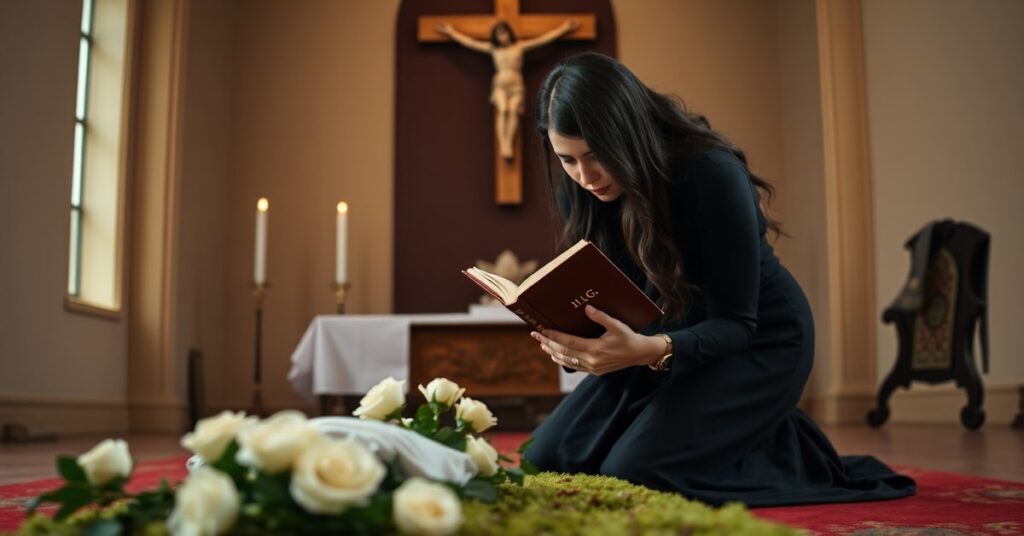
A Catholic mother kneels in prayer in a chapel before an infant's grave, holding a book titled 'H.U.G.' - Here Understood Gently Held
Spiritual

The Idol of Self: How the Conciliar Sect Reduces Suffering to Therapy and Abandons the Cross

EWTN News portal reports on a new book titled “H.U.G.” (“Here, Understood, and Gently held”), authored by Catholic mother Sarah-Elizabeth Pilato, which compiles over 30 testimonies from women who have experienced miscarriage and pregnancy loss. The article describes Pilato’s personal experience of losing a child at age 40, her subsequent feelings of isolation and abandonment, and her mission to provide comfort to grieving mothers through shared stories and reflection questions. The book is being distributed to hospitals, churches, urgent care centers, and therapy offices across the United States, with the goal of making women “feel seen and loved and finds hope in her future.” While the intention to comfort those who suffer is not inherently evil, this initiative—typical of the post-conciliar mentality—reduces the profound mystery of suffering, death, and the fate of unbaptized infants to a purely naturalistic, therapeutic exercise, stripping it of its supernatural dimension and offering the world’s cold comfort where only the Church’s sacramental life and immutable doctrine can truly heal.

Spiritual

St. Anthony of Padua: A Saint Co-opted by the Spirit of Universal Fraternity

EWTN News reports on the feast of St. Anthony of Padua, highlighting his “universal” appeal and the “neighborly” spirit attributed to him by Father Oliviero Svanera, rector of the Basilica of St. Anthony in Padua. The article presents a sanitized, modernist interpretation of the saint, stripping him of his doctrinal rigor and reducing his sanctity to a model of vague humanitarianism and interreligious dialogue, perfectly aligned with the post-conciliar agenda of the “Church of the New Advent.”

Spiritual

A Monument to True Devotion: Reflection Park’s Giant Crucifix and the Enduring Power of the Sorrowful Mysteries

The National Catholic Register portal (June 12, 2026) reports on “Reflection Park” in rural Minnesota, a private devotional site featuring a 34-foot bronze crucifix and life-sized sculptures of the Sorrowful Mysteries of the Rosary, created by Michael Dolan and artist Michael Montag. The article describes the park as an “oasis of prayer and peace” that draws visitors from across the U.S. and abroad, offering a space for contemplation and spiritual renewal.

Spiritual

The Little Flower’s “Little Way”: A Pre-Conciliar Saint Co-opted by the Neo-Church’s Sentimentalist Machine

The National Catholic Register, a portal deeply embedded within the conciliar structures, publishes an article on June 12, 2026, promoting a new book titled *Living the Little Way* by Franciscan Father Joseph Spence. The article purports to explore the spirituality of St. Thérèse of Lisieux, focusing on six “keys” to her “Little Way,” including Scripture, devotion to the Child Jesus and the Holy Face, love of Christ, Marian devotion, fraternal charity, and holiness in suffering. While St. Thérèse herself is a canonized saint of the true Church, her message is here presented through the lens of the post-conciliar, sentimentalist neo-church, stripping it of its supernatural rigor and transforming it into a palatable, naturalistic self-help program for modern “Catholics.”

Spiritual

The Sacred Heart and the War Against God’s Kingdom

The article from the National Catholic Register portal (June 12, 2026) by Joseph Pearce presents a commentary on the controversy surrounding the French film Sacré-Cœur: Son règne n’a pas de fin and the enduring conflict between Catholic devotion to the Sacred Heart and the secularist legacy of the French Revolution. Pearce frames the film’s success and the hostile reactions it provoked as evidence of a deeper spiritual war, noting that devotion to the Sacred Heart has historically been a rallying point for Catholic resistance against revolutionary and anti-Christian forces. He criticizes both secularist censorship and the opposition of “neo-liberal Catholics” who denounced the film as promoting “far-right ideas” and politicizing the Sacred Heart. While Pearce’s intentions are commendable, his analysis suffers from a fatal blindness: it treats the conflict as merely cultural and political, never once acknowledging that the true enemy of the Sacred Heart reigns not in the streets of Paris but in the very structures occupying the Vatican since 1958.

Spiritual

The Sacred Heart Devotion: A Brief History — Instrument of Reparation or Modernist Emasculation?

National Catholic Register portal reports on June 11, 2026, that “devotion to the Sacred Heart of Jesus begins when our Savior’s heart was pierced with a lance and blood and water flowed out.” The article traces the development of this devotion from the 11th and 12th centuries through the Benedictine and Cistercian monasteries, highlighting figures such as St. Bernard of Clairvaux, St. Bonaventure, St. Francis of Assisi, and St. Gertrude. It then moves to the 17th century, emphasizing St. Francis de Sales and St. John Eudes, who promoted the first feast of the Sacred Heart in 1670. The article notes that the devotion spread universally after Jesus appeared to St. Margaret Mary Alacoque in 1675, giving 12 promises and requesting a solemnity in reparation for human ingratitude. It concludes by mentioning that Blessed Pius IX made it a universal feast in 1856, Leo XIII consecrated the human race in 1899, and Pope Francis wrote an encyclical, *Dilexit Nos*, in 2024. This seemingly pious summary, however, conceals a profound theological and spiritual crisis: the reduction of a devotion rooted in reparation and the Kingship of Christ to a sentimental, historically decontextualized narrative that omits the Church’s constant warnings against modernism and the necessity of true conversion.

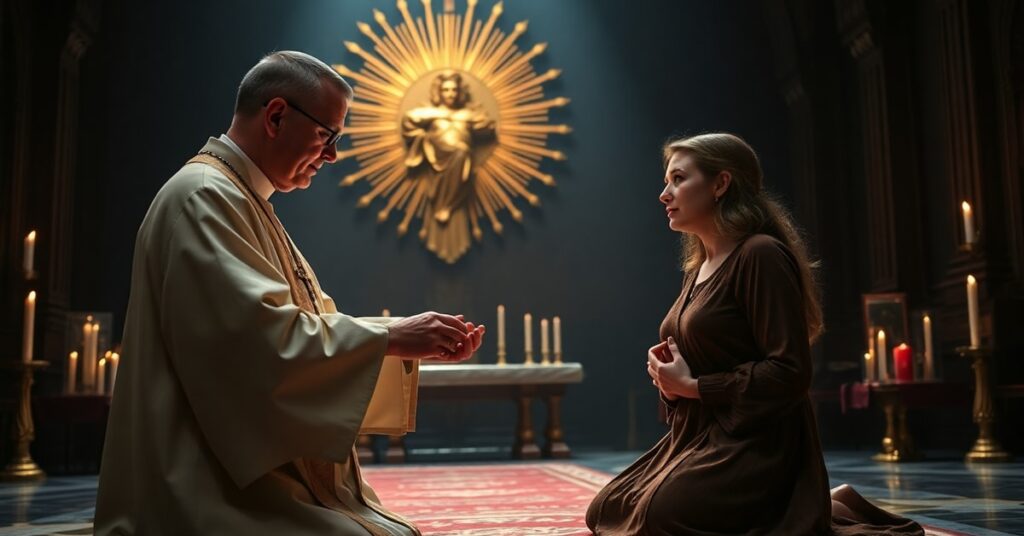
A Traditional Catholic priest and a layperson praying with Sacred Heart badges in an ornate chapel, emphasizing sacramental devotion without superstition.
Spiritual

The Sacred Heart Badge: A Sacramental Rooted in Private Revelation and Its Doctrinal Limits

National Catholic Register portal reports on the Sacred Heart badge, a sacramental approved by the Sacred Congregation of Rites in 1900, tracing its origins to the private revelations of St. Margaret Mary Alacoque and the Marian apparition at Pellevoisin. While the article presents the badge as a powerful means of devotion, it fails to adequately distinguish between the Church’s public revelation and the inherent limitations of private revelations, potentially leading the faithful into a misplaced confidence that borders on superstition rather than a robust theological understanding of sacramentals and the true source of grace.

Spiritual

The Consecrated Timeline: How Devotion to the Sacred Heart Was Hijacked by the Conciliar Sect

The National Catholic Register portal presents a chronological overview of papal teachings on devotion to the Sacred Heart of Jesus, spanning from Blessed Pius IX in 1856 to Leo XIV’s predecessor Francis in 2024. The article dutifully lists encyclicals, canonizations, and institutional acts, presenting an unbroken chain of magisterial endorsement for this essential Catholic devotion. Yet beneath this veneer of pious continuity lies a far more sinister reality: the systematic corruption and modernist reinterpretation of one of the Church’s most profound devotional treasures, culminating in its weaponization by the conciliar sect against the very Faith it was meant to protect.

Scroll to Top
Antichurch.org
Privacy Overview

This website uses cookies so that we can provide you with the best user experience possible. Cookie information is stored in your browser and performs functions such as recognising you when you return to our website and helping our team to understand which sections of the website you find most interesting and useful.