May 2026

Traditional Catholic priest praying before a crucifix with European landmarks in background.
Antichurch

Europe’s Abortion Pill Regime: A Continent Sacrificing Its Children

The National Catholic Register, a portal nominally Catholic yet fully embedded in the structures of the post-conciliar sect, reports on how five European nations—France, Poland, the United Kingdom, Malta, and Ireland—regulate chemical abortion. The article presents the expansion of abortion pill access through telemedicine, the erosion of in-person medical oversight, and the quiet permanence of pandemic-era emergency measures as settled political realities. It quotes pro-abortion legal scholars, government-aligned medical professionals, and even pro-life advocates whose proposals never rise above parliamentary submissions and pregnancy centers. Nowhere does the article state that the direct killing of an innocent human being from the moment of conception is a mortal sin demanding eternal punishment, that the civil authority has a strict duty under God’s law to prohibit and punish it, or that every Catholic who cooperates in this slaughter—whether by legislation, prescription, distribution, or silence—incurs excommunication and the wrath of Almighty God. This silence is not incidental; it is the very essence of the post-conciliar apostasy.

An image depicting the Novus Ordo Mass in Malabo Stadium, Equatorial Guinea, 2026, led by antipope Robert Prevost ('Leo XIV'), critiquing modernist ecumenism and the dilution of Catholic doctrine.
Antichurch

Leo XIV in Africa: Evangelization Reduced to Social Service and Emotional Comfort

National Catholic Register reports that during his final Mass in Equatorial Guinea on April 23, 2026, the usurper Robert Prevost, styling himself “Pope Leo XIV,” urged the local church to “proclaim the Gospel with passion” and bear witness through “faith, service, and solidarity.” The event, held at Malabo Stadium before an estimated 30,000 people, featured flags, songs, dance, and colorful hats accompanying the liturgy—a spectacle more reminiscent of a cultural festival than the unbloody renewal of Calvary’s sacrifice. In his homily delivered in Spanish, Prevost reflected on the encounter between the deacon Philip and the Ethiopian eunuch from Acts 8, framing it as a model for evangelization centered on personal encounter, openness, and inclusion of the marginalized. He quoted Francis’ *Evangelii Gaudium*, warned against “spiritual self-absorption,” and called the faithful to make room for the poor and find joy in God’s love. Yet nowhere in this address—or in the broader narrative of his African journey—was there any mention of the necessity of baptism for salvation, the reality of original sin, the obligation to convert non-Catholics, or the Church’s exclusive claim to be the one true Ark of Salvation. This omission is not accidental; it is the theological fruit of the conciliar revolution, which has replaced the supernatural mission of the Church with a naturalistic humanitarianism dressed in evangelical language.

A traditional Catholic priest in solemn prayer before an altar, contrasting with a distant scene of interfaith dialogue that betrays Christ's exclusive Kingship.
Antichurch

The Conciliar Sect’s Interreligious Dialogue: A Betrayal of Christ the King

VaticanNews portal (April 23, 2026) reports on Cardinal George Koovakad’s reflections regarding the interreligious dimensions of Leo XIV’s apostolic journey to Algeria, Cameroon, Angola, and Equatorial Guinea, framing dialogue among religions as a “privileged path to peace, reconciliation, and social stability.” The article presents this vision as a coherent theological and pastoral perspective, emphasizing gestures such as the exchange of a kiss of peace with an imam at the Great Mosque of Algiers and the invocation of concepts like “universal fraternity” and “shared responsibility” in conflict resolution. This entire enterprise, however, represents a fundamental betrayal of the Catholic Church’s divine mandate and the exclusive salvific mission of Our Lord Jesus Christ, revealing the deep-seated modernist apostasy that has infected the conciliar structures since the mid-20th century.

Antipope Leo XIV departs Equatorial Guinea in a modernist 'Apostolic Journey,' surrounded by secular officials and journalists in a dimly lit airport terminal.
Antichurch

The Usurper’s African Odyssey: A Journey of Empty Gestures and Modernist Apostasy

Vatican News portal reports on the departure of the usurper Leo XIV from Equatorial Guinea, marking the end of his third so-called “Apostolic Journey” abroad. This eleven-day tour encompassed Algeria, Cameroon, Angola, and Equatorial Guinea, during which the antipope presented himself as a “messenger of peace,” offering “encouragement” to citizens and highlighting the “need for justice” to leaders. The article, stripped of any supernatural reality, reduces the mission of the Church to a series of diplomatic niceties and naturalistic observations, perfectly encapsulating the spiritual bankruptcy of the post-conciliar abomination.

A solemn depiction of a Nordic hospital scene highlighting the moral decay of state-funded abortion.
Antichurch

The Abortion Pill in the Nordic Nations: A Model of Civilized Murder

The National Catholic Register (April 23, 2026) reports on the near-total dominance of chemical abortion in Denmark, Norway, and Sweden, where state-funded abortifacients account for 85–97% of all killings of the unborn. The article presents Scandinavia as a “model” of universal health care that pro-abortion advocates in the U.S. seek to emulate, while briefly noting the marginal efforts of Catholic and pro-life dissenters. What the article fails to confront is that this system represents not a medical advance but the industrialization of homicide, normalized by secular governments and tolerated by a compromised clergy.

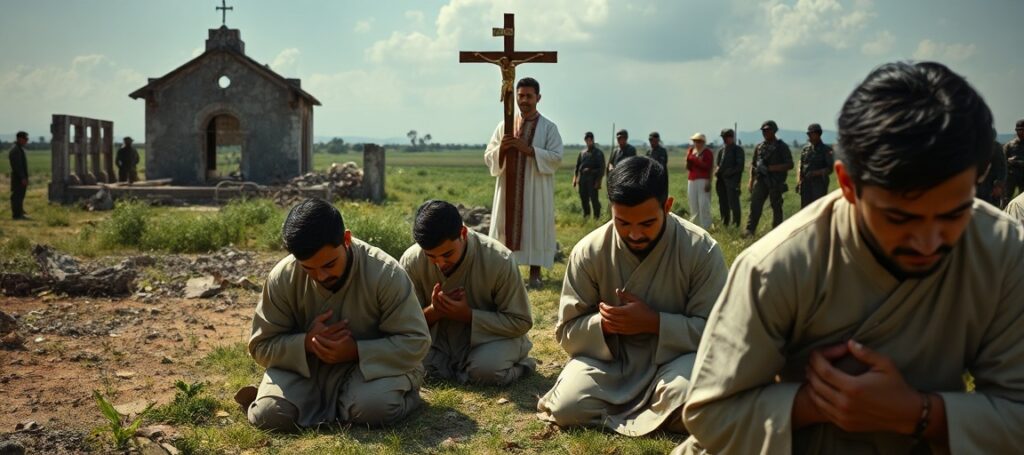
Cristero martyrs kneeling in prayer during persecution under Calles Law, Bishop Sigifredo Noriega holding a crucifix in the background.
World

Martyrs Demand More Than Memory: The Cristero War and the Crisis of Faith Today

EWTN News portal reports that Bishop Sigifredo Noriega of Zacatecas, Mexico, speaking on the centenary of the Cristero War, urged Catholics to “defend your faith by knowing it better.” The bishop recalled the persecution under the Calles Law, the suspension of public worship in 1926, and the sacrifice of over 200,000 martyrs. He lamented that today, for many Catholics, “the religious principles governing our lives are not as solid,” and emphasized the need for deeper faith formation to prevent history from repeating itself.

The bishop’s call, while seemingly pious, reveals a profound spiritual and theological crisis: in an age of apostasy, merely “knowing the faith better” is insufficient without the grace of the true sacraments and the uncompromising defense of Christ’s social Kingship against the very secularism that caused the Cristero persecution.

A solemn scene depicting the usurper Robert Prevost in Malabo Stadium, Equatorial Guinea, surrounded by African faithful during a controversial Mass.
Antichurch

Leo XIV’s African Pilgrimage: A Modernist Missionary Spectacle

Vatican News portal reports on April 23, 2026, that the usurper Robert Prevost, styling himself “Pope Leo XIV,” concluded an 11-day apostolic journey across four African nations with a celebratory Mass at Malabo Stadium in Equatorial Guinea, where he proclaimed that Africa would “enrich my life and ministry as Successor of Peter” and described the continent’s faithful as contributors to the Church’s “holiness and missionary character.” This theatrical finale to a continental tour exemplifies in concentrated form every fundamental error of the post-conciliar revolution: the reduction of the Church’s supernatural mission to naturalistic humanitarianism, the implicit denial of the Church’s exclusive salvific claims, and the idolatrous exaltation of human cultures over the immutable deposit of Faith once delivered to the saints.

A solemn portrait of "Cardinal" Frank Leo holding a letter to Canadian Prime Minister Mark Carney, with a stained-glass depiction of Christ the King in the background.
Antichurch

Cardinal Leo’s Plea Against Euthanasia: A Timid Half-Measure That Ignores the Full Reign of Christ the King

EWTN News reports that Toronto “Cardinal” Frank Leo has written to Canadian Prime Minister Mark Carney and members of Parliament, urging them to support Bill C-218, which would block the expansion of medical assistance in dying (MAID) to those whose sole underlying condition is mental illness. The “cardinal” frames his appeal in terms of “choosing life over death,” expresses “disappointment and anguish” at the expansion of MAID, and calls for investments in palliative care and mental health support. He also requests a free vote for Liberal MPs on the bill, acknowledging that it “raises profound questions of conscience.” The Archdiocese of Toronto is leading the “Help Not Harm” campaign, which has generated approximately 5,000 letters to MPs. While the “cardinal’s” opposition to the expansion of euthanasia is noted, his approach reveals the fundamental impotence and theological bankruptcy of the post-conciliar structure when confronted with the systematic legalized destruction of human life.

A traditional Catholic Mass in Malabo Stadium, Equatorial Guinea, with faithful Catholics in prayer and a priest celebrating the Tridentine Mass.
Antichurch

Leo XIV in Equatorial Guinea: A Mission Stripped of Doctrine, Filled with Naturalistic Sentiment

EWTN News reports that during his final Mass in Africa, held at Malabo Stadium in Equatorial Guinea on April 23, 2026, Leo XIV urged local Catholics to “carry on the mission of Jesus’ first disciples with joy,” proclaim the Gospel “with passion,” and bear witness through lives shaped by “faith, service, and solidarity.” The homily centered on the encounter between the deacon Philip and the Ethiopian eunuch (Acts 8), which Leo interpreted as a model for evangelization—emphasizing openness, inclusion, and personal transformation. He invoked Pope Francis’ *Evangelii Gaudium*, warning against “spiritual self-absorption,” and stressed that Christian faith “does not erase suffering but illuminates it with hope.” The tone was pastoral, emotive, and devoid of doctrinal specificity—typical of the post-conciliar antipapal theater. This performance, while cloaked in biblical imagery, reveals the theological bankruptcy of the conciliar sect: a mission reduced to humanitarian sentiment, stripped of supernatural truth, and silent on the necessity of conversion to the one true Church for salvation.

Scroll to Top
Antichurch.org
Privacy Overview

This website uses cookies so that we can provide you with the best user experience possible. Cookie information is stored in your browser and performs functions such as recognising you when you return to our website and helping our team to understand which sections of the website you find most interesting and useful.