May 2026

Solemn portrait of the Coconut War in Espiritu Santo, highlighting indigenous leaders, colonial authorities, and the absence of Catholic social teaching.
Antichurch

The Coconut War: When the Conciliar Sect Serves Neocolonial Interests in the Pacific

The Pillar Catholic portal — a flagship mouthpiece of the post-conciliar establishment — published on May 23, 2026, a podcast episode in which JD Flynn and Ed. Condon discussed the so-called “Coconut War,” a brief military conflict in 1980 on the island of Espiritu Santo in what was then the New Hebrides (now Vanuatu). The article and podcast segment treat the episode with the characteristic lighthearted, anecdotal tone that has become the hallmark of post-conciliar Catholic media, which transforms even grave matters of war, intervention, and the Church’s mission into conversational fodder for educated liberal Catholics. Beneath this veneer of casual commentary lies a profound silence about the true nature of the Church’s mission, the sinful structures of neocolonialism, and the apostasy of the conciliar sect from the social teaching of Christ the King.

A photorealistic image of Notre-Dame Cathedral's interior and exterior, emphasizing its Gothic architecture as a testament to Catholic theology and the loss of sacred art in modern architecture.
Spiritual

Gothic Architecture as Theology in Stone: Heavenward Aspiration vs. Earthbound Modernism

[Article from the National Catholic Register portal (May 22, 2026)]

The article by Kevin Di Camillo, published by the National Catholic Register, describes the architectural elements of Notre-Dame Cathedral in Paris—gargoyles, flying buttresses, and the open spire—emphasizing their functional and aesthetic roles. While the author acknowledges a superficial theological dimension (gargoyles casting out evil), the commentary ultimately reduces these sacred structures to mere engineering solutions and artistic flourishes, completely ignoring the profound Catholic theology of worship, the nature of the Church as the Mystical Body of Christ, and the absolute necessity of the supernatural orientation of sacred art. The article’s silence on the distinction between true sacred architecture and the modernist “barns” that have replaced it reveals a blindness to the liturgical and ecclesiological crisis of the 20th century.

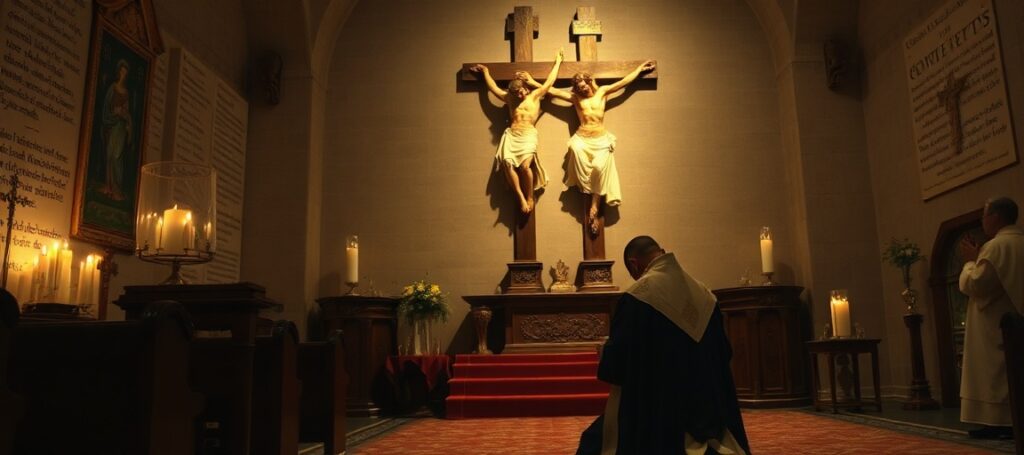
Traditional Catholic priest praying before a crucifix in a reverent chapel setting, highlighting the contrast between true Catholic doctrine and modernist apostasy.
Antichurch

SSPX Episcopal Consecrations and the Synod: A Tale of Two Apostasies

The Pillar portal reports on two interconnected events that expose the depth of the post-conciliar apostasy: the Vatican’s synod department setting deadlines for a 2028 ecclesial assembly, and the SSPX’s planned illicit episcopal consecrations in July. Both phenomena, though seemingly opposed, are fruits of the same modernist vine—rooted in the rejection of immutable Catholic doctrine and the substitution of human innovation for divine law.

A reverent Catholic image of Christ as the Good Shepherd and Lamb of God before a crucifix in a traditional church setting.
Spiritual

Christ the Shepherd, Christ the Lamb: When Sentimentality Replaces Sacrifice

National Catholic Register portal (May 22, 2026) publishes a commentary by Regis Martin, S.T.D., professor of theology at Franciscan University of Steubenville, on the image of Christ as the Good Shepherd and the Lamb of God. The article weaves together biblical references to shepherds in the Old Testament, the parable of the lost sheep, Psalm 23, and George Herbert’s poetic rendering, culminating in the assertion that “the shepherd must be willing to die for his sheep” and that Christ “becomes no less a lamb himself” to atone for sin. Yet for all its devotional warmth, the piece is a masterclass in the modernist evasion of the supernatural: it reduces the supreme propitiatory sacrifice of Calvary to a sentimental metaphor of pastoral care, omits entirely the necessity of the Most Holy Sacrifice of the Mass, the sacramental economy, the reality of original sin, and the absolute demands of the integral Catholic faith. What remains is a Christ who is merely a moral exemplar of self-giving love — a Christ stripped of His kingship, His justice, and His divinity as the only means of salvation.

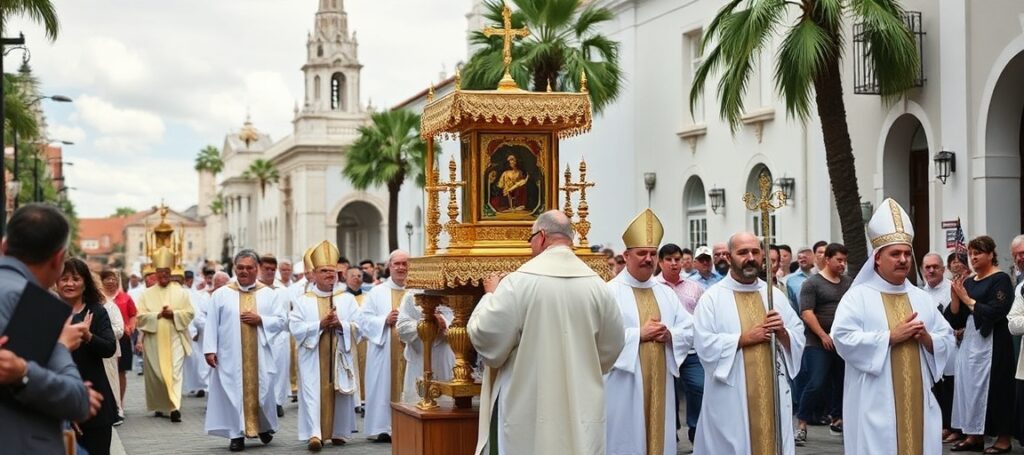
A traditional Catholic Eucharistic procession in St. Augustine, Florida, with Bishop Erik Pohlmeier and pilgrims carrying the Blessed Sacrament along the Cabrini Route.
Antichurch

The Eucharistic Pilgrimage: A Parade of Presumption Masked as Devotion

National Catholic Register portal reports on May 22, 2026, that the 2026 National Eucharistic Pilgrimage, titled “One Nation Under God,” will launch on May 24 in St. Augustine, Florida, commemorating the first recorded Catholic Mass within the future continental United States and coinciding with the nation’s 250th anniversary. Photojournalist Jeffrey Bruno praised the pilgrimage as a “new start” and emphasized the “grace” of the Blessed Sacrament traveling through towns, while Jason Shanks of the National Eucharistic Congress and Bishop Erik Pohlmeier of St. Augustine will participate alongside nine perpetual pilgrims traversing over 2,000 miles along the Eastern Seaboard via the Cabrini Route, concluding in Philadelphia on July 5. Yet beneath the veneer of piety lies a profound theological and spiritual bankruptcy: this spectacle, orchestrated by the conciliar sect, presumes to channel divine grace through a liturgical framework that has been systematically gutted of its sacrificial essence, reducing the Most Holy Eucharist to a tool of nationalistic sentiment and naturalistic humanism rather than the true Unbloody Sacrifice of Calvary offered for the remission of sins and the propagation of the Social Reign of Christ the King.

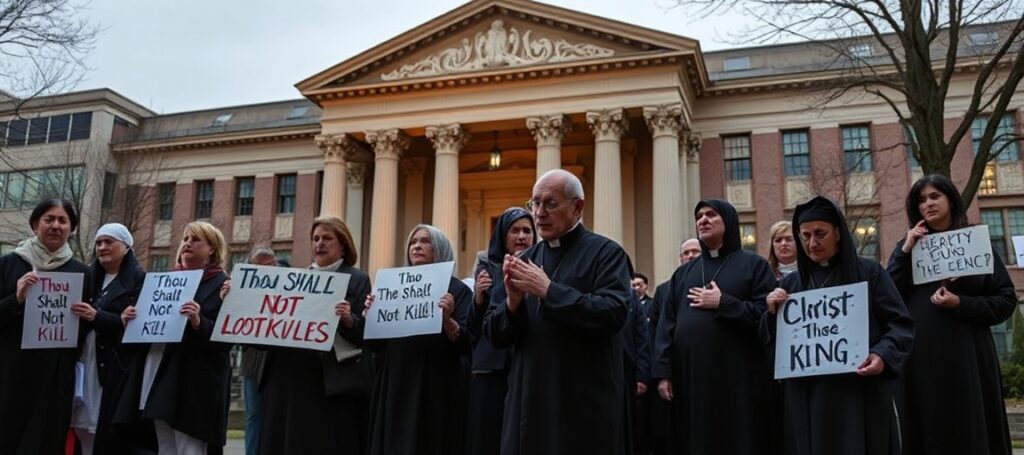
Traditional Catholic protestors outside a Washington courthouse praying for an end to abortion in light of Providence hospital lawsuit.
Antichurch

Washington Hospitals Sued While the Conciliar Sect’s Silence on Abortion Speaks Volumes

The article, sourced from EWTN News (May 22, 2026), reports on three ostensibly “pro-life” developments: a Washington state lawsuit against Providence hospital system for failing to accommodate pregnant and nursing employees, a Pennsylvania attorney general’s appeal to restore a ban on Medicaid abortion funding, and Maine Senator Susan Collins’ absence from abortion-related committee meetings. On the surface, these appear to be incremental legal and political maneuvers in defense of unborn life. However, when examined through the lens of integral Catholic doctrine — the immutable teaching of the Church before the Modernist revolution of 1958 — these efforts are revealed as tragically insufficient, structurally compromised, and symptomatic of a far deeper apostasy that pervades even those institutions that claim to defend life.

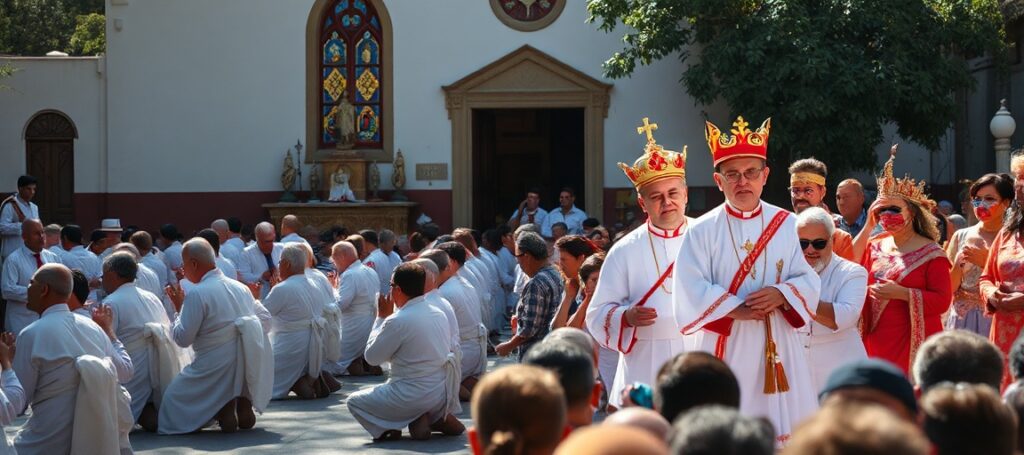
A solemn Pentecost procession in Brazil contrasts with the Festa do Divino's cultural spectacle of jousting and child coronation.
World

Pentecost in Brazil: When Cultural Spectacle Overshadows the Holy Spirit

The Pillar portal reports on the Brazilian “Festa do Divino,” a week-long Pentecost celebration featuring processions, the coronation of a child, dramatic jousting events known as Cavalhadas, and community feasts with food distribution to the poor. While the article presents this as a colorful expression of Catholic faith, a closer examination reveals a troubling subordination of genuine supernatural worship to cultural pageantry and naturalistic spectacle.

Shane and Jenn DeGross, a Catholic couple, stand resolute in their living room with Christ the King imagery, symbolizing their fight for religious freedom in foster care against Washington state's gender ideology policies.
World

Washington State Bends the Knee to Christ the King in Foster Care Settlement

EWTN News portal reports that Washington state has settled a federal lawsuit brought by Shane and Jenn DeGross, a Christian couple who had their foster license denied for refusing to affirm gender ideology. The state agreed to a permanent injunction, policy changes, and $250,000 in legal fees. While the world celebrates this as a “religious freedom” victory, the very framing exposes the bankruptcy of modern “religious liberty” discourse: it seeks tolerance from a secular state rather than the recognition of Christ’s absolute kingship over every nation, law, and public policy. The world calls this a win; the Faith calls it the barest minimum owed to Christians by even pagan governments.

A solemn church interior contrasting true Catholic devotion with modernist distortions during Fulton Sheen's beatification.
Antichurch

The Beatification of Fulton Sheen: A Triumph of Conciliar Apostasy

The Pillar portal reports on the upcoming “beatification” of Fulton Sheen, scheduled for September 24 in St. Louis, presided over by Cardinal Luis Tagle. The article promotes a “Pillar Pilgrimage” to this event, inviting readers to participate in what is described as a “historic moment in American Catholicism.” It emphasizes the social and communal aspects of the trip, including a podcast live show, a visit to Sheen’s tomb in Peoria, and the opportunity to “make friendships” and “have a lot of fun.” The event is presented as a celebration of Sheen’s legacy as “America’s favorite TV bishop.”

This orchestrated spectacle is not a celebration of Catholic sanctity, but a carefully staged propaganda event by the conciliar sect to canonize a figure emblematic of the very apostasy that has dismantled the Church from within.

A realistic depiction of Pentecost with the Apostles receiving the Holy Spirit as tongues of fire in a traditional Catholic church setting.
Spiritual

The Birthday That Never Was: Pentecost, the Holy Spirit, and the Silence of the Conciliar Desert

The National Catholic Register portal, in a piece authored by Msgr. Charles Pope, offers a Pentecost Sunday guide for May 24, 2026. The article presents the feast as the moment when the Holy Spirit descended upon the Apostles, using imagery of rushing wind and tongues of fire drawn from Acts 2:1-11. Msgr. Pope describes Pentecost as a “graduation” rather than a “birthday” of the Church, emphasizing that the Spirit anoints the Church for witness. He identifies the Holy Spirit as “the Love of God, the Wisdom of God, the Peace of God, the light of God, and the Presence of God,” and connects the fire imagery to God’s nature as a “consuming fire” and “refining fire.” The article draws on Old Testament theophanies—the burning bush, the pillar of fire, Sinai—to illustrate the Spirit’s work, concluding that “our God, Holy Fire, comes to dwell in us through his Holy Spirit.” The piece is a catechetical reflection aimed at the faithful of the Archdiocese of Washington, DC, where Msgr. Pope serves as dean and pastor. Yet beneath its devotional veneer lies a profound silence about the state of the Church to which he belongs—a silence that betrays the very Spirit he claims to proclaim.

Scroll to Top
Antichurch.org
Privacy Overview

This website uses cookies so that we can provide you with the best user experience possible. Cookie information is stored in your browser and performs functions such as recognising you when you return to our website and helping our team to understand which sections of the website you find most interesting and useful.