May 2026

Antichurch

The Conciliar Sect’s Canonization Machinery Grinds Another “Servant of God” Into the Dust

EWTN News reports that the Dicastery for the Causes of Saints, under Cardinal Marcello Semeraro, has revoked the nihil obstat for the canonization cause of Bishop Jorge Novak, SVD, of Quilmes, Argentina. The diocese claims the decision stems from “a possible canonical procedure not carried out by Bishop Jorge Novak … regarding the conduct of a priest of the diocese,” while simultaneously asserting that this expresses “no moral judgment regarding the life, virtues, and pastoral ministry” of Novak, who remains a “servant of God.” The diocese and the Society of the Divine Word announced the news “with sorrow,” expressing confidence that Novak enjoys eternal life “even if he is not inscribed in the canonical register of the blessed and saints officially proclaimed by the Church.”

Antichurch

Leo XIV’s Welfare Gospel: Social Justice Without Christ the King

Vatican News portal reports (April 10, 2026) that the antipope Leo XIV met with executives of the Italian National Institute for Social Security (INPS), delivering an address that reduced the Church’s social teaching to a program of secular humanitarianism, economic redistribution, and “human fraternity” — all while remaining entirely silent on the Kingship of Christ, the supernatural end of man, and the only true remedy for social disorder: the Social Reign of Our Lord Jesus Christ. The address is a textbook example of the conciliar Church’s substitution of naturalistic humanism for the integral Catholic faith.

Antichurch

Leo XIV to Chaldean Church: A Modernist Sermon Betraying Christ the King

Vatican News portal reports (April 10, 2026) that the usurper antipope Leo XIV, during a meeting with members of the Chaldean Church convened in Rome for the election of a new Patriarch, delivered a message saturated with the very errors condemned by the pre-conciliar Magisterium. His address, framed as a call for peace and hope, systematically reduces the Church’s mission to naturalistic humanism, omits the supernatural end of the Church, and implicitly endorses the conciliar revolution’s false ecumenism, thereby betraying the integral Catholic faith and the Social Reign of Christ the King.

Antichurch

The Cry for Peace Without Christ the King: Exposing the Empty Humanism of the Conciliar Sect’s Prayer Vigil

On April 10, 2026, EWTN News reported that multiple bishops’ conferences worldwide heeded the call of the usurper Robert Prevost — who illegitimately occupies the Chair of Peter under the name “Pope Leo XIV” — to participate in a prayer vigil for peace on April 11 at St. Peter’s Basilica. The article, rife with the conciliar sect’s characteristic naturalistic rhetoric, reveals the theological bankruptcy of an institution that has abandoned the supernatural mission of the Church in favor of humanitarian platitudes indistinguishable from secular pacifism.

Antichurch

Comboni Sisters in Kisangani: A Study in Naturalistic Humanism Masquerading as Charity

VaticanNews portal (April 10, 2026) reports on the activities of the Comboni Missionary Sisters at the Saint Laurent Centre in Kisangani, Democratic Republic of the Congo, where they care for orphaned and traumatized street children. The article presents the sisters’ work as a model of missionary charity, emphasizing psychological healing, practical skills training, and emotional support. While corporal works of mercy are indeed commendable in themselves, the article — and the apostolate it describes — operates entirely within the framework of naturalistic humanism, devoid of any explicit supernatural purpose, thereby reducing the Church’s mission to mere social work and psychological therapy, a hallmark of the post-conciliar apostasy condemned by the pre-1958 Magisterium.

Spiritual

Zacchaeus in the Sycamore: A Lost Wonder and the Tree That Still Stands

The National Catholic Register portal, in a commentary by James Day published April 10, 2026, offers a meditation on the Gospel episode of Zacchaeus climbing a sycamore tree to see Christ, drawing from it lessons about childhood wonder, the experience of climbing trees, and the Cross as the ultimate “tree” of salvation. The piece weaves together the Lucan narrative, reflections by Romano Guardini and Joseph Ratzinger, the liturgical hymn Crux fidelis, and G. K. Chesterton on wonder, concluding with an invitation to seek clarity of vision before the Cross. While the article is ostensibly devotional, its theological omissions, its reliance on modernist authorities, and its reduction of supernatural conversion to naturalistic sentimentality betray the very wonder it claims to champion.

Antichurch

Bishop Zaidan’s Appeal to Trump Exposes the Bankruptcy of Conciliar Diplomacy

National Catholic Register reports that Bishop A. Elias Zaidan, a native of Lebanon and chair of the U.S. Conference of Catholic Bishops’ Committee on International Justice and Peace, issued an appeal to President Donald Trump on April 9, 2026, urging humanitarian aid and a negotiated peace for Lebanon following Israeli strikes that killed over 300 people. The article describes the displacement of more than one million people, the killing of Father Pierre al-Rahi, and the destruction of Catholic communities in southern Lebanon. Bishop Zaidan expressed gratitude for the U.S.-Iran ceasefire while lamenting that Lebanon was excluded from the agreement. He called for the disarmament of Hezbollah, the implementation of U.N. resolutions, and quoted the antipope Leo XIV’s Easter message. The article presents the bishop’s appeal as a reasonable, pastoral response to a humanitarian catastrophe. This is precisely the problem: the entire framework of the appeal — its reliance on secular diplomacy, United Nations resolutions, and the authority of an antipope — reveals the total theological and spiritual bankruptcy of the conciliar sect’s approach to war, peace, and the governance of nations.

A traditional Catholic bishop appeals for peace in war-torn Lebanon, holding a letter to President Trump.
World

Bishop Zaidan’s Appeal to Trump Exposes the Bankruptcy of Conciliar Diplomacy

EWTN News reports that “Bishop” A. Elias Zaidan, a Lebanese-born prelate occupying a chair within the U.S. Conference of Catholic Bishops’ Committee on International Justice and Peace, issued an appeal to President Donald Trump on April 9, 2026, urging humanitarian aid and peace negotiations for Lebanon following Israeli strikes that killed over 300 people. Zaidan expressed gratitude for the U.S.-Iran ceasefire while lamenting that Lebanon was excluded from the agreement. He called for the disarmament of Hezbollah, the implementation of U.N. resolutions, and quoted the antipope Leo XIV’s Easter message, concluding with an invocation to Our Lady of Lebanon. The article presents this as a straightforward humanitarian appeal, yet beneath its veneer of pastoral concern lies a profound theological and diplomatic capitulation that merits uncompromising scrutiny.

A Catholic bishop in traditional vestments stands solemnly before a grand cathedral, symbolizing the spiritual emptiness of modern papal diplomacy with monarchs.
Antichurch

Papal Diplomacy With Monarchs Masks Spiritual Apostasy

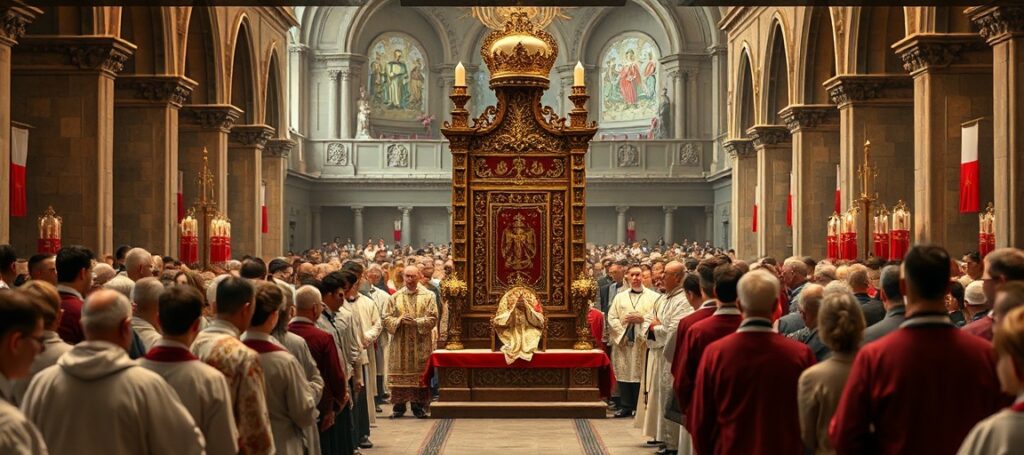
The National Register portal reports on a commentary by Father Raymond J. de Souza analyzing Pope Leo XIV’s diplomatic overtures to Spain and Monaco as a deliberate shift from Pope Francis’s approach. The article highlights how Leo welcomed King Charles III and Queen Camilla as “Royal Confraters,” installed King Felipe VI as honorary canon at St. Mary Major, and made a lightning visit to Monaco — all framed as “easing frictions” and reengaging Catholic Europe. What is conspicuously absent from this entire discussion is any mention of the Catholic Church’s duty to proclaim the Social Kingship of Christ over all nations, not to cozy up to monarchs who preside over abortion, religious indifferentism, and secular governance.

Scroll to Top
Antichurch.org
Privacy Overview

This website uses cookies so that we can provide you with the best user experience possible. Cookie information is stored in your browser and performs functions such as recognising you when you return to our website and helping our team to understand which sections of the website you find most interesting and useful.