2026

Antichurch

The Funeral of a Modernist Giant: Unmasking the Ruini Legacy and the Conciliar Apostasy

National Catholic Register portal reports on the funeral of Cardinal Camillo Ruini, a key figure in the implementation of the conciliar revolution in Italy. The article, a commentary by Father Raymond J. de Souza, paints a glowing portrait of a “giant” of the Church, celebrating his role in shaping post-conciliar Italian Catholicism. However, beneath the veneer of praise for a refined cultured prelate lies the stark reality of a man whose entire career was dedicated to advancing the modernist agenda under the banner of an apostate church. The current usurper, “Pope” Leo XIV, personally celebrated this funeral, offering a homily that serves as a manifesto of the very errors that have laid waste to the Faith. This event is not a moment of solemn remembrance but a public manifestation of the deep-seated apostasy that has infected the highest ranks of the paramasonic structure occupying the Vatican.


Antichurch

The Illusion of Accountability: Vos Estis Lux Mundi and the Theater of Reform

The Pillar portal reports on the seventh anniversary of the motu proprio Vos estis lux mundi, a document promulgated by the antipope Francis in 2019, ostensibly to address clerical sexual abuse and episcopal negligence. The article, authored by JD Flynn, questions whether the policy could be more effective if it led to publicly known consequences beyond mere removal from office. It cites initial praise from Cardinal Daniel DiNardo and Cardinal Sean O’Malley, who claimed the document would bring “predators to justice” and ensure “transparency, and accountability.” However, the article admits that “transparency has not been a feature” of its implementation, and results are only visible when bishops resign—often under the pretext of “health reasons.” Flynn suggests that the binary outcome (resignation or nothing) limits the tool’s effectiveness and proposes alternatives such as the “Hunthausen solution” (appointing a coadjutor to oversee specific areas) or public apologies for administrative failures. The article concludes that a broader range of responses might restore trust among Catholics and foster “a continuous and profound conversion of hearts.”

The fundamental error of this analysis lies in its complete acceptance of the conciliar sect’s framework as legitimate, treating a document issued by an antipope as if it were a valid exercise of papal authority, and proposing reforms within a structure that is itself the product of modernist apostasy. The very premise—that the Church needs new mechanisms for “accountability”—reveals a naturalistic, bureaucratic mindset that reduces the supernatural society established by Christ to a mere human corporation requiring managerial oversight.

Antichurch

The Pillar’s Paywalled Silence: A Conciliar Portal With Nothing Catholic to Say

The Pillar portal reports, behind a paywall, its “Friday Pillar Post” for June 19, 2026 — a podcast episode authored by Ed Condon, offering audio recordings of news from the conciliar sect’s media apparatus. The content is accessible only to paid subscribers, a fitting metaphor for the entire post-conciliar enterprise: the faithful must pay for access to information about an institution that has emptied itself of all supernatural substance. The cited article relates to a podcast summary of ecclesiastical news from structures occupying the Vatican, presented as journalism but functioning as propaganda for the neo-church of the Antichrist. That a Catholic-sounding portal in 2026 has reduced itself to monetized audio snippets — devoid of any mention of the Most Holy Sacrifice, the state of grace, the reality of sin, or the eternal destiny of souls — is itself the most damning indictment of the spiritual bankruptcy of post-conciliarism.

Antichurch

The Neo-Church Co-opts AI Discourse While Silencing the Supernatural

National Catholic Register reports on Artur Kluz, a Catholic tech investor who claims that Pope Leo XIV’s encyclical *Magnifica Humanitas* has sparked unprecedented interest in the Church’s moral vision among Silicon Valley elites. Kluz envisions a new order of Christian “knights” from the tech world to guide the Church through the age of artificial intelligence, asserting that technology is a mirror of its creators and that wisdom must prevail over power. Yet beneath this veneer of engagement lies a profound omission: the article, and the vision it promotes, remains entirely silent on the supernatural mission of the Church, the necessity of sanctifying grace, the reality of original sin, and the absolute primacy of the salvation of souls over technological progress. Instead, it reduces the Church’s role to that of a moral consultant to secular power structures—precisely the error condemned by St. Pius X in *Lamentabili sane exitu* and by Pius XI in *Quas Primas*.

Black Catholic family embracing life against abortion culture in a traditional home setting on Juneteenth
World

A Life Against the Culture of Death: Adoption, Juneteenth, and the Fight for the Unborn

EWTN News reports on Ryan Bomberger, a man conceived in rape and adopted on Juneteenth, who now advocates against abortion, particularly targeting the Black community. His story is a testament to the value of every human life and the power of adoption. While his personal witness is commendable, the article, typical of modernist “pro-life” efforts, remains silent on the ultimate spiritual battle and the necessity of the Church’s social reign, reducing a profound theological crisis to a matter of social activism and “rights.”

Antichurch

Synodality and the New Jerusalem: Leo XIV’s Blueprint for Globalist Idolatry

The National Catholic Register portal reports that on June 19, 2026, the usurper Robert Prevost, styling himself “Pope Leo XIV,” addressed participants of the so-called “Borgo Dialogues” at the Vatican, praising their commitment to the “ecological, social, and economic transformation of the world” grounded in the conciliar sect’s vision of “synodality.” Drawing on his encyclical Magnifica Humanitas, he urged resistance to the “Tower of Babel” of profit idolatry while calling for the construction of a “New Jerusalem” and a “civilization of love” as the guiding principle of economic, political, and cultural life. This address is not merely another diplomatic platitude from the occupant of the Vatican; it is a concentrated distillation of every modernist error condemned by the true Magisterium — a manifesto for the replacement of the supernatural order with a naturalistic, globalist humanism dressed in theological vestments.

Antique Catholic holy card 'Divine Pilot' showing Christ as a navigator with a family in prayer at twilight, symbolizing traditional Catholic devotion and sacramental beauty
Spiritual

Holy Cards and the Lost Contemplative Tradition: A Window Into What the Conciliar Sect Destroyed

National Catholic Register portal reports on Lisa Pellegrini, a Michigan farmer’s wife who founded Catholic Printing Press to collect, restore, and reproduce antique holy cards — devotional images that once formed the spiritual lives of the faithful and even inspired saints like Thérèse of Lisieux. The article describes her recovery of rare 19th-century series such as the “Divine Pilot” and “La Petit Fleur du Divin Prisonnier,” her family’s involvement in the work, and testimonials about the power of sacred beauty to draw souls to prayer. Yet for all its warmth, the article operates entirely within the framework of the post-conciliar “Register” — a publication of the conciliar sect — and thus cannot name the true cause of the devastation Pellegrini is trying to repair: the systematic destruction of sacred art, sacramentals, and contemplative life by the Modernist revolution inaugurated by John XXIII and consummated at Vatican II.

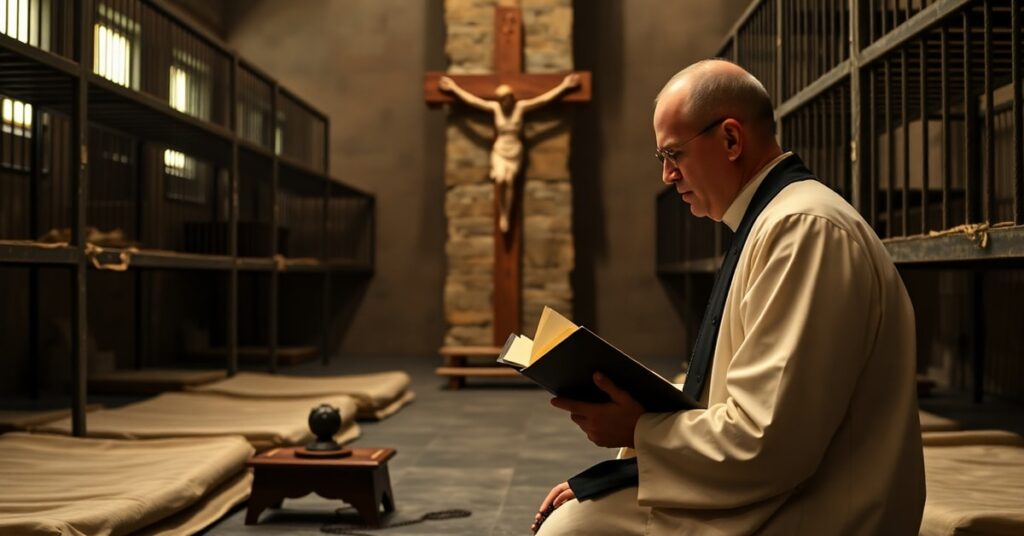
A Catholic priest kneeling in prayer before a crucifix in a prison cell, symbolizing the abandonment of incarcerated Catholics in the post-conciliar Church.
Antichurch

Ecclesiastical Dark Matter and the Abandonment of the Imprisoned Flock

The Pillar portal reports on a June 19, 2026, article by Ed. Condon, which begins with a reflection on the precariousness of human life and the author’s personal spiritual struggles between “fatalism” and “petitioning the Almighty over daily trivialities.” The article then transitions to news items, including an Italian archbishop accused of antisemitism for petitioning against an Israeli novelist, a Kansas priest arrested for embezzling parish funds, and the appointment of a new nuncio to Germany. A significant portion of the article focuses on a presentation at the U.S. bishops’ conference regarding the estimated 400,000 incarcerated Catholics in the United States, described as “ecclesiastical dark matter,” and the profound lack of pastoral care and sacramental access they receive. The article concludes by drawing a parallel between this forgotten population and a “diocese” in canonical terms, lamenting their marginalization. While the article superficially acknowledges the need for pastoral contact, it fundamentally fails to address the root causes of this abandonment within the post-conciliar structures, nor does it offer a truly Catholic solution grounded in the Church’s immutable social teaching and the necessity of the Most Holy Sacrifice.

Catholic bishop praying for peace in Ukraine war while Ukrainian refugees kneel before crucifix
World

Ukraine Suffers New Strikes as Calls for Peace Intensify

VaticanNews portal reports on the ongoing conflict in Ukraine, framing the war within a narrative of “peace calls” and diplomatic pressure while omitting the supernatural dimension of the conflict and the duty of Catholic nations to uphold the Social Kingship of Christ. The article treats a war of territorial and ideological aggression as a mere political crisis to be managed by secular diplomacy and the paramasonic structures of the “European Union,” completely ignoring the Church’s perennial teaching on just war, the condemnation of modern warfare, and the necessity of submitting all nations to the reign of Christ the King.

Scroll to Top
Antichurch.org
Privacy Overview

This website uses cookies so that we can provide you with the best user experience possible. Cookie information is stored in your browser and performs functions such as recognising you when you return to our website and helping our team to understand which sections of the website you find most interesting and useful.